Sequoia, Redwood City
Updated · 3,043 residents
Sequoia is a highly walkable neighborhood in Redwood City, characterized by its mature tree-lined streets and well-preserved early 20th-century architecture. Residents benefit from a lively local atmosphere and convenient access to neighborhood amenities, though the area experiences elevated noise levels due to road traffic.
Key Highlights
About Sequoia
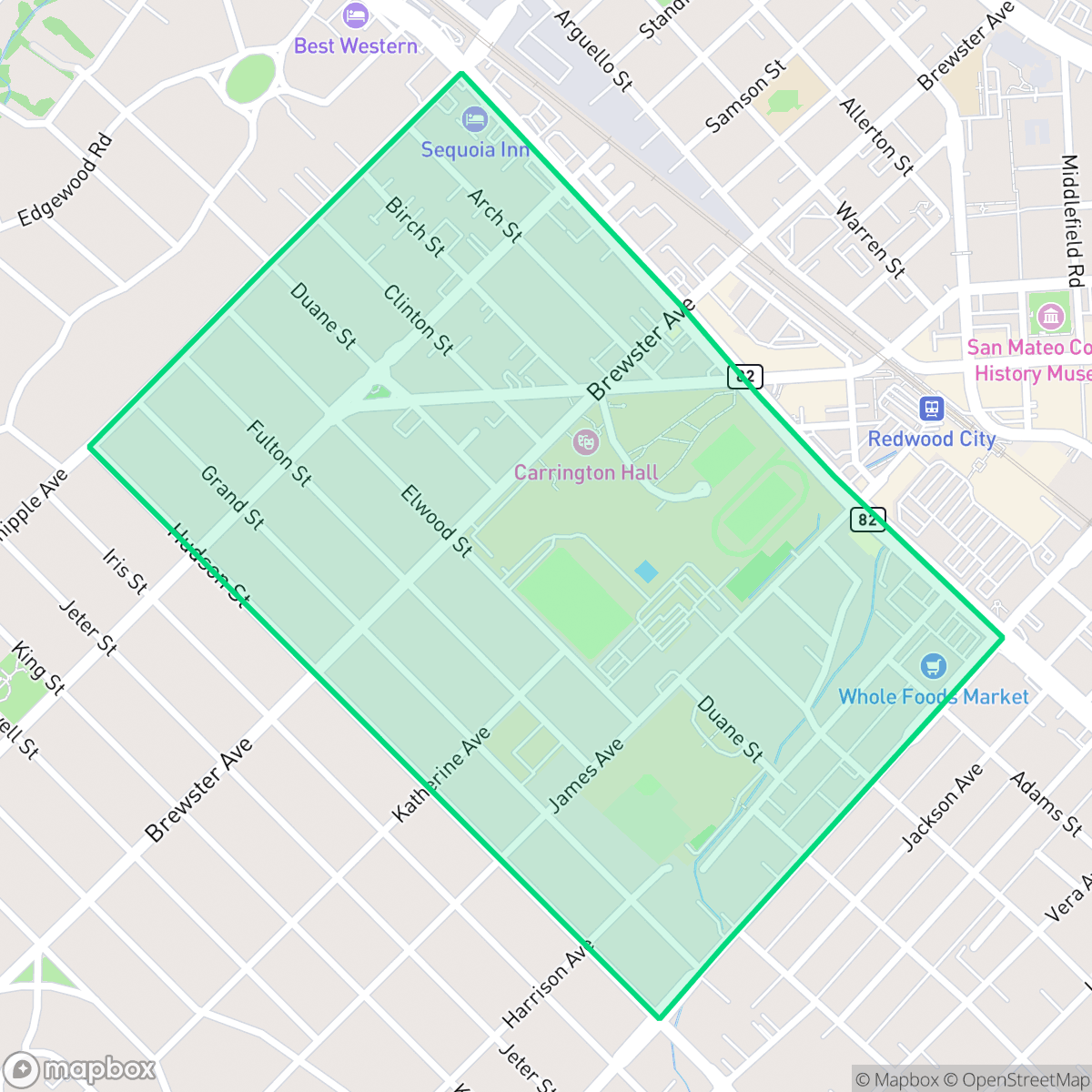
Bounded by Whipple Avenue, Grand Street, Jefferson Avenue, and El Camino Real, the Sequoia neighborhood in Redwood City is defined by its rich educational and architectural heritage. Its centerpiece is Sequoia High School, San Mateo County’s oldest high school. The 35-acre campus sits on the historic "Redwood Farm" estate, which was once owned by Horace Hawes (the "father" of San Mateo County), horse breeder Moses Hopkins, and cement tycoon William Dingee. Built in the 1920s in the Spanish Colonial Revival style, the school is listed on the National Register of Historic Places and features a student-built 1929 Japanese Tea Garden. The surrounding residential streets, such as Broadway, are lined with mature trees and well-preserved bungalow-style homes dating back to the early-to-mid 20th century.
The area offers a distinct suburban environment that prioritizes pedestrian access, earning a top-tier walkability score. The visual appeal is consistently high, supported by established landscaping and cohesive residential design. Social life is centered around community hubs like Bridge City Church, contributing to a more active local vibe than many surrounding parts of the city. The neighborhood maintains a strong sense of place, blending its historic roots with a modern, accessible lifestyle.
Prospective residents should consider the trade-offs regarding acoustic comfort, as road traffic contributes to a higher ambient noise level than the city average. The neighborhood also features a lower privacy index, reflecting its denser residential layout. It is well-suited for those who value walkability and an active community setting over total seclusion or quietude.
Neighborhood Scores Across 15 Qualities
Residential spacing varies throughout the area, featuring both closely packed structures and some buffered properties. Overall, neighbor proximity is higher than the Redwood City average according to iHuus data.
Pedestrian movement is easy throughout the area due to a continuous sidewalk grid and frequent crossings. This level of walkability is notably higher than the Redwood City average, with many destinations reachable via low traffic streets.
Manicured yards and private pools characterize much of the area, though the overall visual variety is slightly lower than the Redwood City average.
Proximity to large sports parks and grass fields provides excellent public green space for dog walking. While sidewalk verges are narrow and greenery is often limited to private yards, the area remains slightly more dog friendly than the Redwood City average according to iHuus data.
A blend of single-family homes and multi-story residential buildings defines this area. This layout is largely consistent with the broader Redwood City landscape.
A noticeable concentration of diverse dining, local services, and social spots creates a more energetic atmosphere than the Redwood City average. While some residential blocks remain quiet, many areas feature a balanced mix of green space and accessible commercial amenities.
Frequent sounds from nearby railroad tracks and major freeway proximity contribute to a less quiet environment than the Redwood City average. According to iHuus data, residents may experience consistent ambient noise throughout the day.
Air quality in Sequoia is slightly below the Redwood City average, consisting of a mix of acceptable and unhealthy days that may occasionally affect sensitive groups according to iHuus data.
Industrial activity is virtually non-existent here, offering a cleaner environment than the Redwood City average. The area is composed of residential and light commercial zones without the presence of warehouses or heavy industrial hazards.
Health insurance enrollment among residents is notably higher than the Redwood City average, according to iHuus data.
Voting patterns and census indicators show a predominantly liberal political leaning, which is slightly more pronounced than the Redwood City average.
Residents live among a diverse range of age groups, including young professionals, families, and seniors. This demographic spread is largely consistent with the broader Redwood City area, according to iHuus data.
Flood risk levels in this area are currently undetermined because a detailed study has not been completed by FEMA. This level of uncertainty is roughly in line with the average found across Redwood City, according to iHuus data.
Address-Level Insights for Sequoia


iHuus Neighborhood Intelligence Insights
Get address-level neighborhood insights for Sequoia
- Street-level scores — see how individual blocks compare, not just neighborhood averages
- Micro-zone boundaries — identify quiet pockets, flood boundaries, and walkable clusters before you visit
- 15 dimensions in full — walkability, noise, air quality, school quality, insurance coverage, population age profile, urban/rural index, and more
- Boundary risk alerts — know if your address sits near a block boundary where scores drop, the kind of detail no listing will ever mention
- School insights — individual school ratings and insights, not just district-level data
- Compare before you commit — side-by-side data across neighborhoods, down to block precision
No credit card required
Compare with Any Neighborhood
| Dimension | Sequoia | Ampex |
|---|---|---|
| 🚶 Walkabilityavg 8.4 | ||
| 🔊 Acoustic Comfortavg 4.29 | ||
| 🤫 Privacy Indexavg 4.9 | ||
| 🎨 Visual Appealavg 7 | ||
| 🐕 Dog Friendlinessavg 6.12 | ||
| 🗺️ Urban-Rural Indexavg 6.63 | ||
| ✨ Neighborhood Vibeavg 4.41 | ||
| 🏥 Health Insurance Coverageavg 7.97 | ||
| 🌿 Air Qualityavg 6.23 | ||
| 🏭 Industrial Proximityavg 8.38 | ||
| 🌊 Flood Safetyavg 4.84 | ||
| 🗳️ Ideological Leanavg 9.73 | ||
| 👥 Population Age Profileavg 4.84 | ||
| 🔥 Fire Safetyavg 0.22 | ||
| 🏫 School Quality |
Sequoia Rankings
School Districts Serving Sequoia
School Insights for Sequoia
Below average outcomes; significant attendance and academic challenges.
School Insights
See what's really behind every school rating near Sequoia
- Individual school ratings — each school's own score with outcome context, not just a district average
- Enrollment & class size data — student-to-teacher ratio and how it compares to the state average
- Full demographics breakdown — ethnicity and gender composition for every school in the enrollment zone
- Every school in the district — all schools within the enrollment boundary ranked by rating, not just the closest one
- Grade levels & benchmarks — elementary through high school, with below/above state-average flags
No credit card required