Palm, Redwood City
Updated · 6,066 residents
The Palm is a dense, grid-based neighborhood in Redwood City defined by its mid-century architectural character and consistent sidewalk network. While the area offers a highly walkable layout, residents should anticipate significant road traffic noise and limited access to public green spaces.
Key Highlights
About Palm
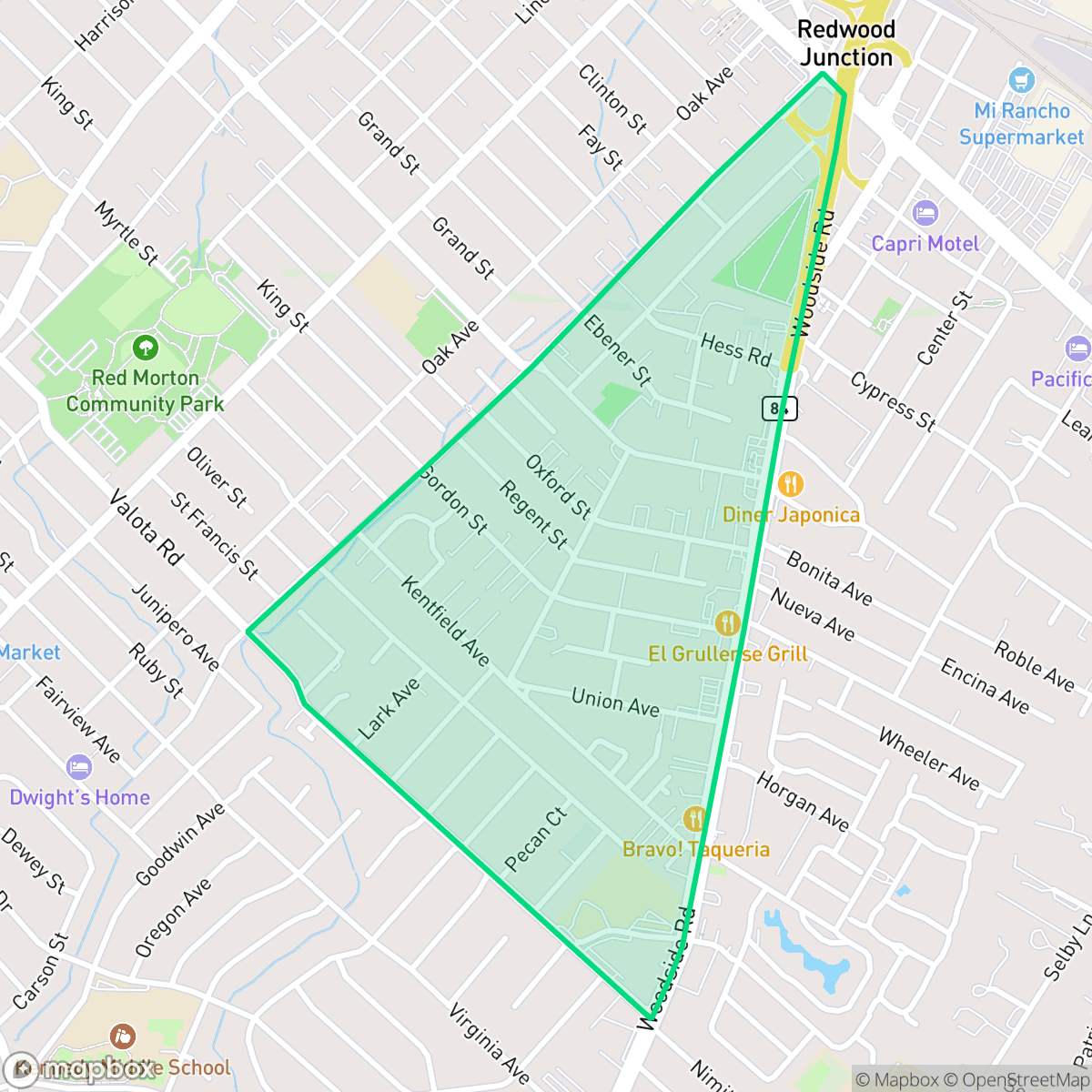
The Palm (or Palm Park) neighborhood in Redwood City features a unique blend of mid-century single-family homes and multi-family housing mostly built between 1940 and 1969. It is home to the historic Union Cemetery, established in 1859 and designated a California State Landmark in 1963 as the city’s only cemetery. The neighborhood’s namesake park has a grassroots origin: in 1958, local youth Carl Kerstan and Billy Crane cleared a small traffic triangle at Palm and Kentfield avenues, planting a tree and erecting a homemade "Palm Park" sign. In 1959, a Canary Island date palm was planted there by a garden club member. This inspired residents to petition for a larger public park, which officially opened nearby in 1979. Other notable landmarks include the Sequoia YMCA and the relocated 1880s Solari Family Windmill.
The neighborhood offers a suburban atmosphere characterized by a mix of single-family homes and multi-family complexes. Its layout features a reliable grid of streets and sidewalks, making it physically accessible for pedestrians. Beyond the residential blocks, the community is anchored by institutional landmarks and light commercial zones, providing a stable and established environment for its residents.
Prospective residents should note that the area presents specific trade-offs regarding acoustic comfort and private outdoor space. High levels of ambient road noise are common, and dog owners may find the lack of public park access restrictive, as most green space is contained within private backyards. While the area is free from industrial hazards, those considering a move should be aware of regional flood and fire safety challenges. It is best suited for individuals who prioritize a central, grid-oriented location over quiet surroundings or extensive public amenities.
Neighborhood Scores Across 15 Qualities
Residential structures feature mixed spacing with some neighbors located closely together. This level of density is roughly in line with the Redwood City average, according to iHuus data.
A dense, grid-like street pattern with continuous sidewalks and clear crosswalks makes pedestrian travel easy. This neighborhood offers a level of walkability that is consistent with the Redwood City average.
Large, well-maintained homes and frequent private backyard pools contribute to a pleasant aesthetic, though the overall visual appeal sits slightly below the Redwood City average.
Limited sidewalk verges and a lack of accessible public parks make it difficult to find dedicated areas for walking pets. According to iHuus data, this neighborhood offers fewer opportunities for outdoor pet activity compared to the Redwood City average.
Residential areas feature a mix of single-family homes and multi-family complexes, making the landscape comparable to the broader Redwood City area. This blend of housing types provides a transition between dense urban blocks and more open surroundings.
A balanced mix of residential streets, green spaces, and local dining options provides a more active atmosphere than much of Redwood City. While the area offers diverse dining and park access, some services require a short drive as they are not all within immediate walking distance.
Frequent noise from nearby railroad tracks and heavy freeway traffic is common in this area. According to iHuus data, acoustic comfort levels are significantly lower than the Redwood City average.
Air quality in this area fluctuates between acceptable and unhealthy levels on certain days. According to iHuus data, these conditions are slightly lower than the Redwood City average, presenting occasional concerns for sensitive groups.
Industrial activity is virtually non-existent here, as the area is composed entirely of residential and recreational spaces. This lack of warehouses or heavy logistics hubs makes the neighborhood even quieter than the Redwood City average.
Health insurance access among residents is lower than the average seen across Redwood City, according to iHuus data.
Voting patterns and census indicators reflect a predominantly liberal political leaning, which is slightly more pronounced than the Redwood City average.
Residents live alongside a balanced spread of young adults, families, and older individuals. This demographic variety is slightly lower than the Redwood City average, according to iHuus data.
Flood risk levels in Palm are consistent with the Redwood City average. According to iHuus data, FEMA has not yet completed a detailed flood study for this specific area.
Address-Level Insights for Palm


iHuus Neighborhood Intelligence Insights
Get address-level neighborhood insights for Palm
- Street-level scores — see how individual blocks compare, not just neighborhood averages
- Micro-zone boundaries — identify quiet pockets, flood boundaries, and walkable clusters before you visit
- 15 dimensions in full — walkability, noise, air quality, school quality, insurance coverage, population age profile, urban/rural index, and more
- Boundary risk alerts — know if your address sits near a block boundary where scores drop, the kind of detail no listing will ever mention
- School insights — individual school ratings and insights, not just district-level data
- Compare before you commit — side-by-side data across neighborhoods, down to block precision
No credit card required
Compare with Any Neighborhood
| Dimension | Palm | Ampex |
|---|---|---|
| 🚶 Walkabilityavg 8.4 | ||
| 🔊 Acoustic Comfortavg 4.29 | ||
| 🤫 Privacy Indexavg 4.9 | ||
| 🎨 Visual Appealavg 7 | ||
| 🐕 Dog Friendlinessavg 6.12 | ||
| 🗺️ Urban-Rural Indexavg 6.63 | ||
| ✨ Neighborhood Vibeavg 4.41 | ||
| 🏥 Health Insurance Coverageavg 7.97 | ||
| 🌿 Air Qualityavg 6.23 | ||
| 🏭 Industrial Proximityavg 8.38 | ||
| 🌊 Flood Safetyavg 4.84 | ||
| 🗳️ Ideological Leanavg 9.73 | ||
| 👥 Population Age Profileavg 4.84 | ||
| 🔥 Fire Safetyavg 0.22 | ||
| 🏫 School Quality |
Palm Rankings
School Districts Serving Palm
School Insights for Palm
Below average outcomes; significant attendance and academic challenges.
School Insights
See what's really behind every school rating near Palm
- Individual school ratings — each school's own score with outcome context, not just a district average
- Enrollment & class size data — student-to-teacher ratio and how it compares to the state average
- Full demographics breakdown — ethnicity and gender composition for every school in the enrollment zone
- Every school in the district — all schools within the enrollment boundary ranked by rating, not just the closest one
- Grade levels & benchmarks — elementary through high school, with below/above state-average flags
No credit card required