Friendly Acres, Redwood City
Updated · 3,820 residents
Friendly Acres is defined by its dense mix of post-war housing and industrial zones positioned near the coastline and major transit corridors. According to iHuus data, the area faces significant noise from road traffic and limited pedestrian infrastructure, making it a utilitarian choice for those prioritizing proximity to logistics hubs and the modern Stanford Redwood City campus.
Key Highlights
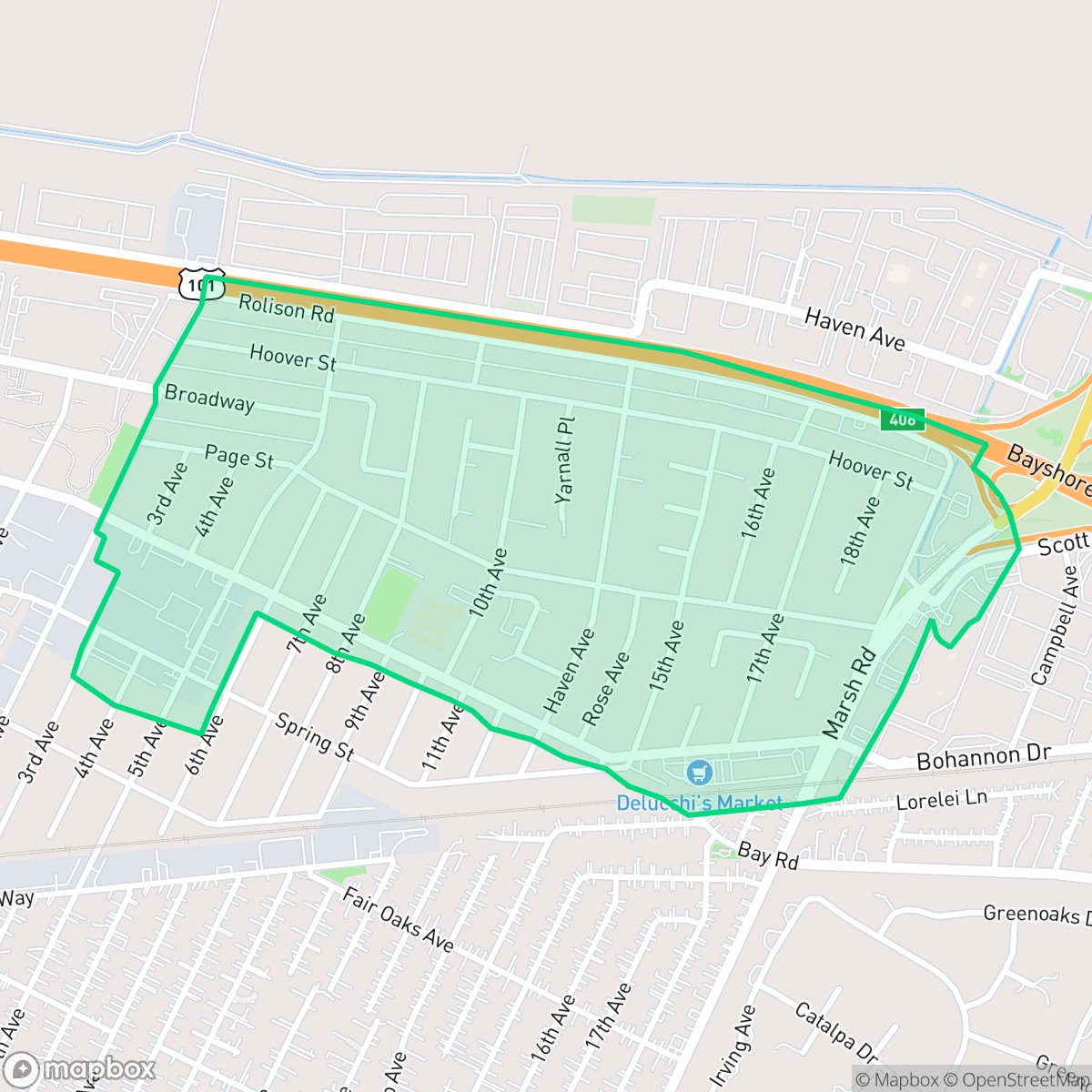
About Friendly Acres
Developed on a former salt swamp in February 1934 by Harry Friend, the Friendly Acres neighborhood in Redwood City, California, began with lots sold for just $20 down. Its most famous architectural landmark is the "Friendly Castle" at 1148 Fifth Avenue, a grand Spanish-style home built in 1936 as Friend's personal residence. The home, along with two other nearby Mediterranean-style residences, was designed by Kapliroff, a Polish-Russian architect who had previously designed buildings for Russia’s last czar, Nicholas II, before escaping the Russian Revolution. Friend also donated land for the local Taft School. Today, Friendly Acres is a diverse, evolving community featuring a mix of post-war housing, light industrial areas, and the modern Stanford University Redwood City campus.
The neighborhood functions as a dense, industrial-adjacent environment characterized by a high concentration of mobile home parks and small tract housing. Residents experience a landscape shaped by its proximity to major freeways and large-scale logistics facilities, which contributes to a consistent background noise level of 71 decibels. While the area offers high levels of health insurance coverage and favorable air quality, it lacks traditional amenities such as public parks, green verges, or walkable commercial districts. The streetscape is tightly packed, often leaving minimal space between structures and offering limited privacy for residents. This location is best suited for individuals who prioritize access to major employment centers and transit routes over suburban quiet or pedestrian-friendly design. Prospective residents should note that the area faces substantial environmental risks, including very low scores for flood and fire safety, which are critical factors for long-term planning. While the community is evolving alongside the nearby university campus, the current infrastructure remains heavily focused on industrial and transit utility rather than residential recreation or open space.
Neighborhood Scores Across 15 Qualities
Close proximity between homes and narrow separations between structures result in less privacy than is typical for Redwood City. According to iHuus data, many residences feature shared property lines or minimal distance between buildings.
Sidewalks are available along many residential streets and crossings are generally safe, though the area is less walkable than the Redwood City average due to a major freeway bisecting the neighborhood and limited pedestrian paths near mobile home parks.
Uniform tract housing and mobile home parks define the landscape, offering less greenery and variety than the Redwood City average. According to iHuus data, the area is characterized by modest yards and minimal luxury landscaping.
Walking options for pets are restricted by industrial zones and dense housing, though some residential streets offer small green buffers and access to a school field. According to iHuus data, overall dog friendliness is below the Redwood City average.
Scattered homes and open land provide a semi-rural feel that is very similar to the broader Redwood City area. Residents can expect a mix of wooded spaces and open fields alongside more developed suburban patches, according to iHuus data.
Primarily composed of suburban streets and light industrial zones, this area offers a low-energy atmosphere that is less lively than the Redwood City average. While select dining options are available, the neighborhood is largely car-oriented with limited social activity or walkable retail hubs.
Frequent noise from nearby freeway and railroad activity makes this area significantly louder than the Redwood City average. According to iHuus data, residents may experience persistent acoustic disturbances throughout the day.
Air remains mostly clean with rare instances of elevated readings. According to iHuus data, the air quality in Friendly Acres is notably better than the Redwood City average.
Active railway lines and warehouses introduce more industrial activity and noise than is typically found in other parts of Redwood City. Residents may experience increased daytime traffic and light pollution due to the proximity of large logistics centers and commercial zones.
Health insurance enrollment among residents is lower than the Redwood City average, according to iHuus data.
Voting patterns and census indicators show a predominantly liberal political leaning, slightly more so than the Redwood City average according to iHuus data.
A balanced mix of young adults, families, and older residents characterizes the area, reflecting a demographic profile that is very similar to the Redwood City average.
Significant flood hazards exist here due to the area being situated in a coastal high-hazard zone with wave action. According to iHuus data, this risk level is considerably higher than the Redwood City average and may result in elevated or prohibitive insurance costs.
Address-Level Insights for Friendly Acres


iHuus Neighborhood Intelligence Insights
Get address-level neighborhood insights for Friendly Acres
- Street-level scores — see how individual blocks compare, not just neighborhood averages
- Micro-zone boundaries — identify quiet pockets, flood boundaries, and walkable clusters before you visit
- 15 dimensions in full — walkability, noise, air quality, school quality, insurance coverage, population age profile, urban/rural index, and more
- Boundary risk alerts — know if your address sits near a block boundary where scores drop, the kind of detail no listing will ever mention
- School insights — individual school ratings and insights, not just district-level data
- Compare before you commit — side-by-side data across neighborhoods, down to block precision
No credit card required
Compare with Any Neighborhood
| Dimension | Friendly Acres | Ampex |
|---|---|---|
| 🚶 Walkabilityavg 8.4 | ||
| 🔊 Acoustic Comfortavg 4.29 | ||
| 🤫 Privacy Indexavg 4.9 | ||
| 🎨 Visual Appealavg 7 | ||
| 🐕 Dog Friendlinessavg 6.12 | ||
| 🗺️ Urban-Rural Indexavg 6.63 | ||
| ✨ Neighborhood Vibeavg 4.41 | ||
| 🏥 Health Insurance Coverageavg 7.97 | ||
| 🌿 Air Qualityavg 6.23 | ||
| 🏭 Industrial Proximityavg 8.38 | ||
| 🌊 Flood Safetyavg 4.84 | ||
| 🗳️ Ideological Leanavg 9.73 | ||
| 👥 Population Age Profileavg 4.84 | ||
| 🔥 Fire Safetyavg 0.22 | ||
| 🏫 School Quality |
Friendly Acres Rankings
School Districts Serving Friendly Acres
School Insights for Friendly Acres
Below average outcomes; significant attendance and academic challenges.
School Insights
See what's really behind every school rating near Friendly Acres
- Individual school ratings — each school's own score with outcome context, not just a district average
- Enrollment & class size data — student-to-teacher ratio and how it compares to the state average
- Full demographics breakdown — ethnicity and gender composition for every school in the enrollment zone
- Every school in the district — all schools within the enrollment boundary ranked by rating, not just the closest one
- Grade levels & benchmarks — elementary through high school, with below/above state-average flags
No credit card required