Farm Hill, Redwood City
Updated · 2,560 residents
Farm Hill is a quiet, low-density residential enclave defined by its hilly terrain and expansive green spaces. Residents enjoy a peaceful atmosphere with high levels of dog friendliness and privacy, though the area remains largely removed from commercial centers and urban activity.
Key Highlights
About Farm Hill
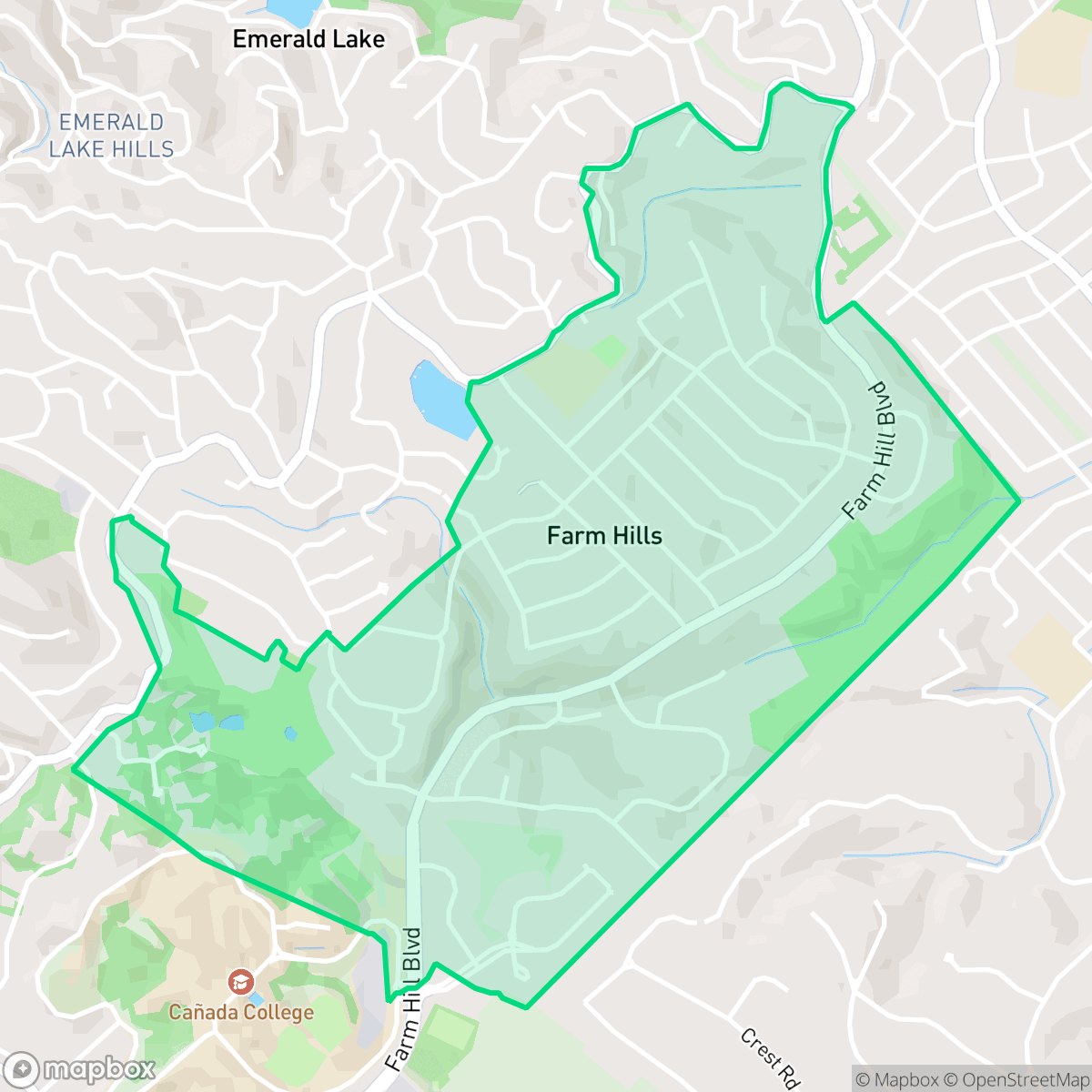
Farm Hill (also known as Farm Hills Estates) is the westernmost hillside neighborhood in Redwood City, California. Developed primarily between 1955 and 1957 by prominent post-war builder Andres "Andy" Oddstad, the neighborhood was designed with sturdy, mid-century ranch-style homes, including Oddstad’s signature "Medallion Series". Unlike neighboring Emerald Hills, which resisted annexation to maintain a rustic atmosphere, Farm Hill was annexed into Redwood City, transitioning from raw hillside terrain into a structured suburban community. In the late 1960s, the neighborhood underwent significant hillside stabilization and grading after mudslide concerns arose. Today, the neighborhood is characterized by its winding, tree-lined streets, generous lot sizes, and local landmarks such as Roy Cloud Elementary School, Stulsaft Park, and the Peninsula Covenant Church.
The area offers a distinct suburban experience characterized by its high urban-rural index and significant open space. With high marks for visual appeal, the neighborhood is noted for its scenic, tree-lined streets and well-maintained properties. According to iHuus data, the community maintains a high level of health insurance coverage and a quiet acoustic environment, making it a stable choice for those prioritizing tranquility over immediate proximity to nightlife or retail hubs.
Prospective residents should note that the neighborhood is not designed for walkability, as the lack of local businesses necessitates vehicle travel for most daily errands. While the area excels in dog friendliness and residential privacy, the low liveliness score reflects its status as a quiet, commuter-focused community. It is best suited for families or individuals who value a serene, low-density environment and are comfortable with the trade-offs of a more remote suburban lifestyle.
Neighborhood Scores Across 15 Qualities
Residential lots feature significant separation between homes, providing more privacy than most areas in Redwood City. Large lot sizes contribute to a sense of seclusion according to iHuus data.
Sidewalks are available on one side of the streets with safe crossings provided. This level of pedestrian infrastructure is lower than the average for Redwood City according to iHuus data.
Large residences and premium amenities provide a highly aesthetic environment that is notably more polished than the Redwood City average. According to iHuus data, the area features well-maintained properties and expansive driveways.
Access to connected green spaces and wide, traffic-safe paths makes this area significantly more pet-friendly than the Redwood City average, according to iHuus data.
Frequent open land and scattered homes among woodlands define this area, providing a more rural feel than the Redwood City average according to iHuus data.
Residential life here is characterized by a calm, low-density setting with very few local businesses within walking distance. This area is notably less active than the Redwood City average, as most daily needs require a vehicle due to the sparse commercial landscape.
Steady traffic sounds from nearby busy streets are present, though levels are notably quieter than the average for Redwood City according to iHuus data.
Air quality in this area fluctuates between acceptable and unhealthy levels. According to iHuus data, conditions are slightly lower than the Redwood City average, which may present occasional concerns for sensitive groups.
Residential streets and open green spaces define this area, which contains no detected warehouses or industrial facilities. According to iHuus data, this lack of industrial proximity is notably higher than the Redwood City average.
Health insurance access is exceptionally high among residents, significantly outpacing the Redwood City average according to iHuus data.
Voting patterns and census indicators reflect a highly liberal political leaning that is consistent with the broader Redwood City area.
Residents live alongside a balanced mix of young adults, families, and seniors. According to iHuus data, this demographic variety is more even than the broader Redwood City area.
Residual flood risk exists within this area, though the neighborhood maintains a higher level of flood safety than the Redwood City average according to iHuus data.
Fire hazard levels in Farm Hill are significantly higher than the Redwood City average. Residents should prepare for enhanced mitigation requirements and increased seasonal precautions according to iHuus data.
Address-Level Insights for Farm Hill


iHuus Neighborhood Intelligence Insights
Get address-level neighborhood insights for Farm Hill
- Street-level scores — see how individual blocks compare, not just neighborhood averages
- Micro-zone boundaries — identify quiet pockets, flood boundaries, and walkable clusters before you visit
- 15 dimensions in full — walkability, noise, air quality, school quality, insurance coverage, population age profile, urban/rural index, and more
- Boundary risk alerts — know if your address sits near a block boundary where scores drop, the kind of detail no listing will ever mention
- School insights — individual school ratings and insights, not just district-level data
- Compare before you commit — side-by-side data across neighborhoods, down to block precision
No credit card required
Compare with Any Neighborhood
| Dimension | Farm Hill | Ampex |
|---|---|---|
| 🚶 Walkabilityavg 8.4 | ||
| 🔊 Acoustic Comfortavg 4.29 | ||
| 🤫 Privacy Indexavg 4.9 | ||
| 🎨 Visual Appealavg 7 | ||
| 🐕 Dog Friendlinessavg 6.12 | ||
| 🗺️ Urban-Rural Indexavg 6.63 | ||
| ✨ Neighborhood Vibeavg 4.41 | ||
| 🏥 Health Insurance Coverageavg 7.97 | ||
| 🌿 Air Qualityavg 6.23 | ||
| 🏭 Industrial Proximityavg 8.38 | ||
| 🌊 Flood Safetyavg 4.84 | ||
| 🗳️ Ideological Leanavg 9.73 | ||
| 👥 Population Age Profileavg 4.84 | ||
| 🔥 Fire Safetyavg 0.22 | ||
| 🏫 School Quality |
Farm Hill Rankings
School Districts Serving Farm Hill
School Insights for Farm Hill
Below average outcomes; significant attendance and academic challenges.
School Insights
See what's really behind every school rating near Farm Hill
- Individual school ratings — each school's own score with outcome context, not just a district average
- Enrollment & class size data — student-to-teacher ratio and how it compares to the state average
- Full demographics breakdown — ethnicity and gender composition for every school in the enrollment zone
- Every school in the district — all schools within the enrollment boundary ranked by rating, not just the closest one
- Grade levels & benchmarks — elementary through high school, with below/above state-average flags
No credit card required