Eagle Hill, Redwood City
Updated · 3,695 residents
Eagle Hill is a quiet, affluent residential enclave in Redwood City defined by its winding, tree-lined streets and historic Craftsman architecture. The area offers high walkability and a peaceful atmosphere, making it a stable choice for those seeking a suburban environment free from industrial activity. According to iHuus data, residents benefit from exceptional acoustic comfort and high levels of health insurance coverage.
Key Highlights
About Eagle Hill
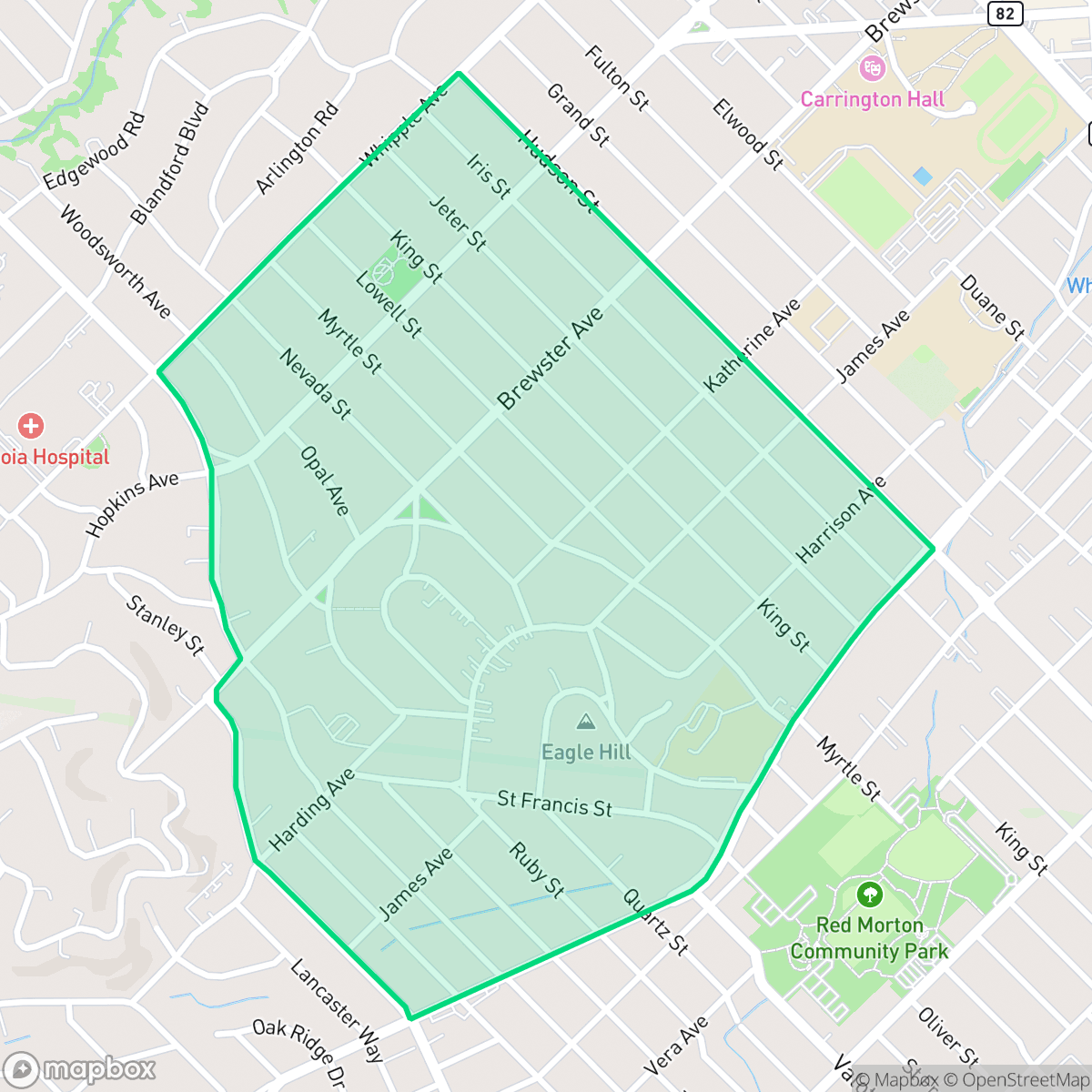
The Eagle Hill neighborhood in Redwood City is centered around its namesake hill, historically known as Mount Eagle. In 1871, millionaire Horace Hawes planned to establish Mount Eagle University on his Redwood Farm property here, but his death and subsequent legal battles with his widow prevented its realization. Instead, the site became home to John Gill Elementary School, dedicated in 1932, which features a landmark Spanish-style main building. Characterized by winding streets that follow the contours of the hill rather than a standard grid, the residential enclave features a variety of custom homes, including century-old Craftsman-style residences. Additionally, the straight-line underground path of the Hetch Hetchy water aqueduct cuts directly through the neighborhood, running alongside the school.
The neighborhood is characterized by its hilly topography and lack of commercial density, which fosters a serene, residential-focused environment. Streets follow the natural contours of the terrain, contributing to a distinct visual appeal marked by manicured lawns and private backyard amenities. With a high degree of acoustic comfort and a total absence of industrial proximity, the area provides a secluded feel despite its location within the broader Redwood City urban core.
While the area is highly walkable with well-maintained sidewalks, it lacks significant commercial hubs, meaning daily errands often require travel outside the immediate vicinity. The local school landscape presents a mix of options, ranging from district-managed schools currently navigating fiscal challenges to high-performing alternative programs. The neighborhood is best suited for families or professionals who prioritize a quiet, stable, and visually appealing suburban lifestyle over proximity to nightlife or retail centers.
Neighborhood Scores Across 15 Qualities
Residential spacing varies between closely packed shared walls and detached homes with small side gaps. This level of density is slightly higher than the Redwood City average, according to iHuus data.
Pedestrian access is excellent due to a dense street grid with sidewalks on both sides of most roads and frequent crossings. This level of walkability is slightly above the Redwood City average, offering a highly navigable environment for residents.
Large homes with private pools and well-maintained yards characterize this area. According to iHuus data, the neighborhood offers a higher level of visual appeal than the Redwood City average.
Access to multiple large sports parks and grass fields makes this area slightly more dog friendly than the Redwood City average. While sidewalk verges can be narrow in certain sections, the proximity to expansive public green spaces provides ample room for exercise.
Residential layouts feature a mix of single-family homes and low-rise structures that align closely with the typical urban-rural balance found throughout Redwood City.
Local streets offer a notable variety of dining and social spots that provide more activity than the Redwood City average. While some blocks remain quiet and residential, many areas feature accessible amenities and green spaces according to iHuus data.
Steady sounds from nearby busy streets are present, though acoustic levels are slightly more tranquil than the average for Redwood City according to iHuus data.
Air quality fluctuates between acceptable and unhealthy levels, presenting occasional concerns for sensitive groups. This level of-air quality is slightly lower than the Redwood City average according to iHuus data.
Industrial activity and heavy warehouses are entirely absent from this area, making it significantly cleaner of industrial hazards than the Redwood City average. According to iHuus data, the neighborhood consists solely of residential, institutional, and light commercial uses.
Health insurance coverage is widespread among Eagle Hill residents, sitting well above the Redwood City average according to iHuus data.
Voting patterns and census indicators in Eagle Hill reflect a predominantly liberal political leaning, which is very similar to the broader Redwood City average.
A balanced mix of young professionals, families, and seniors characterizes the local community. According to iHuus data, this age distribution is slightly more varied than the average seen throughout Redwood City.
Flood risk remains significantly lower here than the Redwood City average, though some residual risk exists within the 500-year floodplain according to iHuus data.
Address-Level Insights for Eagle Hill


iHuus Neighborhood Intelligence Insights
Get address-level neighborhood insights for Eagle Hill
- Street-level scores — see how individual blocks compare, not just neighborhood averages
- Micro-zone boundaries — identify quiet pockets, flood boundaries, and walkable clusters before you visit
- 15 dimensions in full — walkability, noise, air quality, school quality, insurance coverage, population age profile, urban/rural index, and more
- Boundary risk alerts — know if your address sits near a block boundary where scores drop, the kind of detail no listing will ever mention
- School insights — individual school ratings and insights, not just district-level data
- Compare before you commit — side-by-side data across neighborhoods, down to block precision
No credit card required
Compare with Any Neighborhood
| Dimension | Eagle Hill | Ampex |
|---|---|---|
| 🚶 Walkabilityavg 8.4 | ||
| 🔊 Acoustic Comfortavg 4.29 | ||
| 🤫 Privacy Indexavg 4.9 | ||
| 🎨 Visual Appealavg 7 | ||
| 🐕 Dog Friendlinessavg 6.12 | ||
| 🗺️ Urban-Rural Indexavg 6.63 | ||
| ✨ Neighborhood Vibeavg 4.41 | ||
| 🏥 Health Insurance Coverageavg 7.97 | ||
| 🌿 Air Qualityavg 6.23 | ||
| 🏭 Industrial Proximityavg 8.38 | ||
| 🌊 Flood Safetyavg 4.84 | ||
| 🗳️ Ideological Leanavg 9.73 | ||
| 👥 Population Age Profileavg 4.84 | ||
| 🔥 Fire Safetyavg 0.22 | ||
| 🏫 School Quality |
Eagle Hill Rankings
School Districts Serving Eagle Hill
School Insights for Eagle Hill
Below average outcomes; significant attendance and academic challenges.
School Insights
See what's really behind every school rating near Eagle Hill
- Individual school ratings — each school's own score with outcome context, not just a district average
- Enrollment & class size data — student-to-teacher ratio and how it compares to the state average
- Full demographics breakdown — ethnicity and gender composition for every school in the enrollment zone
- Every school in the district — all schools within the enrollment boundary ranked by rating, not just the closest one
- Grade levels & benchmarks — elementary through high school, with below/above state-average flags
No credit card required