Canyon, Redwood City
Updated · 2,692 residents
Defined by its distinctive hilly terrain, the Canyon neighborhood offers an upscale, semi-rural atmosphere characterized by spacious lots and mature tree canopies. While the area provides a quiet, secluded environment, residents should anticipate a car-dependent lifestyle and be mindful of local wildfire safety considerations.
Key Highlights
About Canyon
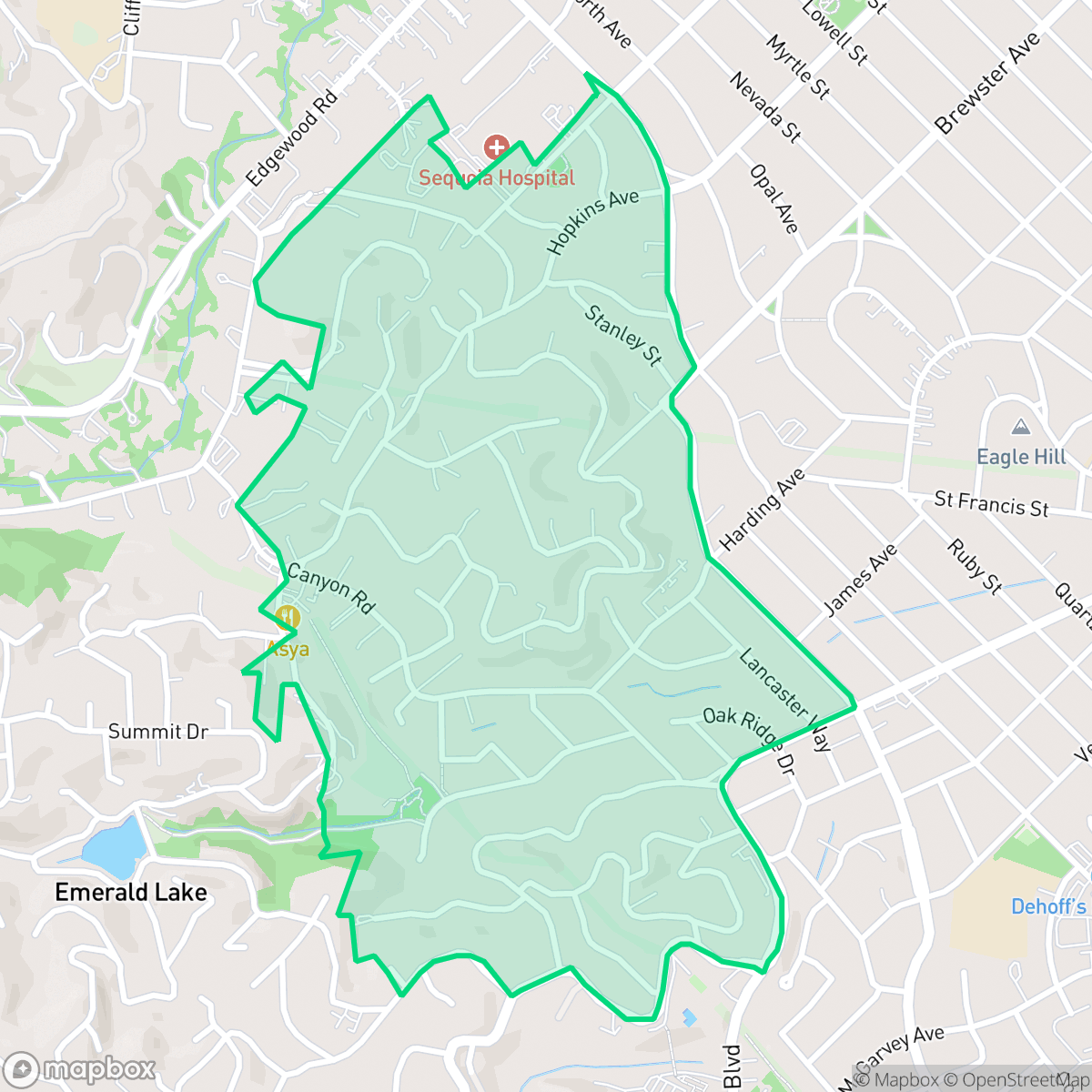
The Canyon neighborhood in Redwood City is defined by its distinctive hilly topography, which features the canyon that gives the area its name. Primarily residential, the neighborhood is characterized by a mix of single-family homes, ranging from mid-20th-century structures to modern, upscale replacements. A major institutional anchor is Sequoia Hospital, which has served the community since 1950. Local landmarks include the long-standing Canyon Inn, a neighborhood staple since 1973, and two public spaces, Dove Beeger Park and Garrett Park, both named for figures significant to local history. The neighborhood’s character is shaped by its challenging, elevated terrain, which provides a secluded, suburban atmosphere despite its proximity to the city's urban core.
The neighborhood is defined by its elevated, wooded landscape, which provides a sense of seclusion and privacy rarely found in more urban settings. Residents enjoy a polished aesthetic, with well-maintained properties and generous spacing between homes that creates a peaceful, semi-rural feel. Because the area is entirely residential and institutional with no industrial presence, the streets remain quiet and free from commercial traffic, according to iHuus data.
Prospective residents should note that this environment necessitates a vehicle for most daily errands, as local services are limited. While the community boasts high levels of health insurance coverage and a diverse age mix, it is important to consider the increased risk of wildfire in this topography. Additionally, while the local school districts offer strong academic programs, they are currently navigating periods of operational and fiscal transition that may impact the overall student experience.
Neighborhood Scores Across 15 Qualities
Housing density is moderate, offering some buffer between neighbors that is higher than the Redwood City average. According to iHuus data, the area features mixed spacing that provides a balance of visibility and separation.
Sidewalks are available on one side of the street with safe crossings, though pedestrian accessibility is lower than the Redwood City average.
Large residences and frequent high-end amenities contribute to an environment that is more visually polished than the Redwood City average. According to iHuus data, the area is characterized by spacious driveways and well-maintained property features.
Access to public parks and wide green verges is consistent with the Redwood City average. Residents can find adequate space for pets, though specialized amenities may be limited compared to more pet-centric areas.
Wooded hillsides and scattered residential structures create a semi-rural atmosphere that is slightly more open than the Redwood City average. Dense tree canopies and large lots characterize much of the area according to iHuus data.
Low-density streets and scattered dining options create a subdued atmosphere that is below the Redwood City average for activity. Most daily errands require a vehicle due to the limited concentration of local businesses and social hubs.
Acoustic levels remain relatively low with only occasional sounds from distant vehicles or trains. This level of tranquility is notably higher than the Redwood City average according to iHuus data.
Air quality levels fluctuate between acceptable and unhealthy, posing occasional concerns for sensitive groups. According to iHuus data, these conditions are slightly lower than the Redwood City average.
Industrial facilities and warehouses are entirely absent from this area, making it more residential than the Redwood City average. According to iHuus data, the neighborhood consists solely of residential and institutional zones with no detected hazard sites.
Health insurance access is nearly universal among Canyon residents, significantly outpacing the Redwood City average according to iHuus data.
Voting patterns and census indicators reflect a predominantly liberal political landscape that is consistent with the broader Redwood City area.
Residents live alongside a balanced variety of young adults, families, and older individuals. This demographic spread is more varied than the average found across Redwood City, according to iHuus data.
Flood risk is notably lower than the Redwood City average, though some residual risk remains due to the area's location within a 500-year floodplain. According to iHuus data, the neighborhood sits in a zone that is generally considered stable but subject to infrequent flooding events.
Significant fire hazards exist in this area, which presents a much higher risk than the Redwood City average according to iHuus data. Residents should be prepared for enhanced wildfire mitigation measures and emergency preparedness.
Address-Level Insights for Canyon


iHuus Neighborhood Intelligence Insights
Get address-level neighborhood insights for Canyon
- Street-level scores — see how individual blocks compare, not just neighborhood averages
- Micro-zone boundaries — identify quiet pockets, flood boundaries, and walkable clusters before you visit
- 15 dimensions in full — walkability, noise, air quality, school quality, insurance coverage, population age profile, urban/rural index, and more
- Boundary risk alerts — know if your address sits near a block boundary where scores drop, the kind of detail no listing will ever mention
- School insights — individual school ratings and insights, not just district-level data
- Compare before you commit — side-by-side data across neighborhoods, down to block precision
No credit card required
Compare with Any Neighborhood
| Dimension | Canyon | Ampex |
|---|---|---|
| 🚶 Walkabilityavg 8.4 | ||
| 🔊 Acoustic Comfortavg 4.29 | ||
| 🤫 Privacy Indexavg 4.9 | ||
| 🎨 Visual Appealavg 7 | ||
| 🐕 Dog Friendlinessavg 6.12 | ||
| 🗺️ Urban-Rural Indexavg 6.63 | ||
| ✨ Neighborhood Vibeavg 4.41 | ||
| 🏥 Health Insurance Coverageavg 7.97 | ||
| 🌿 Air Qualityavg 6.23 | ||
| 🏭 Industrial Proximityavg 8.38 | ||
| 🌊 Flood Safetyavg 4.84 | ||
| 🗳️ Ideological Leanavg 9.73 | ||
| 👥 Population Age Profileavg 4.84 | ||
| 🔥 Fire Safetyavg 0.22 | ||
| 🏫 School Quality |
Canyon Rankings
School Districts Serving Canyon
School Insights for Canyon
Below average outcomes; significant attendance and academic challenges.
School Insights
See what's really behind every school rating near Canyon
- Individual school ratings — each school's own score with outcome context, not just a district average
- Enrollment & class size data — student-to-teacher ratio and how it compares to the state average
- Full demographics breakdown — ethnicity and gender composition for every school in the enrollment zone
- Every school in the district — all schools within the enrollment boundary ranked by rating, not just the closest one
- Grade levels & benchmarks — elementary through high school, with below/above state-average flags
No credit card required