Arlington, Redwood City
Updated · 2,551 residents
Arlington is defined by its historic residential character and curvilinear street layout, offering an affluent and quiet atmosphere. While the area provides a high level of visual appeal with its well-maintained homes, it remains a tranquil, strictly residential enclave with limited commercial activity.
Key Highlights
About Arlington
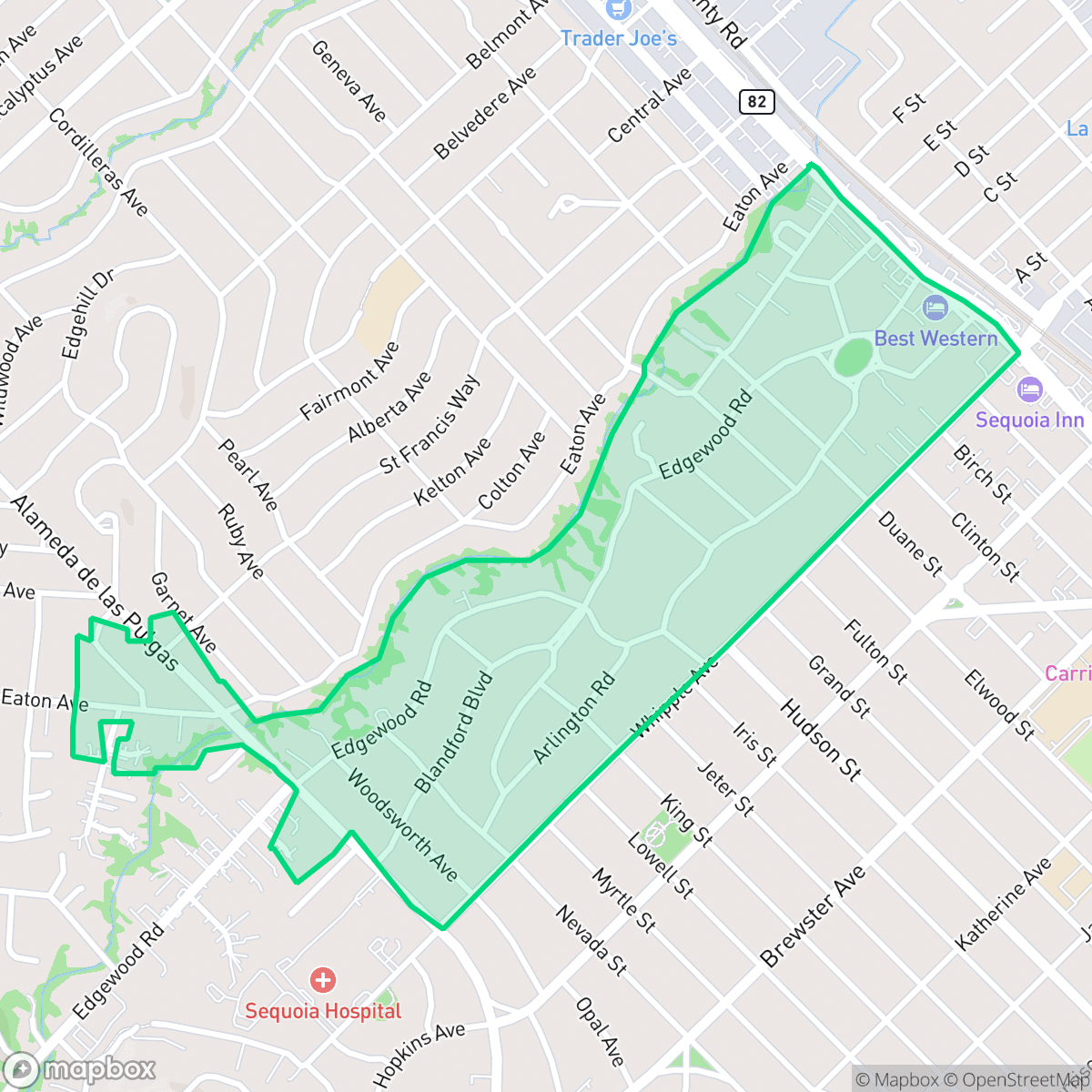
The Arlington neighborhood of Redwood City is home to the historic Wellesley Park subdivision, established in 1888 as the city's first suburban development west of El Camino Real. Conceived as an exclusive commuter rail suburb for San Francisco, it was designed in the Picturesque style by Daniel O’Connell—a journalist and founder of San Francisco’s Bohemian Club—alongside landscape gardener William Brown. Following O'Connell's departure, prominent local attorney George C. Ross brought the project to fruition around 1906. The neighborhood’s distinctive layout features curvilinear streets like Arlington Road and Edgewood Road, which contour around Cordilleras Creek, centering on Wellesley Crescent Park. Originally marked by a massive granite archway at its entrance, the neighborhood evolved from its late 19th-century origins to include 1940s Minimal Traditional and 1950s Ranch-style homes.
The neighborhood serves as a serene residential pocket characterized by its dense suburban layout and high visual appeal. Residents benefit from an environment free of heavy industrial activity, as the area remains strictly residential and light commercial. The streets are lined with large, well-kept homes that contribute to a polished aesthetic, while the proximity to major transit corridors provides a balance between suburban seclusion and regional accessibility.
Prospective residents should consider that the area prioritizes quiet living over high walkability or immediate access to retail. While the streets are generally easy to navigate on foot, the lack of public parks and limited dog-friendly amenities may be a factor for some. With a noise profile primarily influenced by road traffic, the area is best suited for those seeking a stable, affluent community that values privacy and architectural character over high-energy urban convenience.
Neighborhood Scores Across 15 Qualities
Housing density varies across the area, with some sections featuring closely spaced homes and others offering more significant buffers between neighbors. This level of privacy is slightly higher than the Redwood City average according to iHuus data.
Sidewalks and safe crossings are widely available, though the neighborhood is slightly less walkable than the Redwood City average. Many residential streets feature a continuous sidewalk network, even if some paths are partially obscured by tree canopy.
Large homes featuring manicured yards and private swimming pools contribute to a visual landscape that is slightly more polished than the Redwood City average. According to iHuus data, the presence of complex architectural details and well-maintained amenities defines the area's character.
Public park access and wide green verges are scarce in this area. According to iHuus data, most greenery is restricted to private fenced backyards, making the neighborhood less dog-friendly than the Redwood City average.
Residential layouts feature a dense mix of single-family homes and multi-story apartments. This landscape reflects a level of openness that is nearly identical to the Redwood City average.
Suburban blocks offer a balanced mix of residential greenery and accessible dining, providing a level of activity slightly above the Redwood City average. While some areas near the railway feature a notable variety of eateries, other parts of the neighborhood remain quiet and primarily residential.
Consistent sound from nearby thoroughfares is present; this level of acoustic activity is slightly higher than the Redwood City average.
Air quality fluctuates between acceptable and unhealthy levels, representing a situation that is slightly below the Redwood City average. Sensitive groups may experience occasional concern during certain periods according to iHuus data.
Residential streets and light commercial zones predominate, with no heavy industry or large warehouses located within the neighborhood. This level of industrial separation is consistent with the city average, according to iHuus data.
Health insurance access is widespread among Arlington residents, sitting well above the Redwood City average according to iHuus data.
Voting patterns and census indicators reflect a predominantly liberal community, which is slightly more pronounced than the average seen across Redwood City.
Residents live alongside a balanced mix of young adults, families, and seniors. According to iHuus data, this demographic spread is slightly more varied than the average seen across Redwood City.
Flood risk in this area is comparable to the rest of Redwood City; however, a lack of detailed federal studies means the specific level of vulnerability remains undetermined. According to iHuus data, residents should remain aware that current assessments for this neighborhood are not yet fully refined.
Address-Level Insights for Arlington


iHuus Neighborhood Intelligence Insights
Get address-level neighborhood insights for Arlington
- Street-level scores — see how individual blocks compare, not just neighborhood averages
- Micro-zone boundaries — identify quiet pockets, flood boundaries, and walkable clusters before you visit
- 15 dimensions in full — walkability, noise, air quality, school quality, insurance coverage, population age profile, urban/rural index, and more
- Boundary risk alerts — know if your address sits near a block boundary where scores drop, the kind of detail no listing will ever mention
- School insights — individual school ratings and insights, not just district-level data
- Compare before you commit — side-by-side data across neighborhoods, down to block precision
No credit card required
Compare with Any Neighborhood
| Dimension | Arlington | Ampex |
|---|---|---|
| 🚶 Walkabilityavg 8.4 | ||
| 🔊 Acoustic Comfortavg 4.29 | ||
| 🤫 Privacy Indexavg 4.9 | ||
| 🎨 Visual Appealavg 7 | ||
| 🐕 Dog Friendlinessavg 6.12 | ||
| 🗺️ Urban-Rural Indexavg 6.63 | ||
| ✨ Neighborhood Vibeavg 4.41 | ||
| 🏥 Health Insurance Coverageavg 7.97 | ||
| 🌿 Air Qualityavg 6.23 | ||
| 🏭 Industrial Proximityavg 8.38 | ||
| 🌊 Flood Safetyavg 4.84 | ||
| 🗳️ Ideological Leanavg 9.73 | ||
| 👥 Population Age Profileavg 4.84 | ||
| 🔥 Fire Safetyavg 0.22 | ||
| 🏫 School Quality |
Arlington Rankings
School Districts Serving Arlington
School Insights for Arlington
Below average outcomes; significant attendance and academic challenges.
School Insights
See what's really behind every school rating near Arlington
- Individual school ratings — each school's own score with outcome context, not just a district average
- Enrollment & class size data — student-to-teacher ratio and how it compares to the state average
- Full demographics breakdown — ethnicity and gender composition for every school in the enrollment zone
- Every school in the district — all schools within the enrollment boundary ranked by rating, not just the closest one
- Grade levels & benchmarks — elementary through high school, with below/above state-average flags
No credit card required