Kutras Tract, Redding
Updated · 178 residents
The Kutras Tract is a highly walkable Redding neighborhood that balances quiet residential streets with convenient access to waterfront recreation. It offers a dog-friendly environment and a peaceful atmosphere, making it a distinct choice for those seeking a balance between urban accessibility and suburban comfort.
Key Highlights
About Kutras Tract
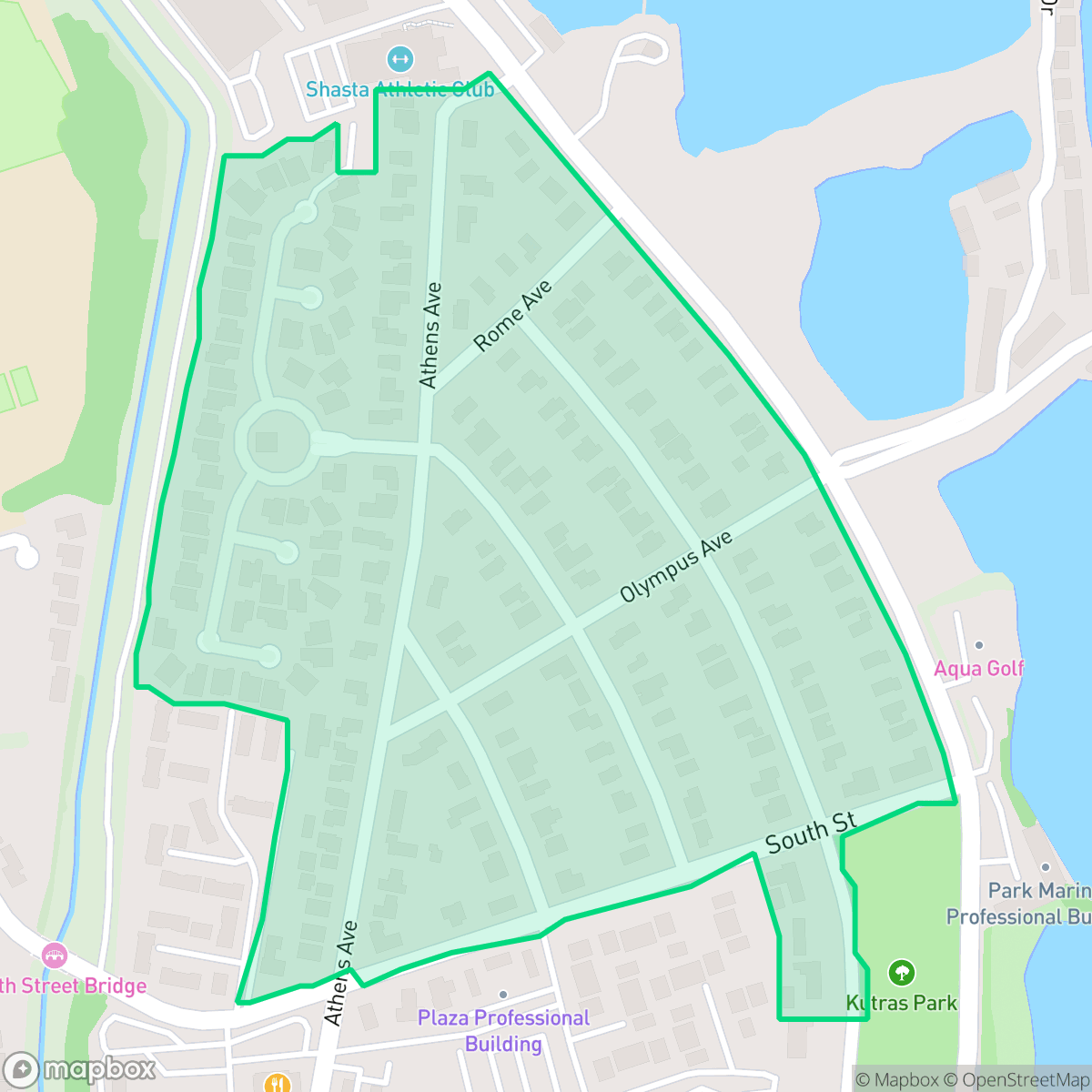
The Kutras Tract in Redding, California, originated in 1935 when Christ Kutras, a Greek immigrant and local restaurateur, purchased the riverfront property near Turtle Bay. From 1938 to 1945, the tract hosted the Shasta Aggregate Plant, which supplied gravel for the construction of Shasta Dam via a historic 9.6-mile-long conveyor belt. Today, "The Monolith," a massive concrete structure preserved in Turtle Bay Exploration Park, remains as a landmark of this industrial era. In 1950, Kutras subdivided the tract for residential and commercial use. Developers Bob and Shirlee Spaid subsequently transformed the waterfront along Park Marina Drive (formerly Thames Drive) into a popular mid-century recreational hub featuring Kutras Park, a golf course, and Kutras Lake.
The neighborhood is defined by its calm, residential character and its proximity to the Sacramento River. It maintains a higher level of walkability than much of the surrounding city, allowing for easier access to local green spaces and the riverfront. While the area is primarily residential, the presence of localized amenities like coffee shops and cafes provides a modest level of convenience for daily needs. The community maintains a stable, quiet environment that is notably removed from industrial activity, fostering a cohesive suburban feel.
Potential residents should note that while the area offers excellent flood safety and high health insurance coverage, it faces significant challenges regarding fire safety. The neighborhood is well-suited for individuals who prioritize outdoor access and a dog-friendly environment, though it is important to weigh the specific risks associated with the local fire profile. The educational landscape is mixed, with high-performing high schools contrasted by inconsistent performance in the local elementary district, requiring families to consider the specific school options available.
Neighborhood Scores Across 15 Qualities
Residential spacing provides a moderate level of separation between neighbors, which is roughly in line with the Redding average. According to iHuus data, the area features mixed density with some buffer zones between properties.
Pedestrian access is well-supported by sidewalks on one side of the street and safe crossings. This level of walkability is notably higher than the Redding average, according to iHuus data.
Modest yards and uniform rooflines define this area, which offers slightly less visual variety than the Redding average according to iHuus data.
Connected green spaces and wide paths provide ample opportunities for exercise; according to iHuus data, this area offers higher levels of dog friendliness than the Redding average.
Frequent open land and scattered homes amid woodland define this area. This landscape offers a more rural feel than the more densely developed parts of Redding.
Local social hubs and dining spots provide a higher level of activity than the Redding average. While some areas offer quiet suburban streets, other sections sit near major transit corridors with more frequent movement.
Frequent noise from nearby transit corridors, such as busy freeways or railroad tracks, is a common feature here. According to iHuus data, acoustic levels are notably higher than the Redding city average.
Air quality in this area fluctuates between acceptable and unhealthy levels, appearing slightly lower than the Redding average according to iHuus data. Sensitive groups may experience occasional concern during periods of poor air circulation.
Industrial facilities and warehouses are entirely absent from this area. Residents can expect a quiet environment with no nearby manufacturing or hazard sites, which is notably better than the Redding average.
Health insurance accessibility is slightly above the Redding average, according to iHuus data. Most residents in this area have access to medical coverage.
Political leanings in this area are predominantly conservative, showing a significantly more conservative tilt than the Redding city average according to iHuus data.
A balanced mix of young adults, families, and older residents defines the area. According to iHuus data, this age distribution is slightly more varied than the typical Redding profile.
Flood risk is significantly lower here than the Redding average, although some residual risk remains within a 500-year floodplain according to iHuus data.
Address-Level Insights for Kutras Tract


iHuus Neighborhood Intelligence Insights
Get address-level neighborhood insights for Kutras Tract
- Street-level scores — see how individual blocks compare, not just neighborhood averages
- Micro-zone boundaries — identify quiet pockets, flood boundaries, and walkable clusters before you visit
- 15 dimensions in full — walkability, noise, air quality, school quality, insurance coverage, population age profile, urban/rural index, and more
- Boundary risk alerts — know if your address sits near a block boundary where scores drop, the kind of detail no listing will ever mention
- School insights — individual school ratings and insights, not just district-level data
- Compare before you commit — side-by-side data across neighborhoods, down to block precision
No credit card required
Compare with Any Neighborhood
| Dimension | Kutras Tract | Lancer Hills Estates |
|---|---|---|
| 🚶 Walkabilityavg 6.64 | ||
| 🔊 Acoustic Comfortavg 4.24 | ||
| 🤫 Privacy Indexavg 6.22 | ||
| 🎨 Visual Appealavg 7.02 | ||
| 🐕 Dog Friendlinessavg 7.58 | ||
| 🗺️ Urban-Rural Indexavg 7.99 | ||
| ✨ Neighborhood Vibeavg 4.12 | ||
| 🏥 Health Insurance Coverageavg 6.95 | ||
| 🌿 Air Qualityavg 6.42 | ||
| 🏭 Industrial Proximityavg 8.8 | ||
| 🌊 Flood Safetyavg 3.38 | ||
| 🗳️ Ideological Leanavg 1.12 | ||
| 👥 Population Age Profileavg 5.16 | ||
| 🔥 Fire Safetyavg 1.22 | ||
| 🏫 School Quality |
Kutras Tract Rankings
School Districts Serving Kutras Tract
School Insights for Kutras Tract
Below average outcomes; significant attendance and academic challenges.
School Insights
See what's really behind every school rating near Kutras Tract
- Individual school ratings — each school's own score with outcome context, not just a district average
- Enrollment & class size data — student-to-teacher ratio and how it compares to the state average
- Full demographics breakdown — ethnicity and gender composition for every school in the enrollment zone
- Every school in the district — all schools within the enrollment boundary ranked by rating, not just the closest one
- Grade levels & benchmarks — elementary through high school, with below/above state-average flags
No credit card required