Red Hill, Rancho Cucamonga
Updated · 3,591 residents
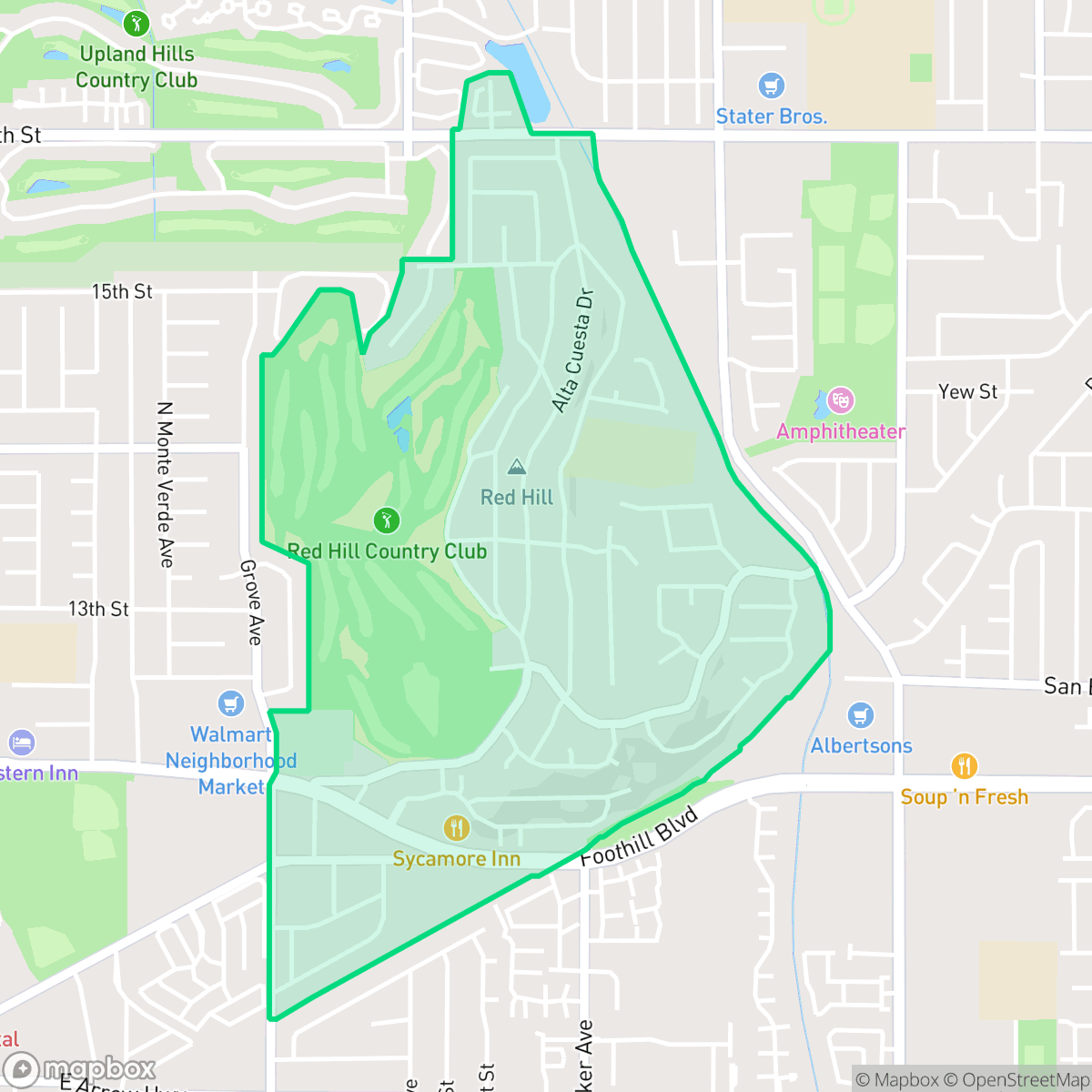
Red Hill is a prominent Rancho Cucamonga neighborhood characterized by its blend of dense suburban residential streets and expansive green spaces. The area offers high walkability and convenient access to local dining and retail, providing a stable, well-insured community for its residents.
Key Highlights
About Red Hill
The Red Hill neighborhood of Rancho Cucamonga is centered around a prominent geological landmark that has shaped local history for centuries. Around 1200 CE, the Kucamongan Native Americans (part of the Gabrielino-Tongva culture) established a village at the base of the hill. In 1839, Mexican land grantee Tiburcio Tapia built a fortified adobe home on Red Hill and planted the area's first vineyards. In 1864, President Abraham Lincoln commissioned the region's first post office at this site. The area transitioned from viticulture and citrus groves to a premier recreation destination in 1921 when the historic Red Hill Country Club was established, featuring a golf course designed by the legendary architect George C. Thomas, Jr.
The neighborhood balances quiet residential living with pockets of commercial activity. Residents benefit from high levels of health insurance coverage and a layout that supports walking to nearby cafes and restaurants. While the area maintains a suburban feel, it features diverse dining options and social hubs that contribute to a moderate level of local activity. The community is well-regarded for its visual appeal and provides a welcoming environment for pet owners, with numerous green spaces integrated throughout the residential landscape.
Living in the area requires balancing certain trade-offs, particularly regarding environmental risks. According to iHuus data, the neighborhood faces significant challenges concerning flood and fire safety, which are important considerations for prospective residents. Despite these factors, the community remains a stable environment, making it a functional choice for those prioritizing access to local amenities and a cohesive suburban atmosphere. The combination of established retail centers and accessible pedestrian paths ensures that daily needs are met without requiring extensive travel.
Neighborhood Scores Across 15 Qualities
Residential spacing varies from dense clusters with shared walls to standard suburban layouts. According to iHuus data, the level of separation between neighbors is slightly higher than the Rancho Cucamonga average.
Sidewalk networks are comprehensive on both sides of most residential and arterial streets. Pedestrian paths are well-defined and match the city average for ease of movement.
Well-maintained driveways and private backyard pools contribute to a pleasant aesthetic. According to iHuus data, the visual quality is largely consistent with the broader Rancho Cucamonga area.
Wide parkway strips and access to a large public athletic field provide better opportunities for pet exercise than the Rancho Cucamonga average. While much of the greenery consists of private yards or narrow sidewalk strips, the presence of connected green belts supports easy walking routes.
Open land and scattered homes provide a semi-rural atmosphere that is consistent with the city average. According to iHuus data, the area features a balance of residential pockets and undeveloped space.
Suburban streets and light industrial areas create a low-energy atmosphere that is slightly below the Rancho Cucamonga average. While some local dining and social hubs are accessible via walkable paths, many essential services and businesses require a car.
Steady traffic sounds from a nearby busy street are common here. According to iHuus data, acoustic comfort levels are higher than the average found throughout Rancho Cucamonga.
Air quality levels typically fluctuate between acceptable and unhealthy conditions. According to iHuus data, the air quality in Red Hill is consistent with the average levels found throughout Rancho Cucamonga.
Residential streets and green spaces dominate the landscape, with only minimal light commercial or warehouse activity nearby. This area remains largely free of heavy industrial zones, performing similarly to the broader city average.
Health insurance access is consistent with the average found throughout Rancho Cucamonga. Residents in this area have reliable access to medical coverage, according to iHuus data.
Political leanings in Red Hill are relatively balanced between conservative and liberal perspectives, sitting slightly more diverse than the Rancho Cucamonga average according to iHuus data.
Residents live among a balanced mix of young adults, families, and older populations. This demographic spread is very similar to the broader Rancho Cucamonga area according to iHuus data.
Properties in this area are located within a designated floodplain, which may necessitate flood insurance. According to iHuus data, the risk of flooding is notably higher here than in the rest of Rancho Cucamonga.
Address-Level Insights for Red Hill


iHuus Neighborhood Intelligence Insights
Get address-level neighborhood insights for Red Hill
- Street-level scores — see how individual blocks compare, not just neighborhood averages
- Micro-zone boundaries — identify quiet pockets, flood boundaries, and walkable clusters before you visit
- 15 dimensions in full — walkability, noise, air quality, school quality, insurance coverage, population age profile, urban/rural index, and more
- Boundary risk alerts — know if your address sits near a block boundary where scores drop, the kind of detail no listing will ever mention
- School insights — individual school ratings and insights, not just district-level data
- Compare before you commit — side-by-side data across neighborhoods, down to block precision
No credit card required
Compare with Any Neighborhood
| Dimension | Red Hill | Central North |
|---|---|---|
| 🚶 Walkabilityavg 8.76 | ||
| 🔊 Acoustic Comfortavg 3.76 | ||
| 🤫 Privacy Indexavg 4.95 | ||
| 🎨 Visual Appealavg 7.01 | ||
| 🐕 Dog Friendlinessavg 6.09 | ||
| 🗺️ Urban-Rural Indexavg 6.71 | ||
| ✨ Neighborhood Vibeavg 3.87 | ||
| 🏥 Health Insurance Coverageavg 8.11 | ||
| 🌿 Air Qualityavg 6.02 | ||
| 🏭 Industrial Proximityavg 8.19 | ||
| 🌊 Flood Safetyavg 3.4 | ||
| 🗳️ Ideological Leanavg 5.31 | ||
| 👥 Population Age Profileavg 4.85 | ||
| 🔥 Fire Safetyavg 0.22 | ||
| 🏫 School Quality |
Red Hill Rankings
School Districts Serving Red Hill
School Insights for Red Hill
Below average outcomes; significant attendance and academic challenges.
School Insights
See what's really behind every school rating near Red Hill
- Individual school ratings — each school's own score with outcome context, not just a district average
- Enrollment & class size data — student-to-teacher ratio and how it compares to the state average
- Full demographics breakdown — ethnicity and gender composition for every school in the enrollment zone
- Every school in the district — all schools within the enrollment boundary ranked by rating, not just the closest one
- Grade levels & benchmarks — elementary through high school, with below/above state-average flags
No credit card required