White Rock, Rancho Cordova
Updated · 5,631 residents
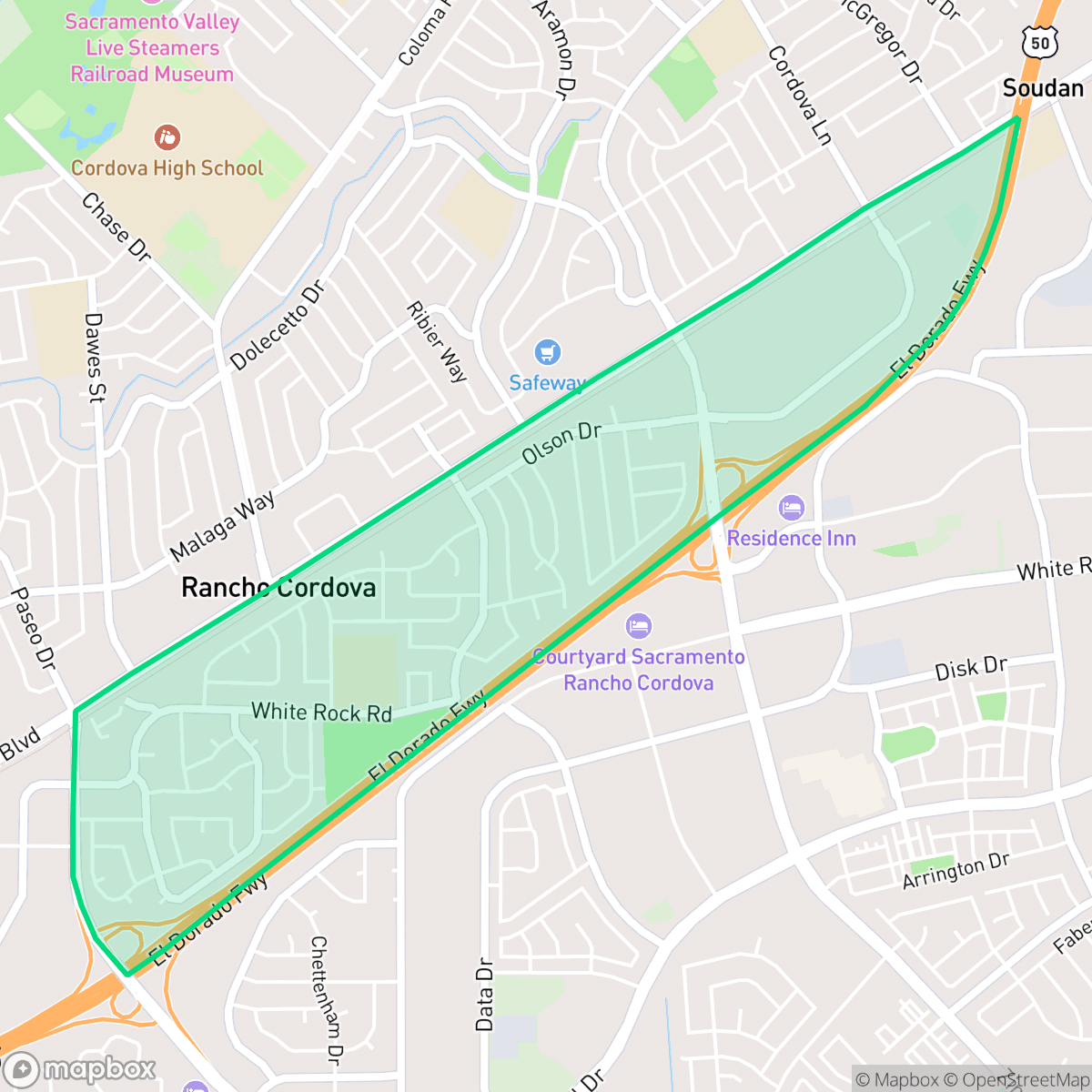
White Rock is a dense suburban community defined by its proximity to major transit corridors and the popular White Rock Neighborhood Park. While residents enjoy a well-connected sidewalk network and easy access to local retail, the area is notably affected by high levels of road traffic noise.
Key Highlights
About White Rock
The White Rock neighborhood in Rancho Cordova is historically anchored by White Rock Road, which originated during the California Gold Rush as the White Rock–Clarksville Immigrant Road. This route was named for a prominent outcropping of white bull quartz that served as a natural landmark and watering oasis for weary miners and travelers heading toward the southern mines. The trail also served as a heavy freight wagon route and a path for the Pony Express, which utilized the nearby Five Mile Station. Today, the preserved geological white rock landmark is protected behind a fence along the paved White Rock Trail. The modern residential neighborhood, developed primarily between 1970 and 1999, features the White Rock Neighborhood Park, home to one of Northern California’s largest splash parks.
The neighborhood functions as a classic suburban hub featuring a mix of single-family homes and multi-story apartment complexes. Residents benefit from consistent sidewalk connectivity, which facilitates travel to local commercial plazas and nearby green spaces. The neighborhood park serves as a central social anchor, particularly for families utilizing its extensive splash pad facilities. According to iHuus data, the area maintains a high degree of residential and retail integration without the presence of heavy industrial hazards.
Prospective residents should account for the acoustic environment, as the proximity to major highways results in elevated traffic noise levels. The area presents a trade-off between its accessible, central location and the challenges of living within a high-traffic corridor. Additionally, while the community is free from heavy industrial activity, it is located in a zone with significant fire safety concerns. Families should also be aware that local schools within the Folsom-Cordova Unified School District face ongoing administrative and academic performance challenges.
Neighborhood Scores Across 15 Qualities
Residential spacing is consistent with the city average, featuring a mix of single-family homes with small yards and higher density apartments with shared walls. According to iHuus data, neighbors are separated by moderate buffers, though some areas feature closely spaced houses with small setbacks.
Sidewalks and clear crosswalks are available throughout most residential and park areas, though large nearby highways act as significant barriers for pedestrians. This level of connectivity is slightly lower than the Rancho Cordova city average.
Standard tract housing and apartment complexes define the landscape, featuring uniform rooflines and small yards. This area offers slightly less visual variety than the Rancho Cordova average, according to iHuus data.
Large public parks and continuous sidewalks provide decent walking opportunities for pets. However, overall dog friendliness is slightly lower than the Rancho Cordova average due to limited connected green space throughout all residential streets.
Open land and scattered homes provide a more rural atmosphere than the typical Rancho Cordova landscape. Residents will find a mix of wooded areas and fields alongside dense suburban pockets, according to iHuus data.
Diverse dining options and local social hubs provide a more active atmosphere than the typical Rancho Cordova neighborhood. While the area features various restaurants and parks, most amenities remain car-dependent due to the presence of light industrial zones and major highways.
Frequent aircraft noise from the nearby airport runway makes this area significantly louder than the Rancho Cordova average. Residents should expect constant acoustic disruption due to immediate proximity to flight paths.
Air quality in this area fluctuates between acceptable and unhealthy levels, matching the average levels seen across Rancho Cordova. Sensitive individuals may experience occasional concerns on certain days, according to iHuus data.
Primarily residential and light commercial, this area lacks heavy industrial warehouses and is slightly cleaner of large-scale manufacturing than the city average. Residents should note the proximity to a nearby Superfund site and potential for utility odors from local service stations, according to iHuus data.
Health insurance enrollment among residents is notable, though slightly lower than the average seen across Rancho Cordova. According to iHuus data, a majority of the population maintains coverage.
Political leanings in this area trend more liberal than the Rancho Cordova average. Residents may find a community with a modest presence of opposing viewpoints, according to iHuus data.
A balanced mix of young adults, families, and older residents characterizes the area. This age distribution is largely consistent with the broader Rancho Cordova population, according to iHuus data.
Flood risk in this area is difficult to precisely determine because FEMA has not yet completed a detailed study for the neighborhood. According to iHuus data, the level of risk appears higher than the average found elsewhere in Rancho Cordova.
Address-Level Insights for White Rock


iHuus Neighborhood Intelligence Insights
Get address-level neighborhood insights for White Rock
- Street-level scores — see how individual blocks compare, not just neighborhood averages
- Micro-zone boundaries — identify quiet pockets, flood boundaries, and walkable clusters before you visit
- 15 dimensions in full — walkability, noise, air quality, school quality, insurance coverage, population age profile, urban/rural index, and more
- Boundary risk alerts — know if your address sits near a block boundary where scores drop, the kind of detail no listing will ever mention
- School insights — individual school ratings and insights, not just district-level data
- Compare before you commit — side-by-side data across neighborhoods, down to block precision
No credit card required
Compare with Any Neighborhood
| Dimension | White Rock | Capital Village |
|---|---|---|
| 🚶 Walkabilityavg 8.57 | ||
| 🔊 Acoustic Comfortavg 3.27 | ||
| 🤫 Privacy Indexavg 5.44 | ||
| 🎨 Visual Appealavg 6.53 | ||
| 🐕 Dog Friendlinessavg 7.28 | ||
| 🗺️ Urban-Rural Indexavg 6.99 | ||
| ✨ Neighborhood Vibeavg 4.41 | ||
| 🏥 Health Insurance Coverageavg 8.03 | ||
| 🌿 Air Qualityavg 5.99 | ||
| 🏭 Industrial Proximityavg 7.66 | ||
| 🌊 Flood Safetyavg 6.4 | ||
| 🗳️ Ideological Leanavg 7.26 | ||
| 👥 Population Age Profileavg 4.84 | ||
| 🔥 Fire Safetyavg 0.44 | ||
| 🏫 School Quality |
White Rock Rankings
School Districts Serving White Rock
School Insights for White Rock
Below average outcomes; significant attendance and academic challenges.
School Insights
See what's really behind every school rating near White Rock
- Individual school ratings — each school's own score with outcome context, not just a district average
- Enrollment & class size data — student-to-teacher ratio and how it compares to the state average
- Full demographics breakdown — ethnicity and gender composition for every school in the enrollment zone
- Every school in the district — all schools within the enrollment boundary ranked by rating, not just the closest one
- Grade levels & benchmarks — elementary through high school, with below/above state-average flags
No credit card required