Cordova Vineyards, Rancho Cordova
Updated · 3,967 residents
Cordova Vineyards is a dense, suburban neighborhood in Rancho Cordova characterized by its mid-century tract housing and grid-like street layout. While the area offers high walkability with established sidewalks and nearby green spaces like Federspiel Park, residents should be aware of moderate traffic noise levels and limited commercial options within walking distance.
Key Highlights
About Cordova Vineyards
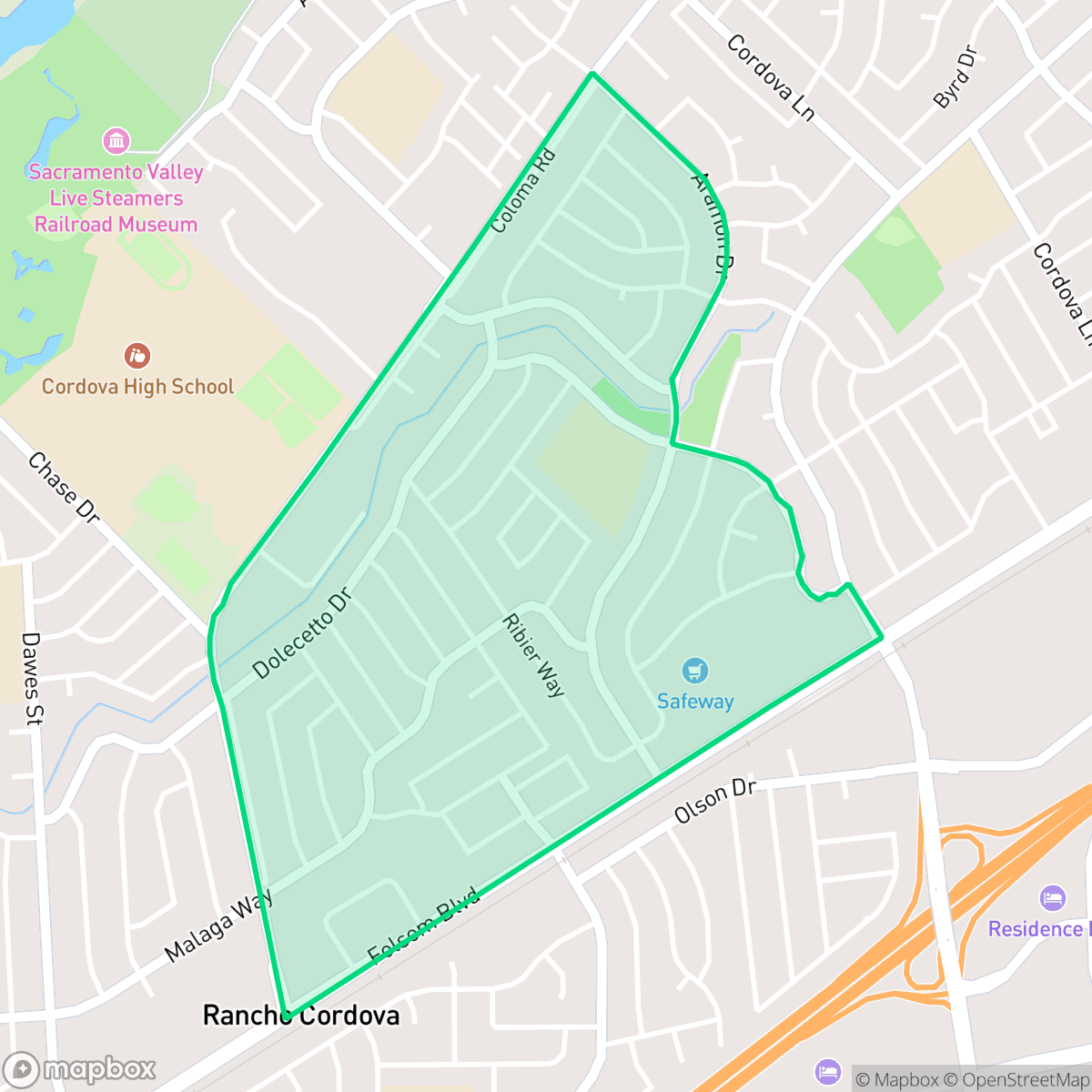
The Cordova Vineyards neighborhood sits on the historic site of the late-19th-century Cordova Vineyards, founded by the Federspiel family, whose wine was famously served at the White House under President Theodore Roosevelt. In the post-World War II era, facing drought and rising taxes, owner Roland Federspiel partnered with Glenn Ahlstrom and builder Jacobsen to transform the agricultural land into one of the region's earliest mass-production housing developments. Construction began in the 1950s at the intersection of Folsom Boulevard and Zinfandel Drive, where the first model homes and sales offices were established. Honoring its viticultural heritage, the neighborhood’s streets—such as Zibibba Way, Furmint Way, Ribier Way, and Aramon Drive—were named after wine grape varieties, preserving the legacy of the original vineyards.
The neighborhood features a classic suburban layout with single-family homes and community schools, maintaining a quiet residential atmosphere. It is well-connected for pedestrians, with consistent sidewalk coverage that makes navigating to local parks and schools straightforward. The area is notably free of industrial hazards, contributing to a stable environment for families and long-term residents. According to iHuus data, the community benefits from strong health insurance coverage and a reliable flood safety profile, making it a practical choice for those prioritizing residential stability over immediate access to dense commercial centers. Living here involves certain trade-offs, such as a lower level of acoustic comfort due to road traffic and relatively close proximity between homes. While the neighborhood provides a solid foundation for suburban life, those seeking a high density of retail or dining options may need to commute to adjacent districts. The area remains a consistent, middle-class residential enclave that balances green space with a functional, pedestrian-friendly street grid.
Neighborhood Scores Across 15 Qualities
Residential spacing offers some buffer between neighbors, though density is slightly higher than the Rancho Cordova average. Homes in certain sections feature close proximity with shared walls or small setbacks.
Established sidewalk networks and pedestrian-friendly cul-de-sacs provide safe routes for walking; however, large nearby highways create notable barriers for crossing major thoroughfares. This level of connectivity is consistent with the city average.
Uniform tract housing and small yards define the landscape, which is typical for the area and slightly below the city average for visual variety. Occasional large homes with swimming pools provide some architectural contrast within the neighborhood.
Large public parks and connected sidewalk networks provide ample space for pet owners. According to iHuus data, these walking options are slightly below the Rancho Cordova average.
Open land and woodland areas are frequently interspersed with scattered homes, providing a more semi-rural atmosphere than the typical suburban density found throughout Rancho Cordova. This layout features a mix of low-density residential pockets and traditional suburban clusters according to iHuus data.
Local amenities and dining options provide more activity than the typical Rancho Cordova area, though the neighborhood remains primarily a quiet, car-dependent suburban setting. Residents can find various restaurants and parks within the vicinity, though many services are located along major transit corridors.
Frequent noise from nearby railroad tracks and heavy freeway traffic is a common occurrence here. According to iHuus data, acoustic conditions in this area are slightly more disruptive than the Rancho Cordova average.
Air quality in this area fluctuates between acceptable and unhealthy levels, which may cause occasional concern for sensitive groups. This level of air quality is consistent with the average found throughout Rancho Cordova.
Residential and educational land uses dominate the area with no detected warehouses or heavy industrial hazards. According to iHuus data, this neighborhood is significantly more free of industrial proximity than the Rancho Cordova average.
Health insurance coverage among residents is high, though slightly lower than the Rancho Cordova average according to iHuus data.
Political leanings in this area are largely liberal, mirroring the broader political landscape found across Rancho Cordova.
A balanced mix of young adults, families, and older residents characterizes the area, mirroring the broader demographic profile seen across Rancho Cordova.
Flood risk in this area is higher than the Rancho Cordova average, as certain sections reside within a 500 year floodplain. Residents should be aware of some residual flood risk according to iHuus data.
Address-Level Insights for Cordova Vineyards


iHuus Neighborhood Intelligence Insights
Get address-level neighborhood insights for Cordova Vineyards
- Street-level scores — see how individual blocks compare, not just neighborhood averages
- Micro-zone boundaries — identify quiet pockets, flood boundaries, and walkable clusters before you visit
- 15 dimensions in full — walkability, noise, air quality, school quality, insurance coverage, population age profile, urban/rural index, and more
- Boundary risk alerts — know if your address sits near a block boundary where scores drop, the kind of detail no listing will ever mention
- School insights — individual school ratings and insights, not just district-level data
- Compare before you commit — side-by-side data across neighborhoods, down to block precision
No credit card required
Compare with Any Neighborhood
| Dimension | Cordova Vineyards | Capital Village |
|---|---|---|
| 🚶 Walkabilityavg 8.57 | ||
| 🔊 Acoustic Comfortavg 3.27 | ||
| 🤫 Privacy Indexavg 5.44 | ||
| 🎨 Visual Appealavg 6.53 | ||
| 🐕 Dog Friendlinessavg 7.28 | ||
| 🗺️ Urban-Rural Indexavg 6.99 | ||
| ✨ Neighborhood Vibeavg 4.41 | ||
| 🏥 Health Insurance Coverageavg 8.03 | ||
| 🌿 Air Qualityavg 5.99 | ||
| 🏭 Industrial Proximityavg 7.66 | ||
| 🌊 Flood Safetyavg 6.4 | ||
| 🗳️ Ideological Leanavg 7.26 | ||
| 👥 Population Age Profileavg 4.84 | ||
| 🔥 Fire Safetyavg 0.44 | ||
| 🏫 School Quality |
Cordova Vineyards Rankings
School Districts Serving Cordova Vineyards
School Insights for Cordova Vineyards
Below average outcomes; significant attendance and academic challenges.
School Insights
See what's really behind every school rating near Cordova Vineyards
- Individual school ratings — each school's own score with outcome context, not just a district average
- Enrollment & class size data — student-to-teacher ratio and how it compares to the state average
- Full demographics breakdown — ethnicity and gender composition for every school in the enrollment zone
- Every school in the district — all schools within the enrollment boundary ranked by rating, not just the closest one
- Grade levels & benchmarks — elementary through high school, with below/above state-average flags
No credit card required