Gregory Gardens, Pleasant Hill
Updated · 5,320 residents
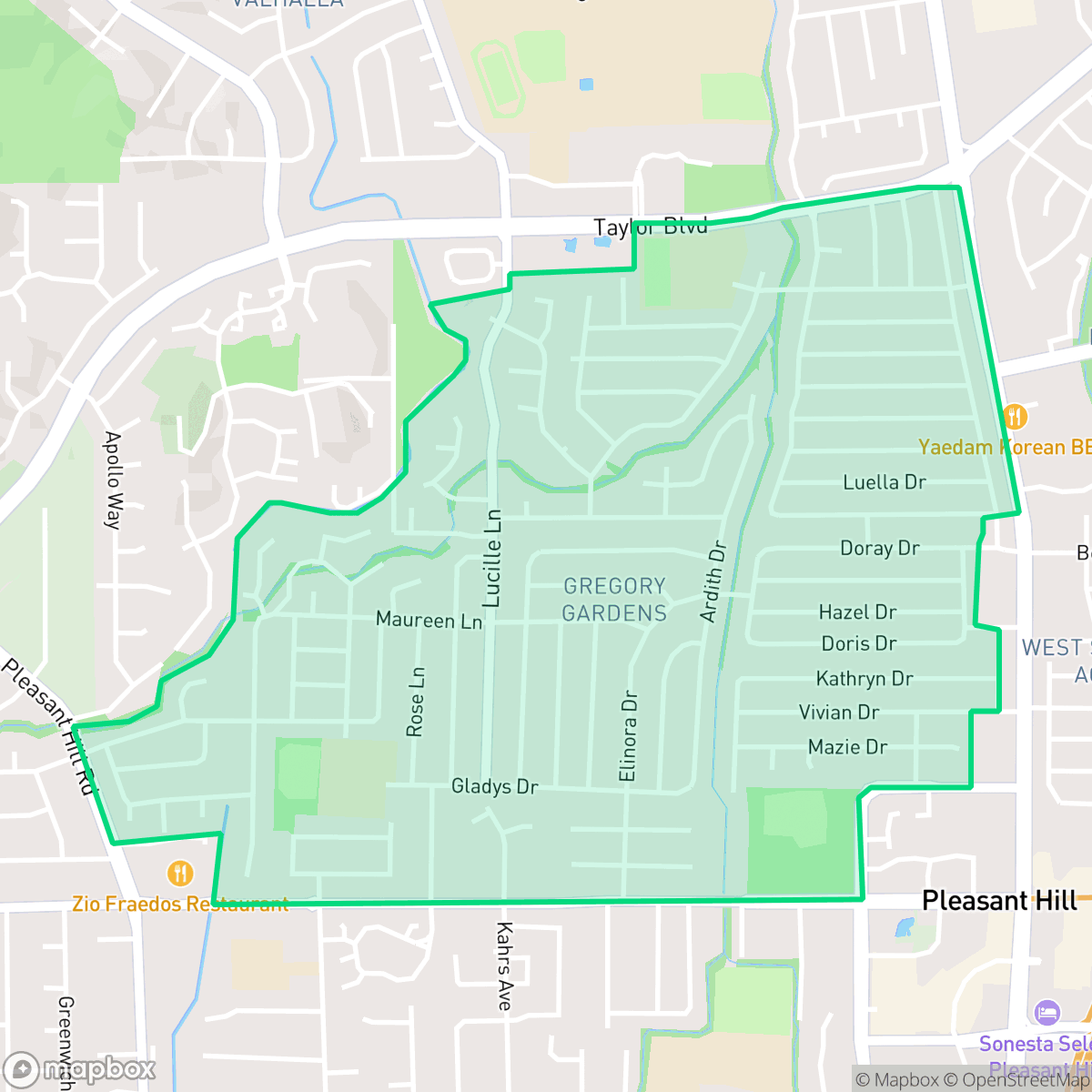
Gregory Gardens is a highly walkable suburban community in Pleasant Hill, characterized by its extensive sidewalk network and proximity to local parks. The neighborhood offers a balanced residential environment with diverse dining options, though residents may experience moderate noise levels due to local road traffic.
Key Highlights
About Gregory Gardens
Developed between 1949 and 1951, Gregory Gardens is a defining post-World War II neighborhood in Pleasant Hill, California. Built on former agricultural fields and drained swampland, the tract originally provided over a thousand modest, single-story mid-century ranch homes marketed to returning veterans utilizing G.I. Bill loans. The minimalistic, sidewalk-free neighborhood featured homes built on concrete slab foundations. Prior to the completion of the Contra Costa Canal, heavy winter rains frequently flooded the area, prompting early residents to paddle down the streets in small boats. Adding to its distinct local character, the developers reportedly named many of the neighborhood’s streets—such as Mary, Ruth, Lucille, and Shirley—after their wives and daughters.
The neighborhood maintains a strong suburban identity defined by its dense layout of single-family homes and apartment complexes. With a high walkability score, the area features continuous sidewalks and clear pedestrian crossings that connect residents to essential amenities, including neighborhood restaurants and green spaces like Pleasant Hill Park. The community is largely residential, providing a stable environment with high rates of health insurance coverage and no proximity to heavy industrial sites or warehouses. Residents benefit from consistent air quality and a well-maintained public infrastructure that supports an active, pedestrian-friendly lifestyle.
Prospective residents should consider the trade-offs of living in this established area, such as the moderate ambient noise levels averaging 60 decibels from road traffic. While the neighborhood provides excellent access to local schools like Strandwood and Gregory Gardens Elementary, the broader school district faces ongoing budgetary and facility challenges. Additionally, the area carries specific environmental risks regarding flood and fire safety that are typical of the region. This neighborhood is well-suited for those who prioritize daily walkability and access to local amenities over absolute acoustic isolation.
Neighborhood Scores Across 15 Qualities
Detached homes feature private yards with a degree of spacing that is slightly above the Pleasant Hill average. Residential structures are closely positioned, typically maintaining a buffer of several meters between neighbors.
Pedestrian movement is easy and safe due to continuous sidewalk networks and clearly marked crossings. This area offers better accessibility for walkers than the Pleasant Hill average according to iHuus data.
Large, well-maintained homes and private amenities contribute to an attractive streetscape that is largely consistent with the city average. According to iHuus data, the area features notable upscale elements such as spacious driveways and frequent backyard pools.
Nearby park access and wide, green-belted paths provide safe walking routes for pets. While slightly below the Pleasant Hill average, the area offers consistent sidewalk verges and mostly fenced private yards.
Frequent open land and scattered homes create a more semi-rural atmosphere compared to the denser suburban layout found elsewhere in Pleasant Hill. According to iHuus data, this area retains pockets of woodland and fields amidst a mix of single-family homes and multi-family complexes.
A balanced mix of quiet residential streets and accessible dining options provides a more active atmosphere than the typical Pleasant Hill neighborhood. According to iHuus data, residents can find a variety of local eateries and green spaces, though many services remain primarily car-dependent.
Frequent auditory disturbances from nearby freeway and railroad traffic characterize this area. According to iHuus data, acoustic comfort is slightly below the Pleasant Hill average.
Air quality remains consistently good with rare instances of elevated readings. According to iHuus data, these conditions are slightly better than the average found throughout Pleasant Hill.
Industrial activity is absent from this area, which consists entirely of residential and light commercial uses. This lack of warehouses or heavy industry makes the neighborhood even more residential than the Pleasant Hill average, according to iHuus data.
Health insurance accessibility is robust in this area, sitting well above the Pleasant Hill average according to iHuus data.
Voting patterns and census indicators in Gregory Gardens align closely with the broader political landscape of Pleasant Hill. According to iHuus data, the neighborhood exhibits a highly liberal ideological lean that is consistent with the city average.
Residents live alongside a diverse mix of young adults, families, and seniors, reflecting a demographic spread very similar to the Pleasant Hill average.
Flood risk levels in this area remain undetermined because a detailed study has not yet been completed by FEMA. According to iHuus data, the potential for flooding is slightly higher than the average for Pleasant Hill.
Address-Level Insights for Gregory Gardens


iHuus Neighborhood Intelligence Insights
Get address-level neighborhood insights for Gregory Gardens
- Street-level scores — see how individual blocks compare, not just neighborhood averages
- Micro-zone boundaries — identify quiet pockets, flood boundaries, and walkable clusters before you visit
- 15 dimensions in full — walkability, noise, air quality, school quality, insurance coverage, population age profile, urban/rural index, and more
- Boundary risk alerts — know if your address sits near a block boundary where scores drop, the kind of detail no listing will ever mention
- School insights — individual school ratings and insights, not just district-level data
- Compare before you commit — side-by-side data across neighborhoods, down to block precision
No credit card required
Compare with Any Neighborhood
| Dimension | Gregory Gardens | Camelback |
|---|---|---|
| 🚶 Walkabilityavg 8.31 | ||
| 🔊 Acoustic Comfortavg 3.54 | ||
| 🤫 Privacy Indexavg 5.86 | ||
| 🎨 Visual Appealavg 7.45 | ||
| 🐕 Dog Friendlinessavg 7.68 | ||
| 🗺️ Urban-Rural Indexavg 6.97 | ||
| ✨ Neighborhood Vibeavg 5.16 | ||
| 🏥 Health Insurance Coverageavg 7.52 | ||
| 🌿 Air Qualityavg 7.92 | ||
| 🏭 Industrial Proximityavg 9.51 | ||
| 🌊 Flood Safetyavg 3.06 | ||
| 🗳️ Ideological Leanavg 9.51 | ||
| 👥 Population Age Profileavg 5.19 | ||
| 🔥 Fire Safetyavg 0.48 | ||
| 🏫 School Quality |
Gregory Gardens Rankings
School Districts Serving Gregory Gardens
School Insights for Gregory Gardens
Below average outcomes; significant attendance and academic challenges.
School Insights
See what's really behind every school rating near Gregory Gardens
- Individual school ratings — each school's own score with outcome context, not just a district average
- Enrollment & class size data — student-to-teacher ratio and how it compares to the state average
- Full demographics breakdown — ethnicity and gender composition for every school in the enrollment zone
- Every school in the district — all schools within the enrollment boundary ranked by rating, not just the closest one
- Grade levels & benchmarks — elementary through high school, with below/above state-average flags
No credit card required