College Park, Pleasant Hill
Updated · 438 residents
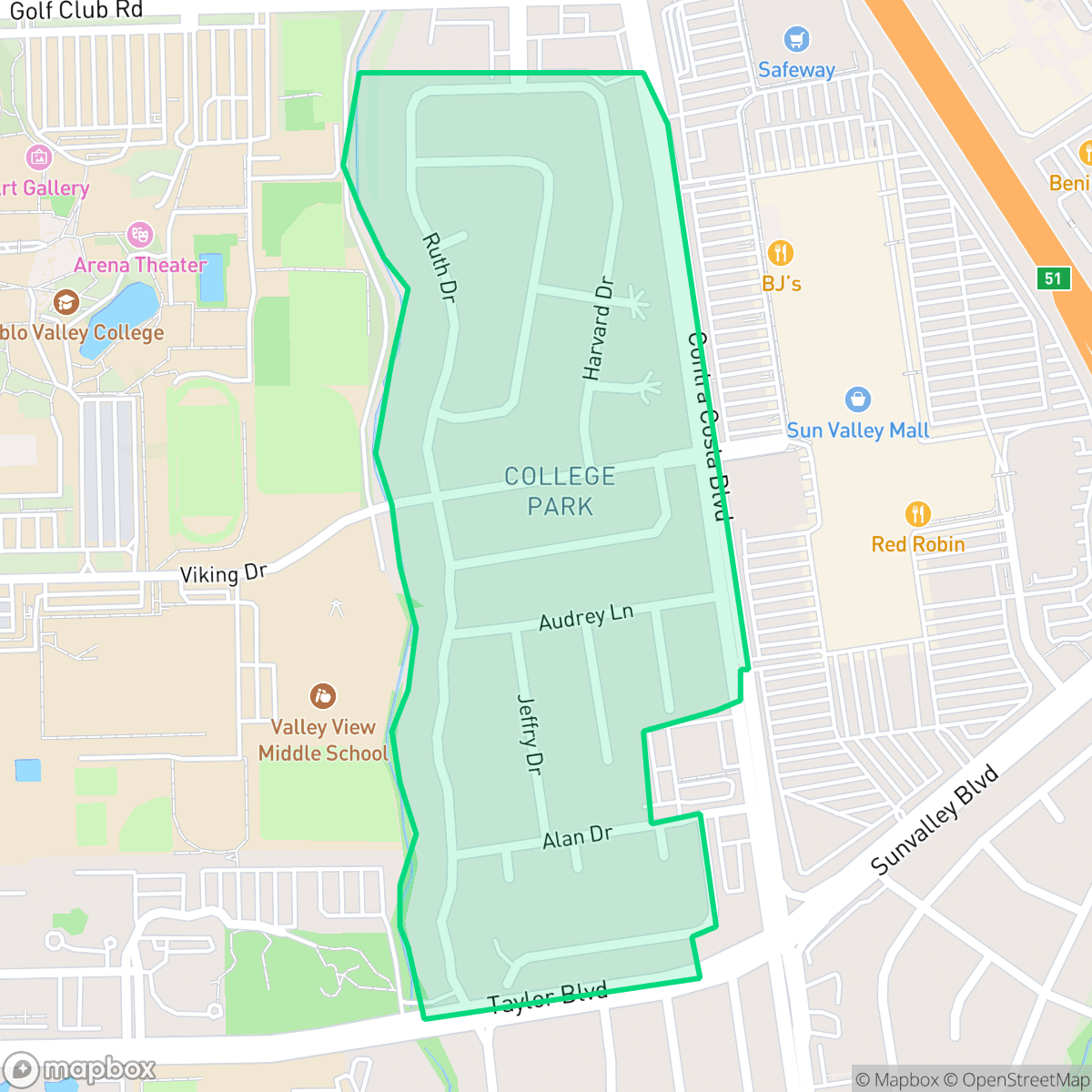
College Park is a highly walkable neighborhood in Pleasant Hill known for its vibrant local dining scene and social atmosphere. While the area offers excellent pedestrian access and clean air, residents should be aware of significant noise from nearby transit corridors and a high risk of flooding.
Key Highlights
About College Park
College Park is characterized by a mix of single-family homes and apartment complexes, creating a suburban environment with a strong social pulse. The neighborhood stands out for its walkability, featuring wide sidewalks and clear crossings that connect residents to various local dining and wellness establishments. According to iHuus data, the community maintains a distinctively liberal ideological lean and hosts a diverse population of young adults, families, and seniors.
Prospective residents should weigh the area's social vibrancy against significant livability trade-offs. The neighborhood experiences frequent acoustic disturbances from the adjacent freeway and railroad tracks, which can impact daily comfort. Additionally, the location falls within a high-hazard zone for flooding, necessitating careful consideration of insurance requirements. Families should also be aware that the local school district faces ongoing budgetary and facility challenges, despite the presence of high-performing campuses within the broader system.
Neighborhood Scores Across 15 Qualities
Residential structures are positioned with mixed spacing, providing some buffer between neighbors. According to iHuus data, this level of separation is roughly consistent with the average across Pleasant Hill.
Pedestrian infrastructure is excellent, featuring wide sidewalks on both sides of streets and clear crossings. This level of walkability is notably higher than the Pleasant Hill average, according to iHuus data.
Uniform tract housing and multi-family units define the landscape, which features less visual variety than the Pleasant Hill average. Most properties consist of tidy yards and standard rooflines, though some areas include shared amenities and small private pools.
Fenced yards and sidewalk verges provide safe walking options, though access to connected green spaces is slightly lower than the Pleasant Hill average.
Residential layouts feature a mix of single-family homes and apartment complexes, though the area is slightly less open than the Pleasant Hill average. According to iHuus data, the landscape lacks the frequent open fields or woodlands found in more semi-rural parts of the city.
Active blocks featuring a notable concentration of local dining and wellness spots create a social atmosphere that is more vibrant than the Pleasant Hill average. According to iHuus data, this area offers a balanced mix of green spaces and accessible commercial units near major transit corridors.
Frequent acoustic disturbances from the nearby freeway and railroad tracks make this area significantly louder than the Pleasant Hill average, according to iHuus data.
Air quality remains consistently clean with very few instances of elevated pollution levels. This neighborhood maintains a standard that is slightly above the Pleasant Hill average, according to iHuus data.
Residential life here is largely undisturbed by heavy industry, though a local brewery may contribute occasional low-level operational noise. This area features slightly more commercial activity than the rest of Pleasant Hill, but it remains significantly more tranquil than the city average.
Health insurance access in this area is lower than the Pleasant Hill average, according to iHuus data.
Voting patterns and census indicators reflect a predominantly liberal community, closely aligning with the broader political landscape of Pleasant Hill.
Residents live alongside a varied demographic of young adults, families, and seniors. This population spread is slightly more concentrated toward younger and middle-aged groups than the Pleasant Hill average, according to iHuus data.
Flood risk in this area is significantly higher than the Pleasant Hill average, as the location falls within a high-hazard zone. Residents should prepare for potentially elevated or prohibitive flood insurance costs according to iHuus data.
Address-Level Insights for College Park


iHuus Neighborhood Intelligence Insights
Get address-level neighborhood insights for College Park
- Street-level scores — see how individual blocks compare, not just neighborhood averages
- Micro-zone boundaries — identify quiet pockets, flood boundaries, and walkable clusters before you visit
- 15 dimensions in full — walkability, noise, air quality, school quality, insurance coverage, population age profile, urban/rural index, and more
- Boundary risk alerts — know if your address sits near a block boundary where scores drop, the kind of detail no listing will ever mention
- School insights — individual school ratings and insights, not just district-level data
- Compare before you commit — side-by-side data across neighborhoods, down to block precision
No credit card required
Compare with Any Neighborhood
| Dimension | College Park | Camelback |
|---|---|---|
| 🚶 Walkabilityavg 8.31 | ||
| 🔊 Acoustic Comfortavg 3.54 | ||
| 🤫 Privacy Indexavg 5.86 | ||
| 🎨 Visual Appealavg 7.45 | ||
| 🐕 Dog Friendlinessavg 7.68 | ||
| 🗺️ Urban-Rural Indexavg 6.97 | ||
| ✨ Neighborhood Vibeavg 5.16 | ||
| 🏥 Health Insurance Coverageavg 7.52 | ||
| 🌿 Air Qualityavg 7.92 | ||
| 🏭 Industrial Proximityavg 9.51 | ||
| 🌊 Flood Safetyavg 3.06 | ||
| 🗳️ Ideological Leanavg 9.51 | ||
| 👥 Population Age Profileavg 5.19 | ||
| 🔥 Fire Safetyavg 0.48 | ||
| 🏫 School Quality |
College Park Rankings
School Districts Serving College Park
School Insights for College Park
Below average outcomes; significant attendance and academic challenges.
School Insights
See what's really behind every school rating near College Park
- Individual school ratings — each school's own score with outcome context, not just a district average
- Enrollment & class size data — student-to-teacher ratio and how it compares to the state average
- Full demographics breakdown — ethnicity and gender composition for every school in the enrollment zone
- Every school in the district — all schools within the enrollment boundary ranked by rating, not just the closest one
- Grade levels & benchmarks — elementary through high school, with below/above state-average flags
No credit card required