Parkway-South Sacramento, Parkway
Updated · 39,988 residents
Parkway-South Sacramento is an established suburban community defined by its mid-century architectural roots and a consistent grid-based street layout. While the area offers a generally walkable residential environment, residents often contend with higher noise levels from nearby transit corridors and proximity to industrial zones.
Key Highlights
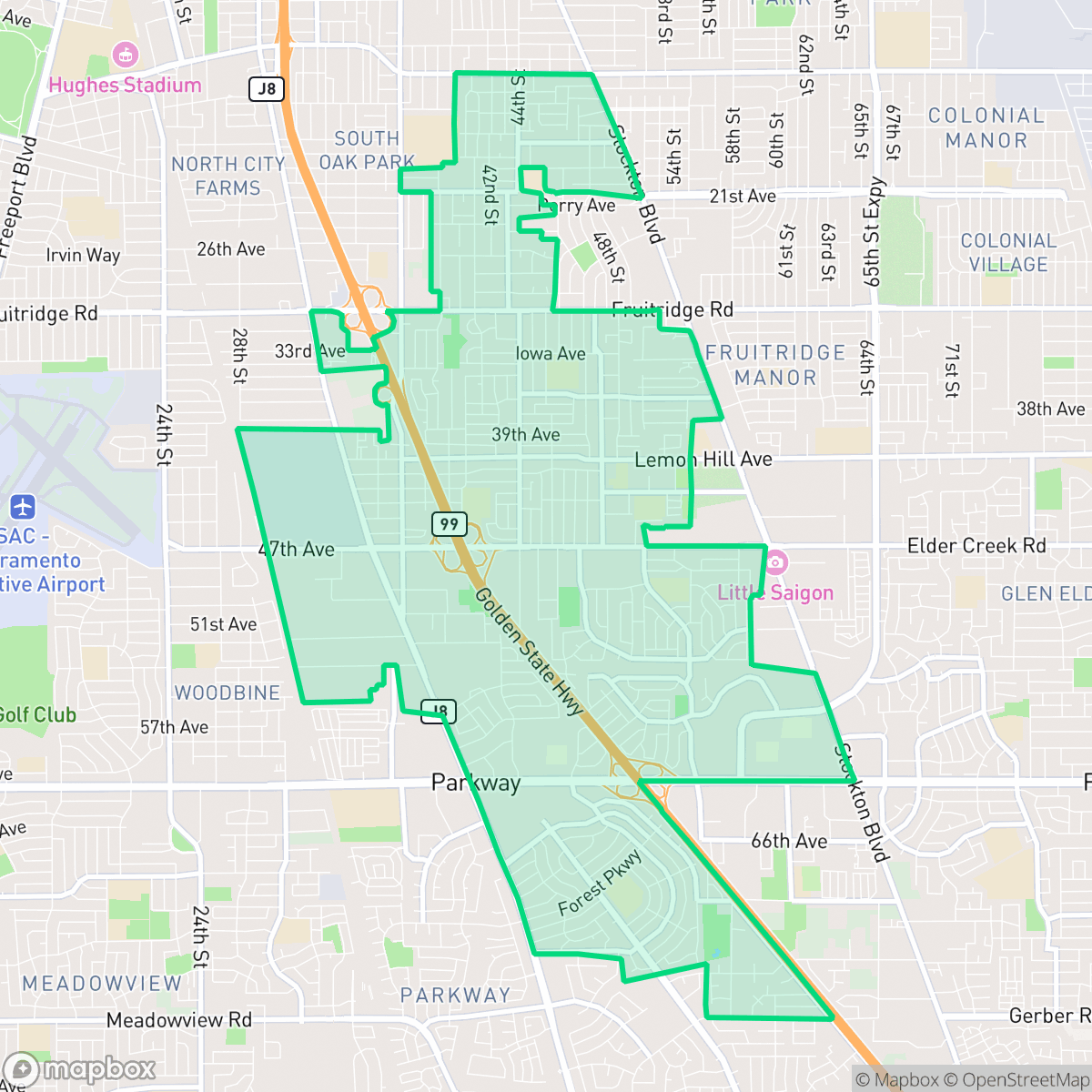
About Parkway-South Sacramento
The history of the Parkway-South Sacramento area is rooted in historic transit corridors like Stockton and Franklin Boulevards, which served as vital routes to farming regions and Stockton during the Gold Rush era. Modern residential development took off in 1953 with the founding of Parkway Estates by Randolph Parks and Associates. Promoted for its cutting-edge post-war architecture, the neighborhood hosted the 1954 Parade of Homes, which was the largest home-building exposition in the West at the time and showcased contemporary ranch and mid-century modern designs. In 1956, local families voted to establish a dedicated park district, which laid the foundation for the expansive Southgate Recreation & Park District. Today, the neighborhood retains its mid-century character, defined by spacious lots, mature trees, and a strong sense of community.
The neighborhood functions as a dense suburban enclave characterized by uniform tract housing and a consistent network of sidewalks. It balances residential life with pockets of light industry and commercial activity, particularly along major transit arteries. According to iHuus data, the area maintains a moderate urban-rural balance, blending single-family residential blocks with essential local services and a variety of dining options.
Prospective residents should note that the area is primarily car-dependent, as major arterial roads and highway infrastructure can disrupt pedestrian connectivity. While the neighborhood provides access to both the Elk Grove and Sacramento City school districts, the acoustic environment is influenced by road traffic, resulting in a moderate noise level. It is well-suited for those seeking a traditional suburban atmosphere with established infrastructure and proximity to regional transit routes.
Neighborhood Scores Across 15 Qualities
Residential spacing is comparable to the Sacramento average, featuring a mix of suburban lots and denser apartment or mobile home clusters. While some areas offer small backyard buffers, certain pockets contain closely packed structures with minimal distance between neighbors.
Consistent sidewalks and low-traffic residential streets provide safe pedestrian routes throughout the neighborhood. According to iHuus data, walkability in this area is slightly higher than the Sacramento average, though major highways and large commercial intersections can create occasional barriers to movement.
Uniform tract housing and apartment complexes define the landscape, featuring consistent rooflines and modest yard sizes. This level of visual variety is typical for the city.
Access to public parks and green verges for pet walking is available but slightly below the Sacramento average. Residents can utilize the central park areas and school fields, though many residential streets feature narrow sidewalks with limited grassy space.
Residential layouts vary from dense suburban grids to low-density areas with significant open space, mirroring the broader city average. This balance of single-family homes, apartments, and light industrial zones creates a transitional landscape between urbanized blocks and more open terrain.
A balanced mix of residential streets and green space provides a steady rhythm of local services and dining. The level of activity and variety of amenities is consistent with the city average.
Frequent noise from nearby railroad tracks and heavy freeway traffic is a common characteristic of this area. This level of acoustic disturbance is consistent with the broader Sacramento average.
Air quality in this area fluctuates between acceptable and unhealthy levels, matching the typical conditions found across Sacramento. Sensitive individuals should monitor local reports for days when air quality presents a concern.
Residential and institutional uses dominate the area with very few heavy industrial hazards or large-scale warehouses visible. According to iHuus data, the lack of significant industrial activity makes this neighborhood slightly more peaceful than the Sacramento average.
Health insurance access in this area is lower than the Sacramento average, according to iHuus data.
Voting patterns and census indicators reflect a predominantly liberal political leaning that is consistent with the city average.
Residents live alongside a balanced mix of young adults, families, and seniors. This demographic spread is consistent with the broader Sacramento area according to iHuus data.
Some residual flood risk exists due to being located within a 500-year floodplain; this level of safety is roughly comparable to the Sacramento city average according to iHuus data.
Address-Level Insights for Parkway-South Sacramento


iHuus Neighborhood Intelligence Insights
Get address-level neighborhood insights for Parkway-South Sacramento
- Street-level scores — see how individual blocks compare, not just neighborhood averages
- Micro-zone boundaries — identify quiet pockets, flood boundaries, and walkable clusters before you visit
- 15 dimensions in full — walkability, noise, air quality, school quality, insurance coverage, population age profile, urban/rural index, and more
- Boundary risk alerts — know if your address sits near a block boundary where scores drop, the kind of detail no listing will ever mention
- School insights — individual school ratings and insights, not just district-level data
- Compare before you commit — side-by-side data across neighborhoods, down to block precision
No credit card required
Compare with Any Neighborhood
| Dimension | Parkway-South Sacramento | Parkway |
|---|---|---|
| 🚶 Walkabilityavg 7.13 | ||
| 🔊 Acoustic Comfortavg 2.86 | ||
| 🤫 Privacy Indexavg 5.31 | ||
| 🎨 Visual Appealavg 5.65 | ||
| 🐕 Dog Friendlinessavg 6 | ||
| 🗺️ Urban-Rural Indexavg 6.55 | ||
| ✨ Neighborhood Vibeavg 4.98 | ||
| 🏥 Health Insurance Coverageavg 6.43 | ||
| 🌿 Air Qualityavg 6 | ||
| 🏭 Industrial Proximityavg 7.1 | ||
| 🌊 Flood Safetyavg 6.73 | ||
| 🗳️ Ideological Leanavg 9.55 | ||
| 👥 Population Age Profileavg 4.5 | ||
| 🔥 Fire Safety | ||
| 🏫 School Quality |
Parkway-South Sacramento Rankings
School Districts Serving Parkway-South Sacramento
School Insights for Parkway-South Sacramento
Below average outcomes; significant attendance and academic challenges.
School Insights
See what's really behind every school rating near Parkway-South Sacramento
- Individual school ratings — each school's own score with outcome context, not just a district average
- Enrollment & class size data — student-to-teacher ratio and how it compares to the state average
- Full demographics breakdown — ethnicity and gender composition for every school in the enrollment zone
- Every school in the district — all schools within the enrollment boundary ranked by rating, not just the closest one
- Grade levels & benchmarks — elementary through high school, with below/above state-average flags
No credit card required