University South, Palo Alto
Updated · 2,903 residents
University South is a highly walkable neighborhood in Palo Alto known for its blend of historic charm and proximity to the city's commercial core. Residents enjoy easy access to local dining and cultural landmarks, though the area experiences moderate noise from road traffic and features densely packed housing.
Key Highlights
About University South
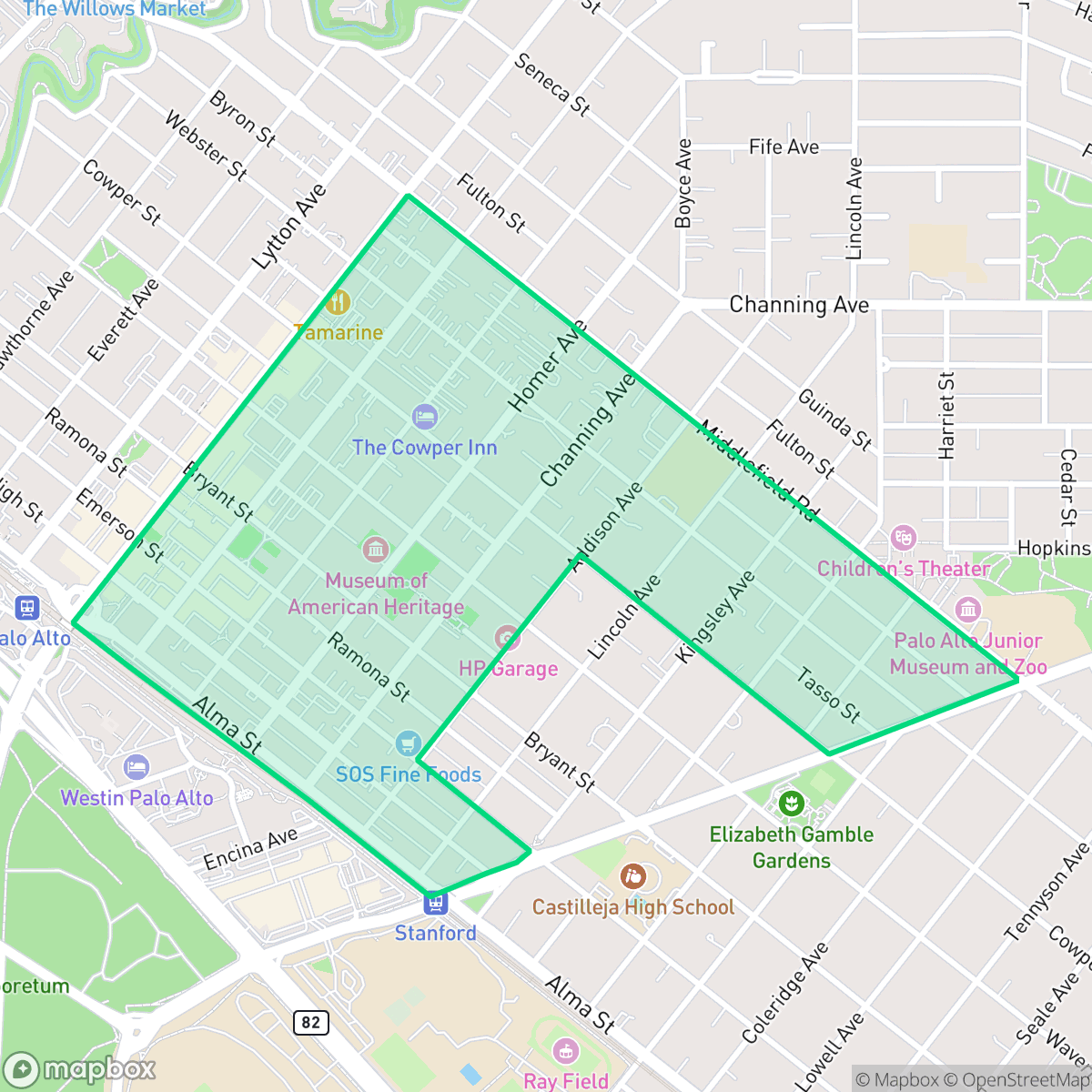
Bounded by University Avenue, Alma Street, Embarcadero Road, and Middlefield Road, Palo Alto’s University South neighborhood is a historic, highly walkable enclave often considered the birthplace of Silicon Valley. It was here, in a garage at 367 Addison Avenue, that Stanford graduates Bill Hewlett and David Packard founded Hewlett-Packard in 1939. Other pioneering residents included transistor co-inventor William Shockley and vacuum-tube inventor Lee de Forest. University South features an eclectic mix of architectural styles, with many residences dating back to the early 20th century. Local landmarks include the Carpenter Gothic-style St. Thomas Aquinas Church, the 1916 Women’s Club of Palo Alto, the Mission Revival-style Roth Building designed by Birge Clark, and the Museum of American Heritage. The neighborhood is also home to the University AME Zion Church, Palo Alto's first African-American church.
The area serves as a central hub in Palo Alto, characterized by its dense, urban-suburban layout and high level of walkability. It maintains a vibrant atmosphere with a variety of dining options and coffee shops located near local parks and museums. The architectural landscape remains diverse, reflecting the area's long-standing history as a significant residential and commercial enclave that balances modern convenience with historic preservation. Living here requires balancing the benefits of a central location against certain urban trade-offs. The neighborhood has a moderate noise profile primarily driven by road traffic, and the proximity of housing units results in limited personal privacy. It is best suited for professionals and families who prioritize pedestrian access to daily amenities and the academic excellence of the Palo Alto Unified School District over quiet, secluded living.
Neighborhood Scores Across 15 Qualities
Residential spacing is consistent with the city average, featuring a mix of densely packed commercial blocks and detached houses with foliage buffers. Some areas may have structures positioned closely together, according to iHuus data.
Continuous sidewalk networks and pedestrian-priority areas make navigating the neighborhood on foot exceptionally easy. This level of accessibility and connectivity for pedestrians is notably higher than the Palo Alto average.
Large, well-maintained homes and high-quality landscaping define the area's aesthetic. This visual character is consistent with the broader Palo Alto average.
Wide, tree-lined residential verges and various green spaces provide safe walking routes away from traffic. While many areas feature small neighborhood parks, the overall dog friendliness is slightly below the Palo Alto city average according to iHuus data.
Mature tree canopies and scattered open spaces define this area, offering a landscape that is slightly less open than the Palo Alto average. Residential blocks transition between dense suburban layouts and pockets of woodland.
Concentrated social hubs and diverse dining options provide a higher level of activity than the Palo Alto average. Residents can access a variety of local cafes, restaurants, and green spaces that create a notably lively suburban atmosphere according to iHuus data.
Steady hum from nearby busy streets defines the acoustic environment. According to iHuus data, this level of noise is notably more noticeable than the average found across Palo Alto.
Air quality in this area fluctuates between acceptable and unhealthy levels, posing occasional concerns for sensitive groups. This level of air quality is consistent with the average found across Palo Alto, according to iHuus data.
Industrial presence is entirely absent here, providing a purely residential and institutional environment that is cleaner than the Palo Alto average. No warehouses, factories, or hazardous industrial sites were detected within the neighborhood boundaries.
Nearly all residents are covered by health insurance, representing a level of coverage that is slightly above the Palo Alto average according to iHuus data.
Voting patterns and census indicators reflect a deeply liberal political leaning that is consistent with the broader Palo Alto area. According to iHuus data, this ideological trend aligns closely with the citywide average.
Residents will find a balanced demographic of young adults, families, and older adults. This age distribution is slightly more varied than the typical profile found across Palo Alto.
Properties in this area are situated within a designated floodplain, which means residents may face a higher risk of flooding and likely require flood insurance. According to iHuus data, this risk level is notably higher than the average found across Palo Alto.
Address-Level Insights for University South


iHuus Neighborhood Intelligence Insights
Get address-level neighborhood insights for University South
- Street-level scores — see how individual blocks compare, not just neighborhood averages
- Micro-zone boundaries — identify quiet pockets, flood boundaries, and walkable clusters before you visit
- 15 dimensions in full — walkability, noise, air quality, school quality, insurance coverage, population age profile, urban/rural index, and more
- Boundary risk alerts — know if your address sits near a block boundary where scores drop, the kind of detail no listing will ever mention
- School insights — individual school ratings and insights, not just district-level data
- Compare before you commit — side-by-side data across neighborhoods, down to block precision
No credit card required
Compare with Any Neighborhood
| Dimension | University South | Adobe Meadow - Meadow Park |
|---|---|---|
| 🚶 Walkabilityavg 8.94 | ||
| 🔊 Acoustic Comfortavg 3.51 | ||
| 🤫 Privacy Indexavg 5.96 | ||
| 🎨 Visual Appealavg 7.97 | ||
| 🐕 Dog Friendlinessavg 7.6 | ||
| 🗺️ Urban-Rural Indexavg 6.74 | ||
| ✨ Neighborhood Vibeavg 4.82 | ||
| 🏥 Health Insurance Coverageavg 9.05 | ||
| 🌿 Air Qualityavg 6.03 | ||
| 🏭 Industrial Proximityavg 8.67 | ||
| 🌊 Flood Safetyavg 3.52 | ||
| 🗳️ Ideological Leanavg 9.81 | ||
| 👥 Population Age Profileavg 5.03 | ||
| 🔥 Fire Safety | ||
| 🏫 School Quality |
University South Rankings
School Districts Serving University South
School Insights for University South
Below average outcomes; significant attendance and academic challenges.
School Insights
See what's really behind every school rating near University South
- Individual school ratings — each school's own score with outcome context, not just a district average
- Enrollment & class size data — student-to-teacher ratio and how it compares to the state average
- Full demographics breakdown — ethnicity and gender composition for every school in the enrollment zone
- Every school in the district — all schools within the enrollment boundary ranked by rating, not just the closest one
- Grade levels & benchmarks — elementary through high school, with below/above state-average flags
No credit card required