South of Midtown, Palo Alto
Updated · 2,696 residents
South of Midtown is an exceptionally walkable Palo Alto neighborhood characterized by its dense grid of streets and mature tree canopy. While the area provides excellent access to top-rated public schools and local parks, residents should be aware of the consistent noise levels originating from nearby road traffic and the transit corridor. The community maintains a quiet, suburban atmosphere defined by its well-manicured landscaping and residential focus.
Key Highlights
About South of Midtown
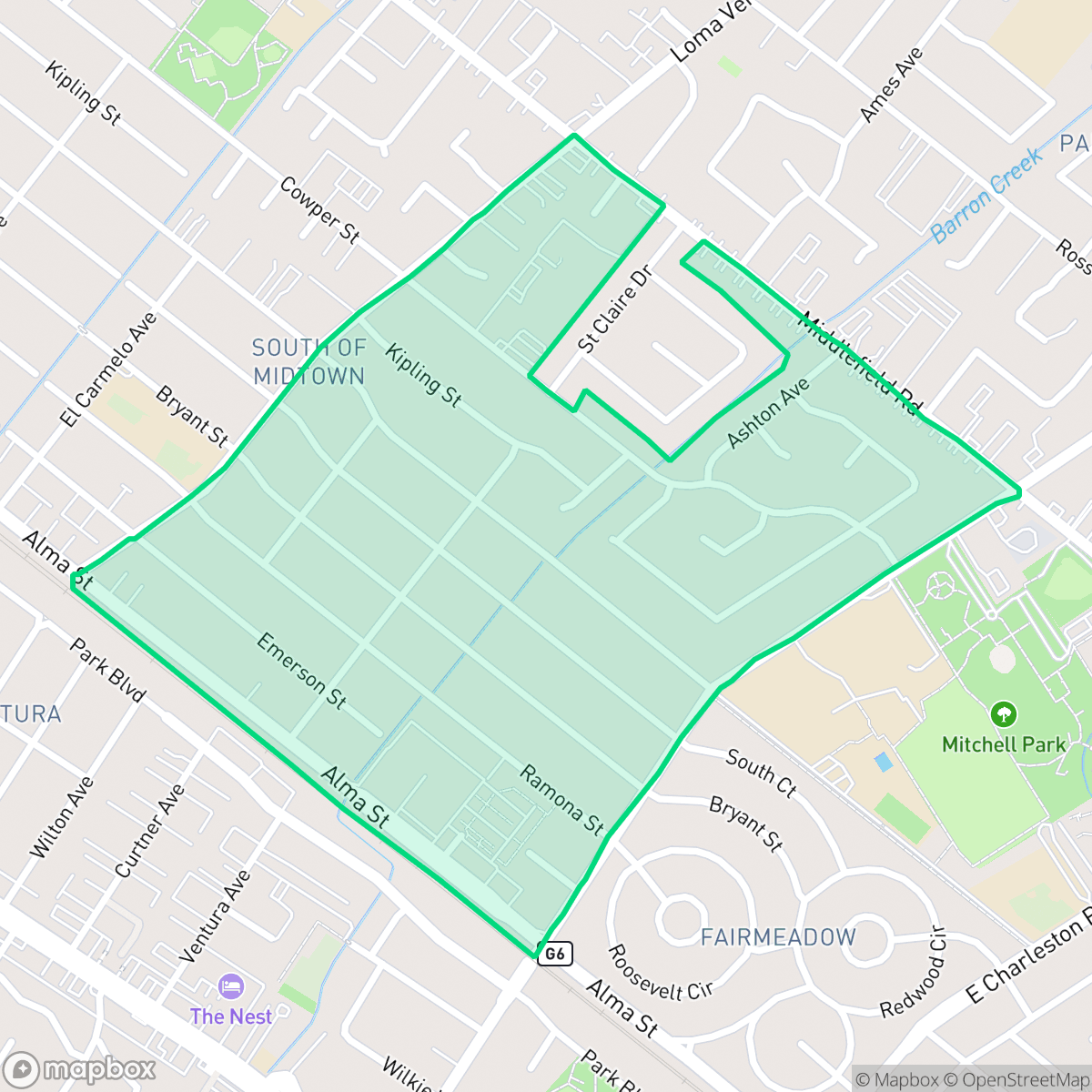
Bounded by Middlefield Road, Loma Verde Avenue, Alma Street, and East Meadow Drive, the South of Midtown neighborhood in Palo Alto is a peaceful, pedestrian-friendly residential community. While some homes in the area date back to the 1930s, the neighborhood's architectural character is primarily defined by post-World War II, single-story "California Modern" Eichler homes built by developer Joseph Eichler starting in the 1950s. Bounded by the active transit corridor of Alma Street and the quieter commercial strip of Middlefield Road, the neighborhood offers a balanced, family-oriented environment. In recent years, balancing the preservation of these historic mid-century modern Eichlers against the construction of larger, contemporary homes has become a central community focus.
The neighborhood functions as a dense suburban enclave, offering a high degree of connectivity through its pedestrian-friendly layout. Residents benefit from proximity to elite educational facilities within the Palo Alto Unified School District, which remains a primary draw for families. The area is marked by a consistent visual appeal, featuring lush greenery and private outdoor spaces that contribute to a high quality of life. As a purely residential and institutional zone, the environment is free from industrial hazards, fostering a stable and safe living space.
Prospective residents should consider the trade-offs regarding acoustic comfort and privacy. Due to the proximity of major transit routes, the neighborhood experiences elevated noise levels, averaging 64 decibels. Additionally, the high density of the area means that homes are often positioned closely together, which may limit personal privacy compared to more spacious suburban settings. This neighborhood is best suited for families and professionals who prioritize school quality and walkability over absolute acoustic solitude.
Neighborhood Scores Across 15 Qualities
Residential spacing is relatively dense with houses situated close to one another, making the privacy level slightly lower than the Palo Alto average. According to iHuus data, some areas feature minimal separation between structures, though many properties still maintain moderate setbacks.
Continuous sidewalks and frequent pedestrian crossings make navigating the area on foot easy. This neighborhood offers a more walkable environment than the Palo Alto average due to its dense sidewalk network and proximity to local parks.
Large homes with well-maintained landscaping and numerous private backyard pools define the local scenery. This area is consistent with the broader Palo Alto average for visual quality.
Continuous sidewalks with green verges and access to public parks with sports fields provide ample space for pets. While the area offers many pleasant walking routes, the overall dog friendliness is slightly below the Palo Alto average.
Suburban development here features a mix of single-family homes and multi-story apartment complexes within a significant tree canopy. According to iHuus data, the area is slightly less open than the Palo Alto average, leaning more toward a built-up residential landscape.
Residential streets and green spaces create a serene atmosphere, though local activity levels are lower than the Palo Alto average. While some dining and parks are reachable on foot, many essential services require a car.
Frequent acoustic disturbances occur due to the neighborhood's proximity to major freeway corridors and railroad tracks. This level of noise is consistent with the average experienced across Palo Alto.
Air quality in this area fluctuates between acceptable and unhealthy levels, mirroring the broader Palo Alto average. Sensitive groups should remain mindful of occasional periods of poor air quality according to iHuus data.
Heavy industrial presence and large warehouses are absent from this area, matching the city average for low industrial density. Residents should note that a nearby EPA Superfund site exists, which may involve potential soil or groundwater contaminants according to iHuus data.
Health insurance access is nearly universal among residents, mirroring the high levels found across Palo Alto. According to iHuus data, coverage rates in this area are consistent with the city average.
Voting patterns and census indicators reflect a very liberal political leaning, slightly higher than the Palo Alto average according to iHuus data.
Residents live alongside a balanced mix of young professionals, families, and older adults. This demographic spread is consistent with the broader Palo Alto area.
Flood risk in this area is higher than the Palo Alto average, though official FEMA assessments for this specific neighborhood remain incomplete.
Address-Level Insights for South of Midtown


iHuus Neighborhood Intelligence Insights
Get address-level neighborhood insights for South of Midtown
- Street-level scores — see how individual blocks compare, not just neighborhood averages
- Micro-zone boundaries — identify quiet pockets, flood boundaries, and walkable clusters before you visit
- 15 dimensions in full — walkability, noise, air quality, school quality, insurance coverage, population age profile, urban/rural index, and more
- Boundary risk alerts — know if your address sits near a block boundary where scores drop, the kind of detail no listing will ever mention
- School insights — individual school ratings and insights, not just district-level data
- Compare before you commit — side-by-side data across neighborhoods, down to block precision
No credit card required
Compare with Any Neighborhood
| Dimension | South of Midtown | Adobe Meadow - Meadow Park |
|---|---|---|
| 🚶 Walkabilityavg 8.94 | ||
| 🔊 Acoustic Comfortavg 3.51 | ||
| 🤫 Privacy Indexavg 5.96 | ||
| 🎨 Visual Appealavg 7.97 | ||
| 🐕 Dog Friendlinessavg 7.6 | ||
| 🗺️ Urban-Rural Indexavg 6.74 | ||
| ✨ Neighborhood Vibeavg 4.82 | ||
| 🏥 Health Insurance Coverageavg 9.05 | ||
| 🌿 Air Qualityavg 6.03 | ||
| 🏭 Industrial Proximityavg 8.67 | ||
| 🌊 Flood Safetyavg 3.52 | ||
| 🗳️ Ideological Leanavg 9.81 | ||
| 👥 Population Age Profileavg 5.03 | ||
| 🔥 Fire Safety | ||
| 🏫 School Quality |
South of Midtown Rankings
School Districts Serving South of Midtown
School Insights for South of Midtown
Below average outcomes; significant attendance and academic challenges.
School Insights
See what's really behind every school rating near South of Midtown
- Individual school ratings — each school's own score with outcome context, not just a district average
- Enrollment & class size data — student-to-teacher ratio and how it compares to the state average
- Full demographics breakdown — ethnicity and gender composition for every school in the enrollment zone
- Every school in the district — all schools within the enrollment boundary ranked by rating, not just the closest one
- Grade levels & benchmarks — elementary through high school, with below/above state-average flags
No credit card required