Palo Verde, Palo Alto
Updated · 2,564 residents
Palo Verde is a quiet, mid-century residential enclave known for its architectural integrity and proximity to top-tier schools in the Palo Alto Unified School District. The area offers a highly walkable environment with consistent sidewalks, though residents should note the modest privacy provided by its dense suburban layout and potential concerns regarding nearby environmental sites.
Key Highlights
About Palo Verde
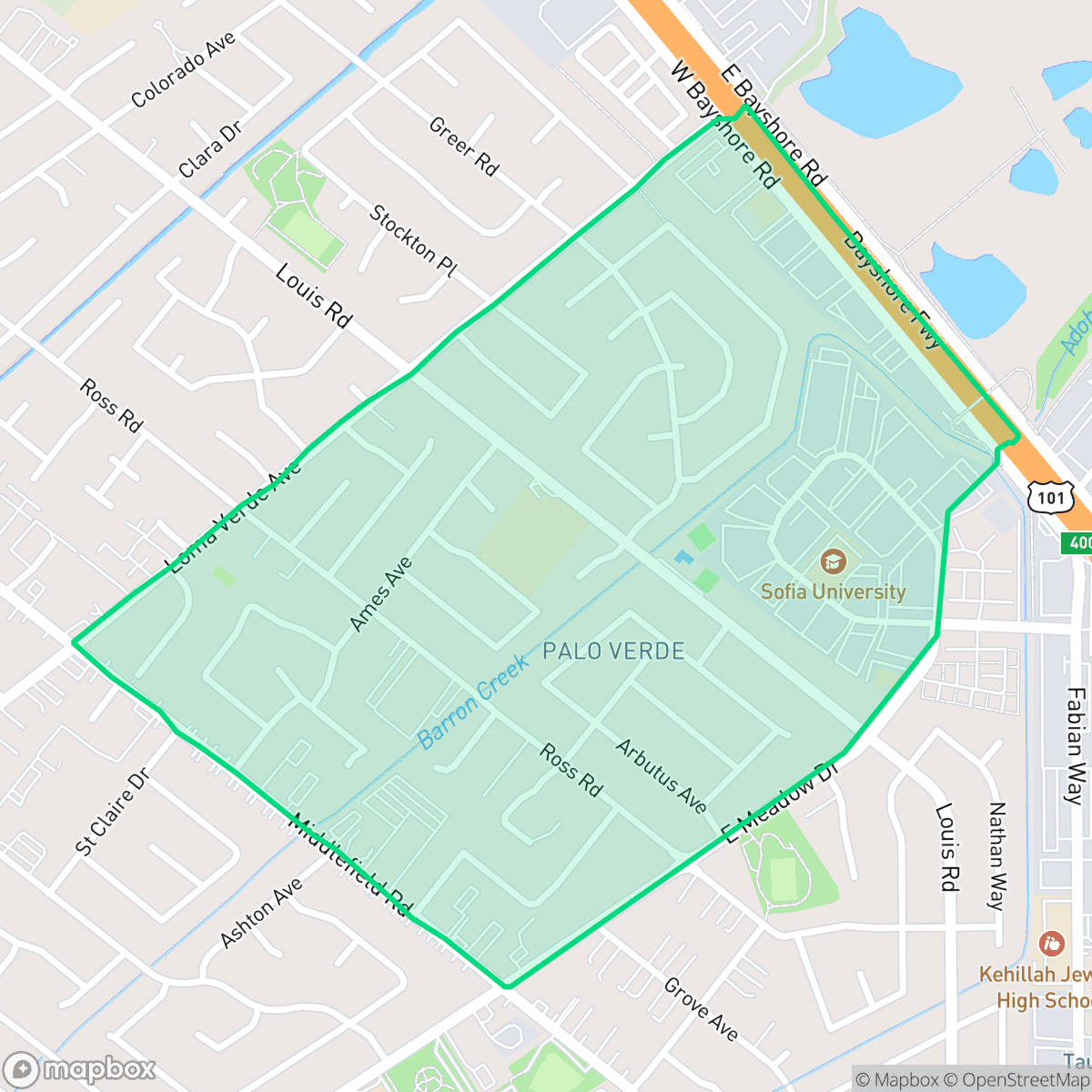
The Palo Verde neighborhood in Palo Alto, California, is a mid-century enclave primarily developed between 1957 and 1958 by renowned modernist builder Joseph Eichler. Though originally mapped under the names "Royal Manor" and "Faircourt," the 202-home tract eventually adopted the name Palo Verde from the nearby elementary school. The neighborhood is architecturally defined by classic Eichler homes featuring post-and-beam construction, flat roofs, and floor-to-ceiling glass walls, interspersed with traditional ranch-style houses. Palo Verde's community-centric design is anchored by the Eichler Swim and Tennis Club on Louis Road and the central Palo Verde Park. Additionally, the neighborhood is bisected by the Bryant Street Bike Boulevard, a dedicated, resident-friendly cycling corridor that underscores the area’s long-standing affinity for outdoor living and neighborhood connectivity.
Palo Verde functions as a tranquil, suburban pocket of Palo Alto, characterized by a low-key atmosphere that prioritizes residential comfort. The area benefits from excellent health insurance coverage and consistent, pedestrian-friendly infrastructure, making it a functional choice for those who value daily walkability. While the neighborhood maintains a relatively quiet acoustic profile, the daily rhythm is largely defined by local residential life rather than commercial activity, as businesses are limited in the immediate vicinity.
Living in this enclave requires balancing the benefits of a premier school district with specific environmental considerations. The proximity to an EPA Superfund site necessitates awareness of potential soil and groundwater conditions. According to iHuus data, the tight spacing between homes results in limited privacy, which is a common trade-off in this dense, mid-century development. It is best suited for families or professionals who prioritize academic access and a stable, quiet environment over high-density urban amenities.
Neighborhood Scores Across 15 Qualities
Residential structures feature typical suburban spacing with moderate separation between neighbors. This level of density is consistent with the Palo Alto average according to iHuus data.
Continuous sidewalks on both sides of most streets and clear pedestrian crossings make navigating the area on foot easy. According to iHuus data, the level of walkability in Palo Verde is notably higher than the Palo Alto city average.
Large homes with complex architecture and well-maintained landscaping define the landscape, matching the city average for visual quality. Many properties feature private backyard pools and spacious, manicured grounds according to iHuus data.
Continuous sidewalks with wide green verges and nearby public parks provide safe, accessible routes for pets. While highly functional, these amenities are slightly below the Palo Alto average.
Vast wetlands and open spaces characterize much of the area, providing a sense of openness that is slightly more rural than the Palo Alto average. This landscape features a mix of dense suburban development and scattered homes situated near woodland and fields, according to iHuus data.
Low levels of social activity and a lack of nearby commercial hubs make this area significantly less lively than the Palo Alto average. Residents should expect a quiet, suburban environment that primarily relies on vehicles to reach most businesses and services.
Steady sounds from nearby busy streets are present, though the area remains significantly quieter than the Palo Alto average according to iHuus data.
Air quality in this area fluctuates between acceptable and unhealthy levels, occasionally posing risks to sensitive groups. According to iHuus data, conditions are slightly less favorable than the Palo Alto average.
Light commercial activity is present, but the proximity to a nearby EPA Superfund site may result in potential soil or groundwater contamination. This neighborhood has a higher presence of industrial-related concerns than the Palo Alto average.
Nearly all residents are covered by health insurance, representing a rate that is higher than the Palo Alto average according to iHuus data.
Voting patterns and census indicators show a deeply liberal leaning that is consistent with the broader Palo Alto area, according to iHuus data.
Residents live among a diverse range of age groups, including young professionals, families, and seniors. This demographic spread is slightly more varied than the typical age distribution found across Palo Alto.
Significant flood and wave action risks exist here because the area is located within a coastal high-hazard zone. According to iHuus data, this risk level is substantially higher than the Palo Alto city average and may result in elevated insurance costs.
Address-Level Insights for Palo Verde


iHuus Neighborhood Intelligence Insights
Get address-level neighborhood insights for Palo Verde
- Street-level scores — see how individual blocks compare, not just neighborhood averages
- Micro-zone boundaries — identify quiet pockets, flood boundaries, and walkable clusters before you visit
- 15 dimensions in full — walkability, noise, air quality, school quality, insurance coverage, population age profile, urban/rural index, and more
- Boundary risk alerts — know if your address sits near a block boundary where scores drop, the kind of detail no listing will ever mention
- School insights — individual school ratings and insights, not just district-level data
- Compare before you commit — side-by-side data across neighborhoods, down to block precision
No credit card required
Compare with Any Neighborhood
| Dimension | Palo Verde | Adobe Meadow - Meadow Park |
|---|---|---|
| 🚶 Walkabilityavg 8.94 | ||
| 🔊 Acoustic Comfortavg 3.51 | ||
| 🤫 Privacy Indexavg 5.96 | ||
| 🎨 Visual Appealavg 7.97 | ||
| 🐕 Dog Friendlinessavg 7.6 | ||
| 🗺️ Urban-Rural Indexavg 6.74 | ||
| ✨ Neighborhood Vibeavg 4.82 | ||
| 🏥 Health Insurance Coverageavg 9.05 | ||
| 🌿 Air Qualityavg 6.03 | ||
| 🏭 Industrial Proximityavg 8.67 | ||
| 🌊 Flood Safetyavg 3.52 | ||
| 🗳️ Ideological Leanavg 9.81 | ||
| 👥 Population Age Profileavg 5.03 | ||
| 🔥 Fire Safety | ||
| 🏫 School Quality |
Palo Verde Rankings
School Districts Serving Palo Verde
School Insights for Palo Verde
Below average outcomes; significant attendance and academic challenges.
School Insights
See what's really behind every school rating near Palo Verde
- Individual school ratings — each school's own score with outcome context, not just a district average
- Enrollment & class size data — student-to-teacher ratio and how it compares to the state average
- Full demographics breakdown — ethnicity and gender composition for every school in the enrollment zone
- Every school in the district — all schools within the enrollment boundary ranked by rating, not just the closest one
- Grade levels & benchmarks — elementary through high school, with below/above state-average flags
No credit card required