Old Palo Alto, Palo Alto
Updated · 3,721 residents
Old Palo Alto is a prestigious residential enclave defined by its tree-lined streets and diverse, high-end architectural heritage. While the neighborhood offers a tranquil environment with excellent access to elite schools, residents experience moderate walkability and average levels of privacy compared to the broader city.
Key Highlights
About Old Palo Alto
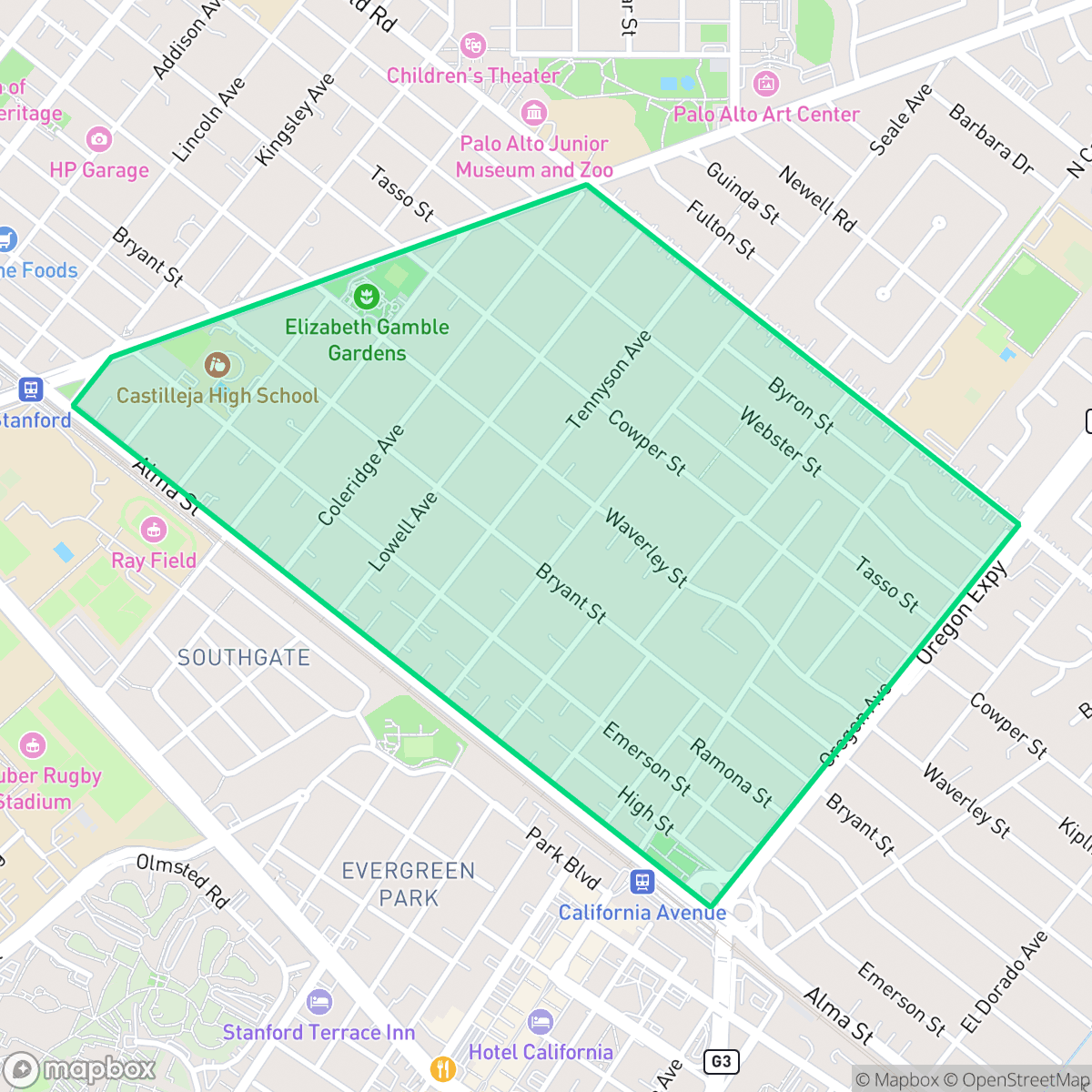
Old Palo Alto traces its origins to the 19th-century Rancho Rinconada del Arroyo de San Francisquito land grant. Developed as a premier residential enclave near Stanford University, its first home was built for the Gamble family of Procter & Gamble. Today, the 2.5-acre Elizabeth F. Gamble Garden, featuring a 1902 Colonial Revival main house, serves as a historic public landmark. The neighborhood is renowned for its diverse, high-end architecture, displaying an exceptional array of Tudor Revival, Mediterranean, and Spanish Colonial Revival designs, including several masterworks by prominent local architects Birge Clark and Pedro de Lemos. Historically a haven for intellectual and industrial pioneers, Old Palo Alto has maintained its quiet, tree-canopied character while serving as the home of modern tech icons like Steve Jobs and Larry Page.
The area is characterized by spacious, well-maintained lots and a strong sense of community, anchored by proximity to top-tier academic institutions within the Palo Alto Unified School District. According to iHuus data, the neighborhood maintains a high visual appeal score, reflecting its commitment to preserving its unique architectural character and lush, canopy-covered streets. It functions primarily as a quiet, residential retreat, benefiting from minimal industrial proximity and a high rate of health insurance coverage among its residents.
Prospective residents should note that while the neighborhood provides a serene atmosphere, it is less walkable than other parts of the city and offers limited amenities for dog owners. The acoustic environment is generally comfortable, though road traffic remains the primary source of ambient noise. Given its strong school performance, the area is particularly well-suited for families seeking long-term stability and a quiet, suburban lifestyle within a short distance of major tech hubs.
Neighborhood Scores Across 15 Qualities
Detached homes feature moderate setbacks with consistent spacing between neighbors. This level of separation is typical for the city average, providing a balanced mix of open space and suburban density.
Wide sidewalks and clear pedestrian crossings are available throughout the neighborhood, making it more accessible for walkers than the Palo Alto average. A complete sidewalk network on both sides of the streets provides easy navigation through residential and commercial zones.
Large home footprints, private pools, and lush, meticulously landscaped lots provide a high level of greenery and aesthetic quality. This level of visual amenity is consistent with the city average for Palo Alto.
Wide green verges and multiple public parks provide ample, safe space for pet owners. While highly accessible for walking, this area sits slightly below the city average for dog friendliness according to iHuus data.
Mature tree canopies and scattered open spaces create a lush, semi-rural feel that is slightly more wooded than the Palo Alto average. This dense suburban layout provides a balance of single-family homes and integrated greenery according to iHuus data.
Local social hubs and dining options provide a more active atmosphere than the typical Palo Alto neighborhood. While many blocks remain quiet and residential, there is a noticeable presence of community landmarks and leisure businesses throughout the area.
Frequent noise from nearby transit corridors and major roadways can be disruptive. According to iHuus data, acoustic comfort in this area is slightly lower than the Palo Alto average.
Air quality levels in this area are consistent with the Palo Alto average. Residents may experience occasional periods of concern for sensitive groups during certain weather conditions, according to iHuus data.
Residential and light commercial structures comprise the entirety of this area, with no warehouses or hazardous industrial sites detected. This lack of heavy industry provides a cleaner environment than the Palo Alto average, according to iHuus data.
Nearly all residents are covered by health insurance plans, which is slightly below the Palo Alto average.
Voting patterns and census indicators reflect a predominantly liberal political leaning, consistent with the broader Palo Alto area.
A diverse range of age groups exists here, including young adults, families, and older residents. This demographic spread is slightly more varied than the Palo Alto city average, according to iHuus data.
Properties are located within a designated floodplain, which may necessitate flood insurance. This level of risk is slightly higher than the average for Palo Alto, according to iHuus data.
Address-Level Insights for Old Palo Alto


iHuus Neighborhood Intelligence Insights
Get address-level neighborhood insights for Old Palo Alto
- Street-level scores — see how individual blocks compare, not just neighborhood averages
- Micro-zone boundaries — identify quiet pockets, flood boundaries, and walkable clusters before you visit
- 15 dimensions in full — walkability, noise, air quality, school quality, insurance coverage, population age profile, urban/rural index, and more
- Boundary risk alerts — know if your address sits near a block boundary where scores drop, the kind of detail no listing will ever mention
- School insights — individual school ratings and insights, not just district-level data
- Compare before you commit — side-by-side data across neighborhoods, down to block precision
No credit card required
Compare with Any Neighborhood
| Dimension | Old Palo Alto | Adobe Meadow - Meadow Park |
|---|---|---|
| 🚶 Walkabilityavg 8.94 | ||
| 🔊 Acoustic Comfortavg 3.51 | ||
| 🤫 Privacy Indexavg 5.96 | ||
| 🎨 Visual Appealavg 7.97 | ||
| 🐕 Dog Friendlinessavg 7.6 | ||
| 🗺️ Urban-Rural Indexavg 6.74 | ||
| ✨ Neighborhood Vibeavg 4.82 | ||
| 🏥 Health Insurance Coverageavg 9.05 | ||
| 🌿 Air Qualityavg 6.03 | ||
| 🏭 Industrial Proximityavg 8.67 | ||
| 🌊 Flood Safetyavg 3.52 | ||
| 🗳️ Ideological Leanavg 9.81 | ||
| 👥 Population Age Profileavg 5.03 | ||
| 🔥 Fire Safety | ||
| 🏫 School Quality |
Old Palo Alto Rankings
School Districts Serving Old Palo Alto
School Insights for Old Palo Alto
Below average outcomes; significant attendance and academic challenges.
School Insights
See what's really behind every school rating near Old Palo Alto
- Individual school ratings — each school's own score with outcome context, not just a district average
- Enrollment & class size data — student-to-teacher ratio and how it compares to the state average
- Full demographics breakdown — ethnicity and gender composition for every school in the enrollment zone
- Every school in the district — all schools within the enrollment boundary ranked by rating, not just the closest one
- Grade levels & benchmarks — elementary through high school, with below/above state-average flags
No credit card required