Midtown, Palo Alto
Updated · 9,961 residents
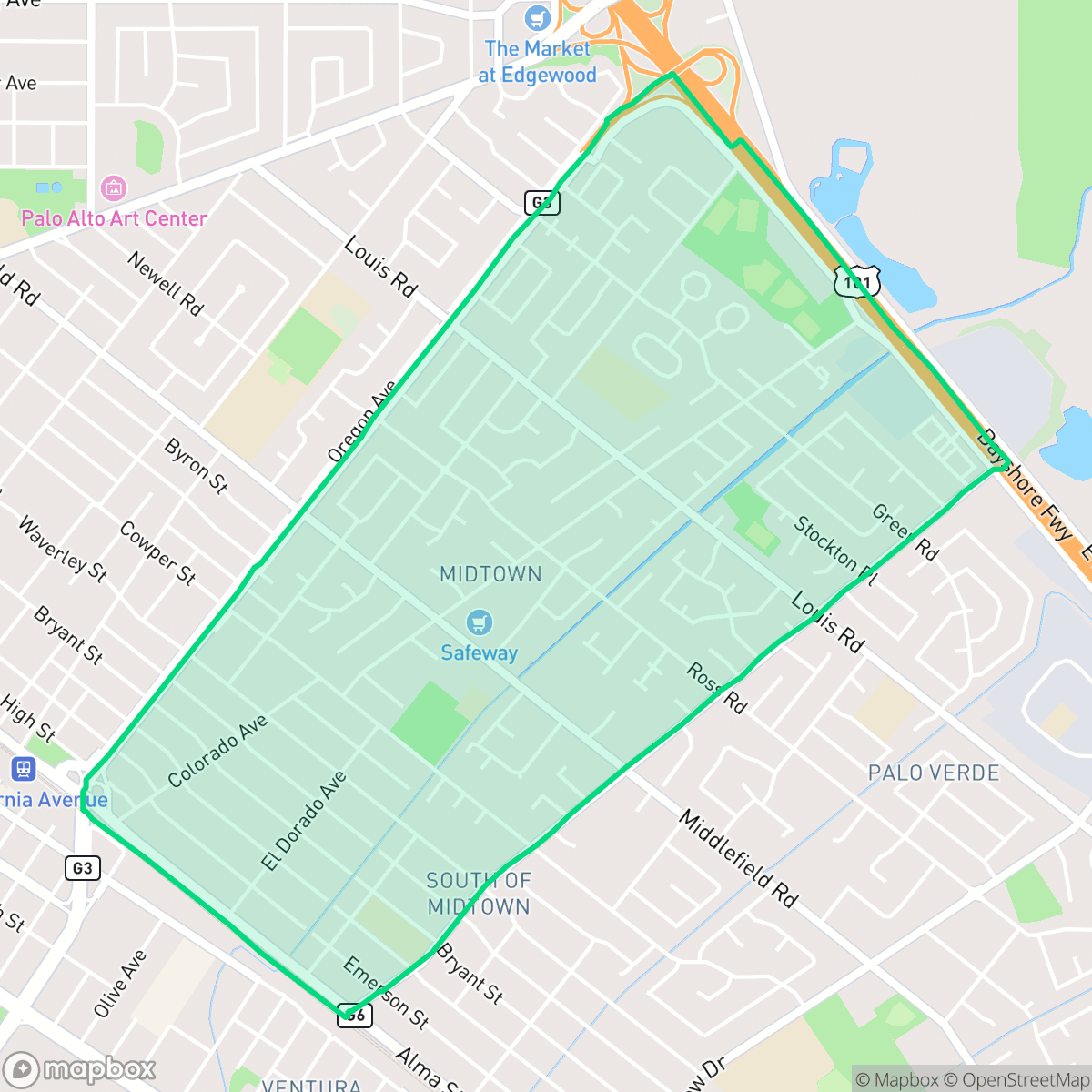
Midtown is a highly walkable, family-oriented neighborhood known for its manicured landscapes and blend of mid-century architecture. Residents benefit from excellent access to top-tier public schools and extensive pedestrian pathways, though the area experiences notable noise from nearby transit corridors and elevated flood risk.
Key Highlights
About Midtown
Midtown Palo Alto originated from 19th-century Mexican rancho land grants, later transitioning into farmland and orchards. Its modern identity was forged during the post-World War II suburban boom, when the area was developed to provide housing for returning servicemen. The neighborhood is characterized by a blend of mid-century architectural styles, including iconic Eichler homes and California ranch-style houses. A significant historical milestone occurred in 1948 on Lawrence Lane, which became the site of the city’s first planned integrated neighborhood, established by the Palo Alto Fair Play Council to include Asian American, Black, and white homeowners. Today, Midtown remains a family-oriented district anchored by the Midtown Shopping Center and landmarks such as the Winter Lodge, an outdoor ice-skating rink, and Greer Park, the city's largest park outside of its nature preserves.
The neighborhood is defined by a dense suburban character that balances manicured, upscale residential streets with a mature tree canopy. As a highly walkable area, it features a complete network of sidewalks and frequent crosswalks that connect residents to local parks and services. The community maintains a quiet, suburban rhythm, attracting a diverse demographic of young professionals, families, and seniors who value the area's established aesthetic and high levels of health insurance coverage. According to iHuus data, the community is strongly liberal in its political orientation, reflecting the broader values of the surrounding city.
Prospective residents should consider a few specific trade-offs when evaluating the area. The neighborhood faces higher noise levels due to its proximity to major freeways and railroad tracks, and certain properties reside within a designated floodplain that may require insurance. While the housing density provides a cohesive community feel, it results in less private outdoor space than some other parts of the city. Despite these factors, the area remains a premier choice for families seeking access to the elite Palo Alto Unified School District and a safe, pedestrian-friendly environment.
Neighborhood Scores Across 15 Qualities
Residential spacing is relatively dense with limited buffers between homes, making the area slightly less private than the Palo Alto average according to iHuus data.
Pedestrian access is exceptional due to a complete sidewalk network and frequent crosswalks at major intersections. This area offers superior connectivity for walkers compared to the Palo Alto average, featuring many low-traffic streets and safe residential cul-de-sacs.
Large homes featuring complex rooflines, well-manicured landscaping, and frequent private backyard pools characterize the area. This level of visual aesthetic is consistent with the city average.
Wide, grassy verges and accessible public parks with sports fields provide ample space for pets. While similar to the city average, the continuous sidewalks and green spaces throughout Midtown offer a safe environment for walking dogs away from traffic.
Residential layouts feature a dense mix of single-family homes and multi-unit apartments integrated with a mature tree canopy. This suburban character is slightly more developed than the Palo Alto average, according to iHuus data.
Local activity levels are slightly below the Palo Alto average, characterized by a subdued rhythm of residential life and scattered services. While some walkable paths connect to local parks and restaurants, many parts of the area remain car-oriented and tranquil.
Frequent noise from nearby railroad tracks and major freeways characterizes this area. According to iHuus data, acoustic comfort levels are consistent with the Palo Alto city average.
Air quality in this area fluctuates between acceptable and unhealthy levels, mirroring the average found across Palo Alto. Sensitive individuals may experience occasional concerns during certain periods, according to iHuus data.
Primarily residential and light commercial, this area lacks heavy industry or large warehouses. While industrial activity is minimal, iHuus data indicates proximity to a former Superfund site which may have historical implications for soil and groundwater.
Health insurance enrollment among residents is nearly universal, remaining very close to the Palo Alto average according to iHuus data.
Voting patterns and census indicators reflect a very liberal leaning, which is consistent with the broader Palo Alto area. According to iHuus data, this political orientation is slightly more pronounced here than the city average.
Residents live alongside a balanced mix of young professionals, families, and seniors. This demographic distribution is consistent with the broader Palo Alto area, according to iHuus data.
Properties in this area fall within a designated floodplain, which may necessitate flood insurance. According to iHuus data, the risk level here is higher than the Palo Alto city average.
Address-Level Insights for Midtown


iHuus Neighborhood Intelligence Insights
Get address-level neighborhood insights for Midtown
- Street-level scores — see how individual blocks compare, not just neighborhood averages
- Micro-zone boundaries — identify quiet pockets, flood boundaries, and walkable clusters before you visit
- 15 dimensions in full — walkability, noise, air quality, school quality, insurance coverage, population age profile, urban/rural index, and more
- Boundary risk alerts — know if your address sits near a block boundary where scores drop, the kind of detail no listing will ever mention
- School insights — individual school ratings and insights, not just district-level data
- Compare before you commit — side-by-side data across neighborhoods, down to block precision
No credit card required
Compare with Any Neighborhood
| Dimension | Midtown | Adobe Meadow - Meadow Park |
|---|---|---|
| 🚶 Walkabilityavg 8.94 | ||
| 🔊 Acoustic Comfortavg 3.51 | ||
| 🤫 Privacy Indexavg 5.96 | ||
| 🎨 Visual Appealavg 7.97 | ||
| 🐕 Dog Friendlinessavg 7.6 | ||
| 🗺️ Urban-Rural Indexavg 6.74 | ||
| ✨ Neighborhood Vibeavg 4.82 | ||
| 🏥 Health Insurance Coverageavg 9.05 | ||
| 🌿 Air Qualityavg 6.03 | ||
| 🏭 Industrial Proximityavg 8.67 | ||
| 🌊 Flood Safetyavg 3.52 | ||
| 🗳️ Ideological Leanavg 9.81 | ||
| 👥 Population Age Profileavg 5.03 | ||
| 🔥 Fire Safety | ||
| 🏫 School Quality |
Midtown Rankings
School Districts Serving Midtown
School Insights for Midtown
Below average outcomes; significant attendance and academic challenges.
School Insights
See what's really behind every school rating near Midtown
- Individual school ratings — each school's own score with outcome context, not just a district average
- Enrollment & class size data — student-to-teacher ratio and how it compares to the state average
- Full demographics breakdown — ethnicity and gender composition for every school in the enrollment zone
- Every school in the district — all schools within the enrollment boundary ranked by rating, not just the closest one
- Grade levels & benchmarks — elementary through high school, with below/above state-average flags
No credit card required