Greenmeadow, Palo Alto
Updated · 3,063 residents
Greenmeadow is a mid-century modern enclave in South Palo Alto known for its architectural cohesion and strong community focus. While the area offers high walkability and access to top-tier schools, residents should be aware of elevated road noise and proximity to industrial sites.
Key Highlights
About Greenmeadow
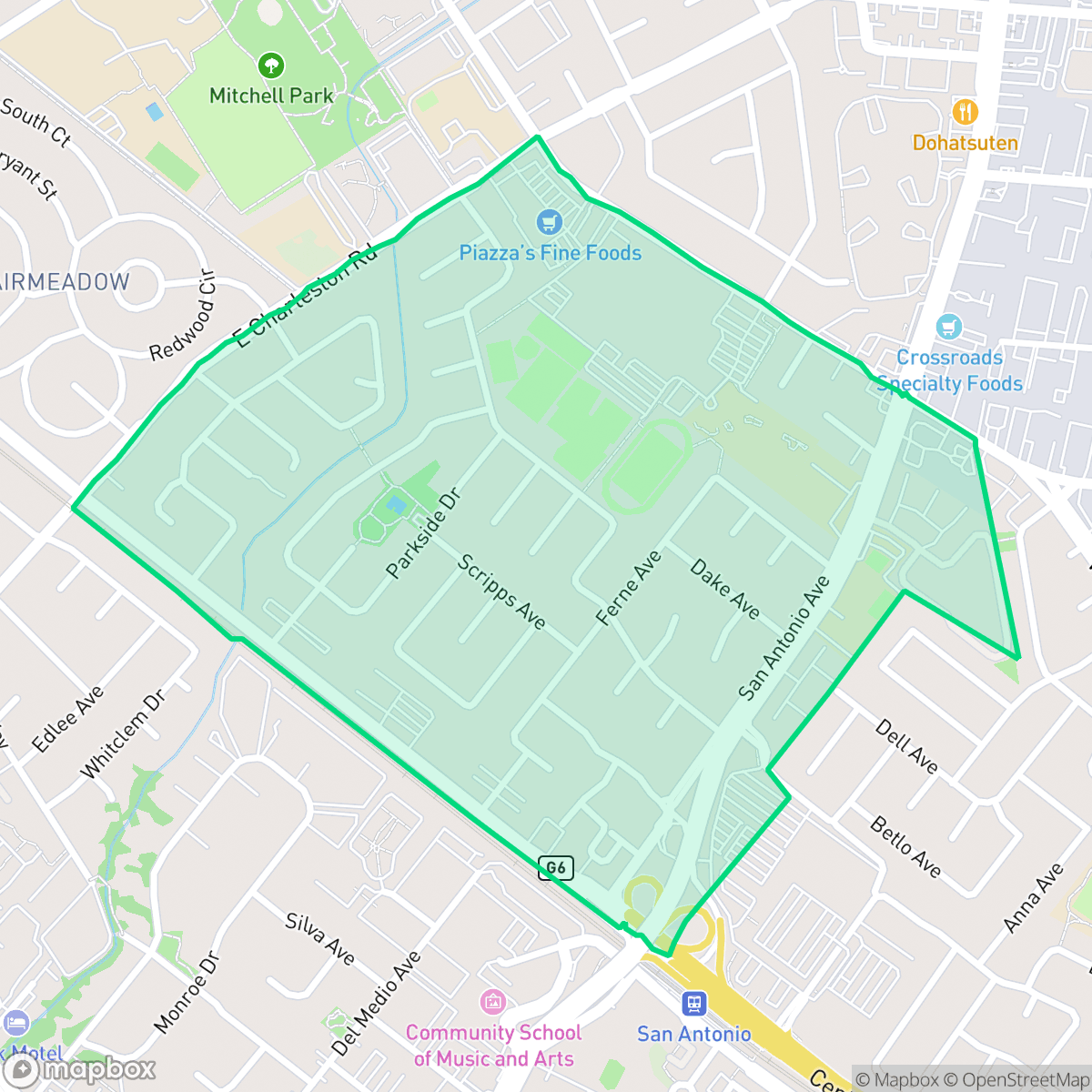
Developed by Joseph Eichler between 1954 and 1955 on former agricultural land, the Greenmeadow neighborhood in South Palo Alto is a premier example of mid-century modern suburban planning. Designed by renowned modernist architects A. Quincy Jones and Frederick Emmons, with landscaping by Thomas Church, the tract features approximately 270 single-story homes. These homes are celebrated for their signature post-and-beam construction, flat roofs, clerestory windows, and seamless indoor-outdoor integration. At the heart of the neighborhood is its historic community center, park, and pool, which were established in 1955 to foster a tight-knit community. To protect this shared infrastructure, residents formed the Greenmeadow Community Association with the help of a young local attorney, Pete McCloskey. In 2005, Greenmeadow was added to the National Register of Historic Places, honoring its exceptional architectural integrity.
Greenmeadow maintains a distinct suburban atmosphere defined by its signature residential architecture and ample green space. Residents benefit from a robust sidewalk network that encourages pedestrian activity, alongside access to elite public education within the Palo Alto Unified School District. The neighborhood serves as a stable, ideologically aligned community that prioritizes local engagement through its central community facilities and park space.
Prospective residents should consider the trade-offs inherent to this location, including higher ambient noise levels primarily driven by road traffic. While the area is well-maintained and visually appealing, it is situated near industrial zones with historical environmental considerations regarding soil and groundwater. It is best suited for families or individuals seeking a stable, architecturally significant environment who are comfortable with the realities of living in a dense, active suburban corridor.
Neighborhood Scores Across 15 Qualities
Residential spacing varies between closely packed structures and standard suburban layouts with private backyards. This level of density is slightly higher than the Palo Alto average, providing a mix of open buffer zones and more intimate neighborly proximity according to iHuus data.
Sidewalks and low-traffic cul-de-sacs provide safe routes for pedestrians, though some commercial parking areas may act as obstacles. This level of walkability is slightly below the Palo Alto city average.
Large, well-maintained lots and private pools characterize this area. While the visual appeal is notable due to the presence of upscale amenities, it sits slightly below the Palo Alto city average.
Expansive sports parks and wide residential parkways offer ample space for pet owners. According to iHuus data, the availability of connected green corridors and tree-lined streets is roughly in line with the Palo Alto average.
Residential layouts consist of single-family homes and multi-family apartments interspersed with parks and large sports complexes. This balance of developed space and open land is relatively consistent with the broader Palo Alto area, according to iHuus data.
Suburban streets and green spaces provide a tranquil atmosphere, though the level of activity and access to local services is lower than the Palo Alto average. While various dining and social spots exist within the area, many businesses require a short drive as they are not all within walking distance.
Frequent noise from nearby railroads and major transit corridors impacts the area. According to iHuus data, acoustic comfort is notably lower than the Palo Alto average.
Air quality in Greenmeadow fluctuates between acceptable and unhealthy levels on certain days. According to iHuus data, these conditions are consistent with the city average for Palo Alto.
Commercial activity and light industrial units are more prevalent here than in most parts of Palo Alto. Residents should be aware that an adjacent EPA Superfund site may pose potential risks to groundwater and soil quality, according to iHuus data.
Health insurance enrollment among residents is slightly below the Palo Alto average, according to iHuus data.
Voting patterns and census indicators reflect a deeply liberal political leaning that is consistent with the rest of Palo Alto. According to iHuus data, the area maintains a political profile very similar to the city average.
Residents live among a diverse mix of young professionals, families, and seniors. This age distribution is slightly more varied than the typical Palo Alto profile, according to iHuus data.
Properties in this area are located within a designated floodplain, which may necessitate flood insurance coverage. According to iHuus data, this level of risk is consistent with the broader Palo Alto area.
Address-Level Insights for Greenmeadow


iHuus Neighborhood Intelligence Insights
Get address-level neighborhood insights for Greenmeadow
- Street-level scores — see how individual blocks compare, not just neighborhood averages
- Micro-zone boundaries — identify quiet pockets, flood boundaries, and walkable clusters before you visit
- 15 dimensions in full — walkability, noise, air quality, school quality, insurance coverage, population age profile, urban/rural index, and more
- Boundary risk alerts — know if your address sits near a block boundary where scores drop, the kind of detail no listing will ever mention
- School insights — individual school ratings and insights, not just district-level data
- Compare before you commit — side-by-side data across neighborhoods, down to block precision
No credit card required
Compare with Any Neighborhood
| Dimension | Greenmeadow | Adobe Meadow - Meadow Park |
|---|---|---|
| 🚶 Walkabilityavg 8.94 | ||
| 🔊 Acoustic Comfortavg 3.51 | ||
| 🤫 Privacy Indexavg 5.96 | ||
| 🎨 Visual Appealavg 7.97 | ||
| 🐕 Dog Friendlinessavg 7.6 | ||
| 🗺️ Urban-Rural Indexavg 6.74 | ||
| ✨ Neighborhood Vibeavg 4.82 | ||
| 🏥 Health Insurance Coverageavg 9.05 | ||
| 🌿 Air Qualityavg 6.03 | ||
| 🏭 Industrial Proximityavg 8.67 | ||
| 🌊 Flood Safetyavg 3.52 | ||
| 🗳️ Ideological Leanavg 9.81 | ||
| 👥 Population Age Profileavg 5.03 | ||
| 🔥 Fire Safety | ||
| 🏫 School Quality |
Greenmeadow Rankings
School Districts Serving Greenmeadow
School Insights for Greenmeadow
Below average outcomes; significant attendance and academic challenges.
School Insights
See what's really behind every school rating near Greenmeadow
- Individual school ratings — each school's own score with outcome context, not just a district average
- Enrollment & class size data — student-to-teacher ratio and how it compares to the state average
- Full demographics breakdown — ethnicity and gender composition for every school in the enrollment zone
- Every school in the district — all schools within the enrollment boundary ranked by rating, not just the closest one
- Grade levels & benchmarks — elementary through high school, with below/above state-average flags
No credit card required