Green Acres, Palo Alto
Updated · 1,514 residents
Green Acres is a highly walkable residential enclave in Palo Alto defined by its mid-century modern architecture and expansive, tree-lined lots. While the neighborhood offers exceptional access to elite schools and public green spaces, residents should be aware of significant road traffic noise and proximity to historical environmental sites.
Key Highlights
About Green Acres
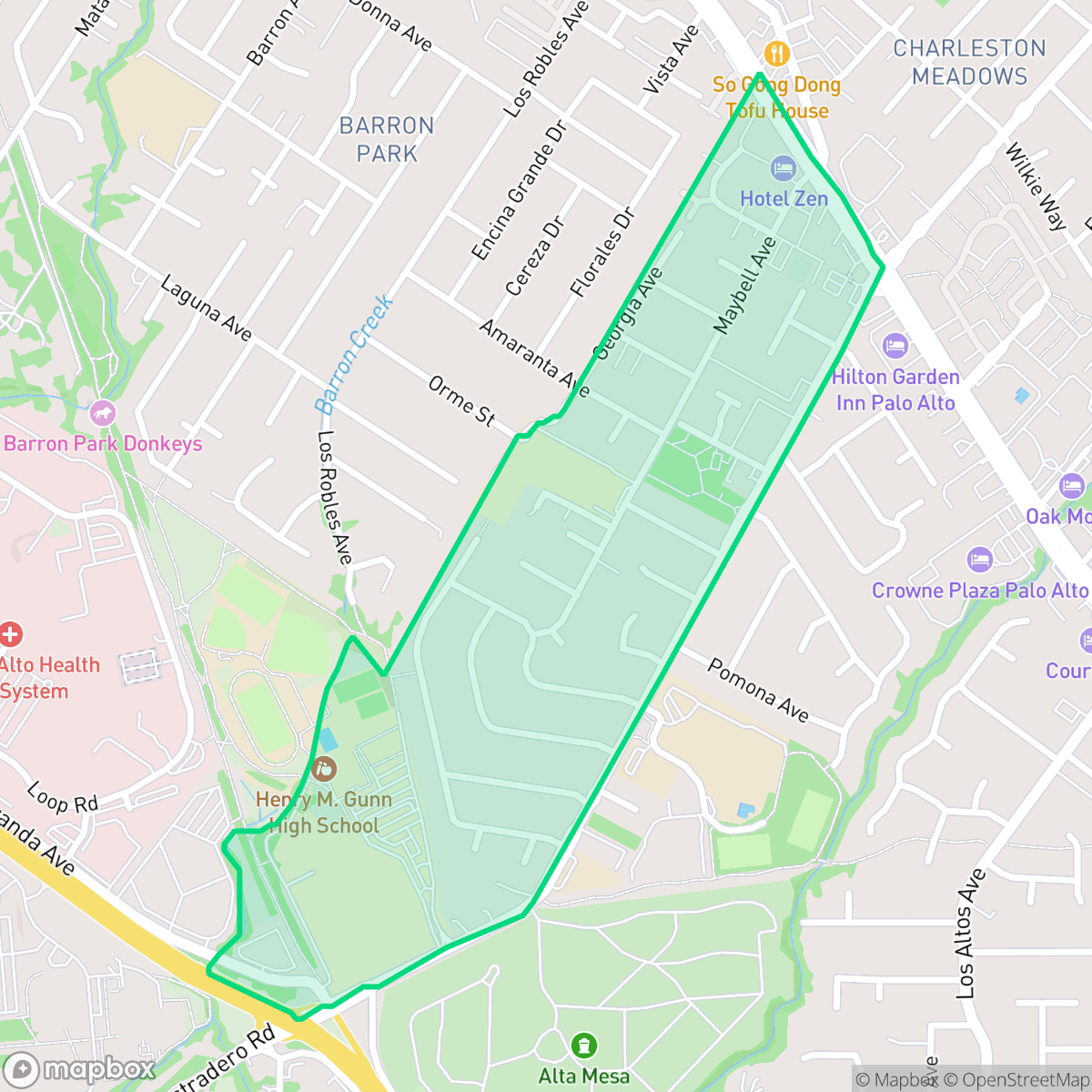
Located on Palo Alto’s southwestern edge, the Green Acres neighborhood was once covered by sprawling apricot, pear, and citrus orchards. Its residential transition began in the 1950s, developing in phases—Green Acres I and II—divided by Arastradero Road. The neighborhood is characterized by its post-war mid-century modern and ranch-style homes situated on spacious, tree-lined lots. In 1972, residents of Green Acres I successfully petitioned to underground their utilities, serving as a pilot district for Palo Alto. Culturally, the neighborhood’s heritage is anchored by Juana Briones Park, dedicated in 1989 on land once belonging to pioneering 19th-century female landowner Juana Briones de Miranda. On its eastern edge along El Camino Real, the historic Dinah’s Garden Hotel stands on the former site of the landmark 1940s eatery Dinah’s Shack.
The area maintains a calm, suburban atmosphere with a blend of single-family residences and apartment complexes. Its high walkability is supported by continuous sidewalks throughout the neighborhood, facilitating easy access to local parks and nearby dining options. According to iHuus data, the community benefits from strong health insurance coverage and an active, engaged population, contributing to a stable and well-maintained environment.
Prospective residents should consider the trade-offs regarding acoustic comfort, as average noise levels from surrounding road traffic are elevated. The neighborhood is well-suited for families prioritizing access to the top-rated Palo Alto Unified School District, specifically the highly regarded Juana Briones Elementary and Henry M. Gunn High School. While the area offers a high quality of life, it is important to note the presence of nearby environmental sites that may impact groundwater and soil conditions.
Neighborhood Scores Across 15 Qualities
Residential spacing is consistent with the city average, offering a mix of single-family homes and multi-unit complexes with moderate buffers between neighbors. According to iHuus data, the layout provides a balanced level of separation between adjacent properties.
Continuous sidewalks on both sides of residential and arterial roads ensure safe pedestrian movement. This neighborhood offers superior walkability compared to the Palo Alto average, featuring ample crossings and pedestrian-priority areas.
Professionally landscaped yards and large estates with private pools define the area. According to iHuus data, the visual quality of this neighborhood is consistent with the Palo Alto average.
Access to two public parks and wide, green sidewalk verges makes pet walking easy. According to iHuus data, the area offers higher levels of connectivity for pets than the Palo Alto average.
Open land and woodland pockets provide a more rural feel than much of Palo Alto. Residents can expect a landscape of scattered homes and greenery that is more expansive than the typical suburban density found across the city.
Low-density residential streets and parks provide a calm environment, but local business access is limited and requires driving. According to iHuus data, the level of social activity and commercial density is lower than the Palo Alto average.
Frequent noise from nearby major transit corridors and flight paths is common in this area. According to iHuus data, acoustic comfort is slightly lower than the Palo Alto average.
Air quality in this area fluctuates between acceptable and unhealthy levels, mirroring the typical conditions found across Palo Alto. Sensitive groups may experience occasional concern on certain days according to iHuus data.
Residential streets and open green spaces dominate the area, though an adjacent EPA Superfund site indicates potential for soil or groundwater contamination. While the neighborhood features very little industrial activity, its level of industrial proximity is slightly higher than the Palo Alto average according to iHuus data.
Health insurance access is nearly universal among residents, sitting slightly above the Palo Alto average according to iHuus data.
Voting patterns and census indicators show a predominantly liberal community that is slightly more progressive than the Palo Alto average.
A diverse mix of young adults, families, and older residents characterizes the area, representing a slightly more varied age spread than the Palo Alto average according to iHuus data.
Residual flood risk exists within this area due to its location in a 500-year floodplain; however, safety levels remain significantly higher than the Palo Alto city average, according to iHuus data.
Address-Level Insights for Green Acres


iHuus Neighborhood Intelligence Insights
Get address-level neighborhood insights for Green Acres
- Street-level scores — see how individual blocks compare, not just neighborhood averages
- Micro-zone boundaries — identify quiet pockets, flood boundaries, and walkable clusters before you visit
- 15 dimensions in full — walkability, noise, air quality, school quality, insurance coverage, population age profile, urban/rural index, and more
- Boundary risk alerts — know if your address sits near a block boundary where scores drop, the kind of detail no listing will ever mention
- School insights — individual school ratings and insights, not just district-level data
- Compare before you commit — side-by-side data across neighborhoods, down to block precision
No credit card required
Compare with Any Neighborhood
| Dimension | Green Acres | Adobe Meadow - Meadow Park |
|---|---|---|
| 🚶 Walkabilityavg 8.94 | ||
| 🔊 Acoustic Comfortavg 3.51 | ||
| 🤫 Privacy Indexavg 5.96 | ||
| 🎨 Visual Appealavg 7.97 | ||
| 🐕 Dog Friendlinessavg 7.6 | ||
| 🗺️ Urban-Rural Indexavg 6.74 | ||
| ✨ Neighborhood Vibeavg 4.82 | ||
| 🏥 Health Insurance Coverageavg 9.05 | ||
| 🌿 Air Qualityavg 6.03 | ||
| 🏭 Industrial Proximityavg 8.67 | ||
| 🌊 Flood Safetyavg 3.52 | ||
| 🗳️ Ideological Leanavg 9.81 | ||
| 👥 Population Age Profileavg 5.03 | ||
| 🔥 Fire Safety | ||
| 🏫 School Quality |
Green Acres Rankings
School Districts Serving Green Acres
School Insights for Green Acres
Below average outcomes; significant attendance and academic challenges.
School Insights
See what's really behind every school rating near Green Acres
- Individual school ratings — each school's own score with outcome context, not just a district average
- Enrollment & class size data — student-to-teacher ratio and how it compares to the state average
- Full demographics breakdown — ethnicity and gender composition for every school in the enrollment zone
- Every school in the district — all schools within the enrollment boundary ranked by rating, not just the closest one
- Grade levels & benchmarks — elementary through high school, with below/above state-average flags
No credit card required