Greater Miranda, Palo Alto
Updated · 243 residents
Greater Miranda is a secluded, visually striking enclave defined by its quiet, rural-suburban atmosphere and proximity to open green spaces. While it offers a high degree of privacy and a serene environment, residents should be aware of the persistent road traffic noise from the nearby Foothill Expressway.
Key Highlights
About Greater Miranda
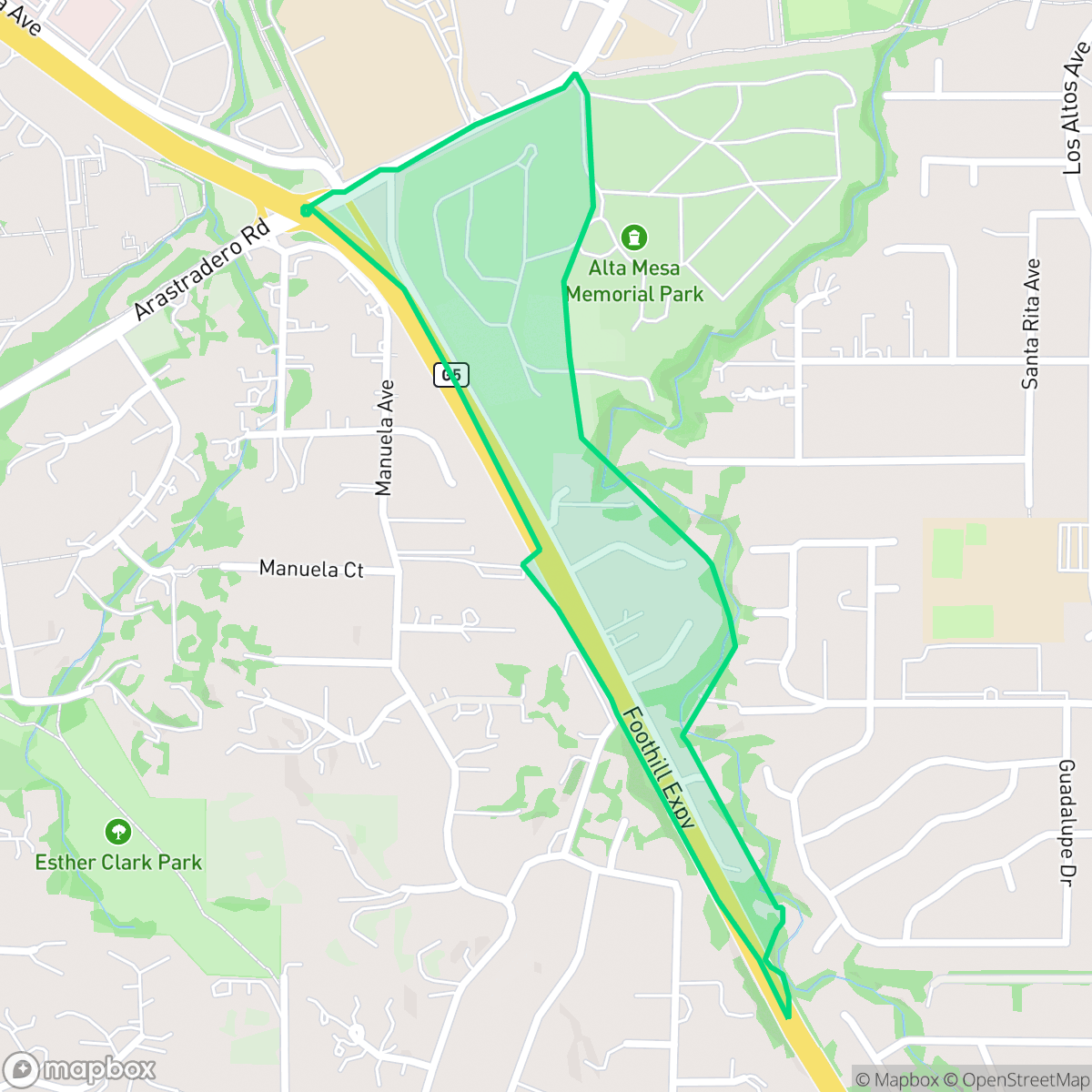
The Greater Miranda neighborhood in Palo Alto, California, carries a rich history tracing back to 1850, when the pioneering Mexican-American landowner Doña Juana Briones de Miranda purchased the land for $300. Originally a agricultural orchard, the area was annexed to Palo Alto in 1959, with residential development primarily taking off in the 1960s. Today, this secluded enclave consists of approximately 55 single-family homes situated on three cul-de-sacs—Arroyo Court, Miranda Green, and Moana Court—extending off Miranda Avenue. Landlocked on three sides, the neighborhood is bordered by Foothill Expressway, Adobe Creek, and Alta Mesa Memorial Park. Greater Miranda is notably the only neighborhood in Palo Alto that borders a cemetery, a unique proximity that residents credit with preserving the area's exceptionally quiet, rural-suburban character.
The area maintains a distinct, low-density character that sets it apart from the typical urban density of Palo Alto. With its cul-de-sac layout and adjacency to natural buffers like Adobe Creek and a local memorial park, the neighborhood provides a high level of visual appeal and a sense of remoteness. It is a quiet, residential pocket that prioritizes privacy, making it well-suited for those who value a tranquil living environment over proximity to commercial hubs or high-traffic amenities.
Prospective residents should note that the neighborhood experiences elevated noise levels due to its location near major arterial roads. While it offers excellent access to top-tier school districts and maintains a strong sense of community stability, the tradeoff for its secluded nature includes limited walkability to retail or services. It is an ideal setting for individuals or families seeking a stable, aesthetically pleasing environment who are comfortable with a more car-dependent lifestyle.
Neighborhood Scores Across 15 Qualities
Large residential lots with significant separation between homes provide a sense of privacy that is slightly higher than the Palo Alto average, according to iHuus data.
Pedestrian infrastructure is excellent, featuring wide sidewalks on both sides of streets and ample crossings. This level of accessibility is consistent with the average found throughout Palo Alto.
Large custom homes and significant privacy buffers create an aesthetic that is notably more lush and manicured than the Palo Alto average. This area is characterized by low density housing and high quality architectural features according to iHuus data.
Abundant large parks, trails, and open spaces provide many opportunities for pet owners. This area offers significantly more access to recreational space for dogs than the Palo Alto average, according to iHuus data.
Frequent open land and scattered homes amidst woodlands provide a more spacious, semi-rural feel than the typical Palo Alto landscape. According to iHuus data, this area offers more greenery and open space than the city average.
Low density and significant open space characterize this area, resulting in a tranquil environment with fewer local businesses than the Palo Alto average. Most residents will find a serene setting, though access to commercial services often requires driving.
Frequent noise from nearby freeway and railroad corridors characterizes this area. Acoustic comfort is slightly lower than the Palo Alto average, according to iHuus data.
Air quality in this area fluctuates between acceptable and unhealthy levels. According to iHuus data, these conditions are consistent with the average seen throughout Palo Alto.
No warehouses, industrial facilities, or hazard sites are present in this area. This neighborhood remains exclusively residential and features significantly fewer industrial influences than the Palo Alto average, according to iHuus data.
Health insurance coverage is nearly universal among residents, appearing very similar to the Palo Alto city average according to iHuus data.
Voting patterns and census indicators reflect a deeply liberal political landscape that is consistent with the broader Palo Alto area.
A balanced mix of young adults, families, and older residents characterizes the area. This demographic spread is more varied than the typical Palo Alto profile, according to iHuus data.
Flood risk in this area is notably higher than the Palo Alto average, though the specific level of danger remains undetermined due to a lack of detailed federal studies. Residents should remain aware of potential vulnerabilities during extreme weather events.
Address-Level Insights for Greater Miranda


iHuus Neighborhood Intelligence Insights
Get address-level neighborhood insights for Greater Miranda
- Street-level scores — see how individual blocks compare, not just neighborhood averages
- Micro-zone boundaries — identify quiet pockets, flood boundaries, and walkable clusters before you visit
- 15 dimensions in full — walkability, noise, air quality, school quality, insurance coverage, population age profile, urban/rural index, and more
- Boundary risk alerts — know if your address sits near a block boundary where scores drop, the kind of detail no listing will ever mention
- School insights — individual school ratings and insights, not just district-level data
- Compare before you commit — side-by-side data across neighborhoods, down to block precision
No credit card required
Compare with Any Neighborhood
| Dimension | Greater Miranda | Adobe Meadow - Meadow Park |
|---|---|---|
| 🚶 Walkabilityavg 8.94 | ||
| 🔊 Acoustic Comfortavg 3.51 | ||
| 🤫 Privacy Indexavg 5.96 | ||
| 🎨 Visual Appealavg 7.97 | ||
| 🐕 Dog Friendlinessavg 7.6 | ||
| 🗺️ Urban-Rural Indexavg 6.74 | ||
| ✨ Neighborhood Vibeavg 4.82 | ||
| 🏥 Health Insurance Coverageavg 9.05 | ||
| 🌿 Air Qualityavg 6.03 | ||
| 🏭 Industrial Proximityavg 8.67 | ||
| 🌊 Flood Safetyavg 3.52 | ||
| 🗳️ Ideological Leanavg 9.81 | ||
| 👥 Population Age Profileavg 5.03 | ||
| 🔥 Fire Safety | ||
| 🏫 School Quality |
Greater Miranda Rankings
School Districts Serving Greater Miranda
School Insights for Greater Miranda
Below average outcomes; significant attendance and academic challenges.
School Insights
See what's really behind every school rating near Greater Miranda
- Individual school ratings — each school's own score with outcome context, not just a district average
- Enrollment & class size data — student-to-teacher ratio and how it compares to the state average
- Full demographics breakdown — ethnicity and gender composition for every school in the enrollment zone
- Every school in the district — all schools within the enrollment boundary ranked by rating, not just the closest one
- Grade levels & benchmarks — elementary through high school, with below/above state-average flags
No credit card required