Garland, Palo Alto
Updated · 343 residents
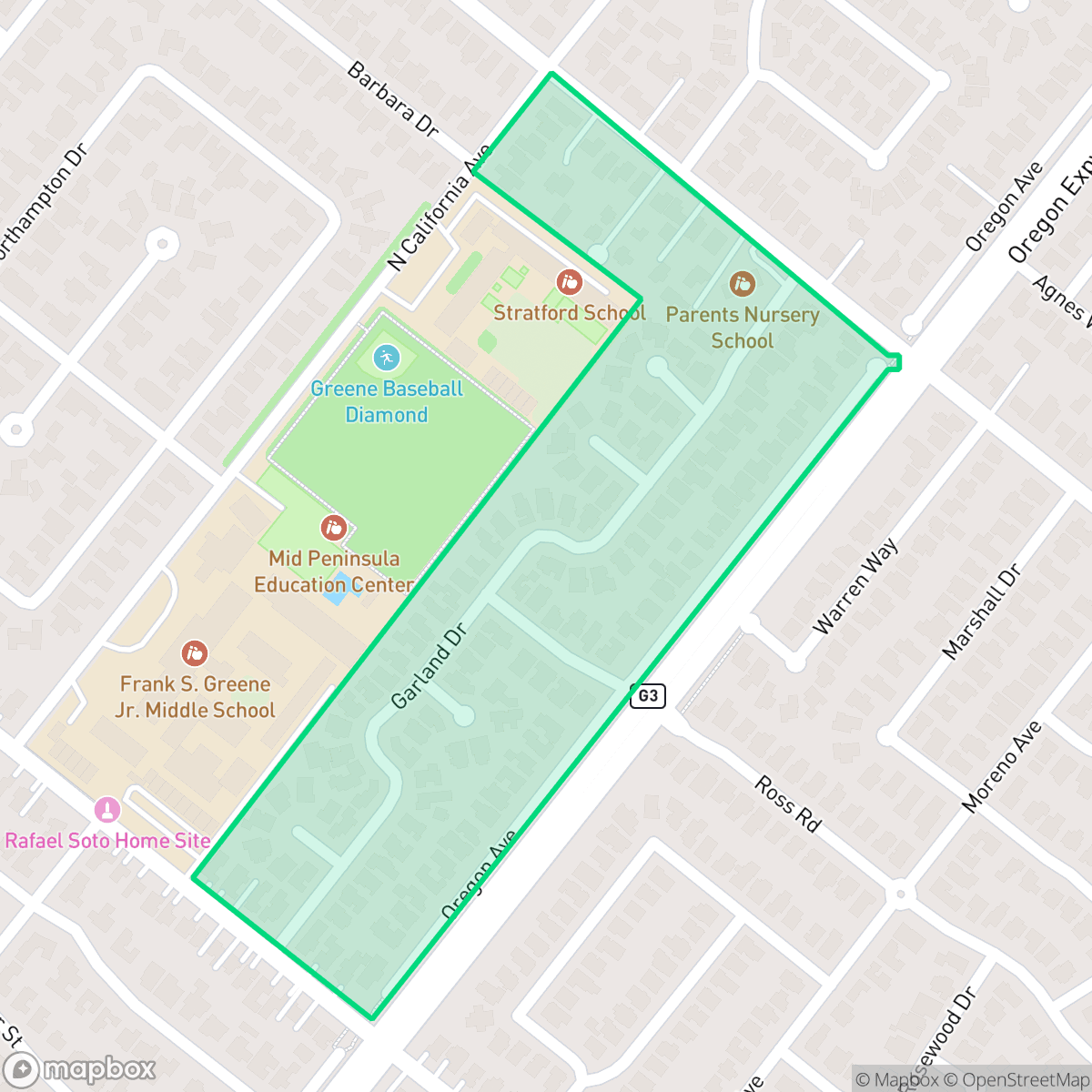
Garland is a quiet, residential enclave in Palo Alto defined by its mix of ranch-style houses and mid-century modern Eichler homes. The area offers exceptional walkability and a peaceful atmosphere, though it remains relatively removed from the city's commercial centers.
Key Highlights
About Garland
Once part of the 19th-century Rancho Rinconada del Arroyo de San Francisquito, the land that comprises the Garland neighborhood in Palo Alto, California, was later purchased by John and Temperance Garland. When the property was subdivided in 1945, the central street was named Garland Drive in their honor. Development of the neighborhood’s nearly 100 ranch-style homes was led by the Coastwise building company. During the late 1950s, the area expanded with the Garland Park subdivision, featuring Joseph Eichler's signature mid-century modern post-and-beam homes. Today, the neighborhood is characterized by its quiet, curvilinear streets designed to reduce cut-through traffic, and its mature, canopy-forming magnolia trees.
The neighborhood serves as a tranquil residential pocket within Palo Alto, characterized by its mature magnolia-lined streets and a deliberate layout designed to minimize cut-through traffic. According to iHuus data, the area maintains a high level of walkability, allowing residents easy access to the surrounding community despite the limited number of businesses located directly within its borders. The architectural landscape remains a primary draw, offering a blend of traditional ranch-style residences and iconic post-and-beam homes that contribute to the area's visual appeal. Prospective residents should note that while the neighborhood provides a serene environment, it experiences moderate noise levels primarily attributed to local road traffic. Families are often drawn to the area due to its inclusion in the Palo Alto Unified School District, which is widely recognized for its academic excellence. However, individuals considering a move should be aware of environmental factors, as the area faces notable challenges regarding flood and fire safety. Despite these considerations, the community remains a stable and highly desirable location for those prioritizing school quality and a quiet, pedestrian-friendly lifestyle.
Neighborhood Scores Across 15 Qualities
Residential spacing in Garland is consistent with the Palo Alto average, offering a mix of building densities and some buffer between neighboring properties. According to iHuus data, the area provides a moderate level of separation between structures.
Pedestrian-priority areas and wide sidewalks on both sides of the street make navigating the neighborhood easy on foot. This level of accessibility is notably higher than the average for Palo Alto, according to iHuus data.
Large residences and high-end amenities define the area's aesthetic, matching the typical visual quality found across Palo Alto. According to iHuus data, the presence of spacious driveways and well-maintained properties creates a consistent sense of openness.
Integrated green spaces and wide, low-traffic paths provide ample area for walking dogs. According to iHuus data, this neighborhood offers a higher level of accessibility for pet owners than the Palo Alto average.
Frequent open land and scattered homes amidst woodland characterize this area. The landscape is slightly less open than the typical Palo Alto neighborhood, according to iHuus data.
Low levels of commercial activity and street life make this area feel more subdued than most of Palo Alto. Residents will find a primarily suburban setting where most daily services require a vehicle to reach.
Frequent noise from nearby railroad tracks and major freeway corridors characterizes this area. According to iHuus data, acoustic comfort levels are slightly below the Palo Alto city average.
Air quality in this area fluctuates between acceptable and unhealthy levels on certain days. According to iHuus data, these conditions are consistent with the broader Palo Alto average.
Industrial presence is non-existent in this area, offering a cleaner environment than the Palo Alto average. According to iHuus data, the neighborhood consists entirely of residential streets and open green spaces with no detected warehouses or hazard sites.
Health insurance access is nearly universal among residents, performing slightly above the Palo Alto average according to iHuus data.
Voting patterns and census indicators show a predominantly liberal leaning, which is consistent with the broader Palo Alto area according to iHuus data.
Residents of all life stages are represented here, offering a demographic balance that is slightly more varied than the Palo Alto average. According to iHuus data, the area features a stable mix of young professionals, families, and older adults.
Significant flood and wave action risks exist here due to the coastal high-hazard zone designation. According to iHuus data, this risk is substantially higher than the Palo Alto average and may result in elevated or prohibitive insurance costs.
Address-Level Insights for Garland


iHuus Neighborhood Intelligence Insights
Get address-level neighborhood insights for Garland
- Street-level scores — see how individual blocks compare, not just neighborhood averages
- Micro-zone boundaries — identify quiet pockets, flood boundaries, and walkable clusters before you visit
- 15 dimensions in full — walkability, noise, air quality, school quality, insurance coverage, population age profile, urban/rural index, and more
- Boundary risk alerts — know if your address sits near a block boundary where scores drop, the kind of detail no listing will ever mention
- School insights — individual school ratings and insights, not just district-level data
- Compare before you commit — side-by-side data across neighborhoods, down to block precision
No credit card required
Compare with Any Neighborhood
| Dimension | Garland | Adobe Meadow - Meadow Park |
|---|---|---|
| 🚶 Walkabilityavg 8.94 | ||
| 🔊 Acoustic Comfortavg 3.51 | ||
| 🤫 Privacy Indexavg 5.96 | ||
| 🎨 Visual Appealavg 7.97 | ||
| 🐕 Dog Friendlinessavg 7.6 | ||
| 🗺️ Urban-Rural Indexavg 6.74 | ||
| ✨ Neighborhood Vibeavg 4.82 | ||
| 🏥 Health Insurance Coverageavg 9.05 | ||
| 🌿 Air Qualityavg 6.03 | ||
| 🏭 Industrial Proximityavg 8.67 | ||
| 🌊 Flood Safetyavg 3.52 | ||
| 🗳️ Ideological Leanavg 9.81 | ||
| 👥 Population Age Profileavg 5.03 | ||
| 🔥 Fire Safety | ||
| 🏫 School Quality |
Garland Rankings
School Districts Serving Garland
School Insights for Garland
Below average outcomes; significant attendance and academic challenges.
School Insights
See what's really behind every school rating near Garland
- Individual school ratings — each school's own score with outcome context, not just a district average
- Enrollment & class size data — student-to-teacher ratio and how it compares to the state average
- Full demographics breakdown — ethnicity and gender composition for every school in the enrollment zone
- Every school in the district — all schools within the enrollment boundary ranked by rating, not just the closest one
- Grade levels & benchmarks — elementary through high school, with below/above state-average flags
No credit card required