Fairmeadow, Palo Alto
Updated · 1,709 residents
Fairmeadow is a distinctive residential enclave in Palo Alto, recognized for its mid-century modern architecture and unique circular street design. Residents enjoy high visual appeal and access to top-tier schools, though the area experiences notable ambient noise from nearby traffic and requires awareness of local environmental factors.
Key Highlights
About Fairmeadow
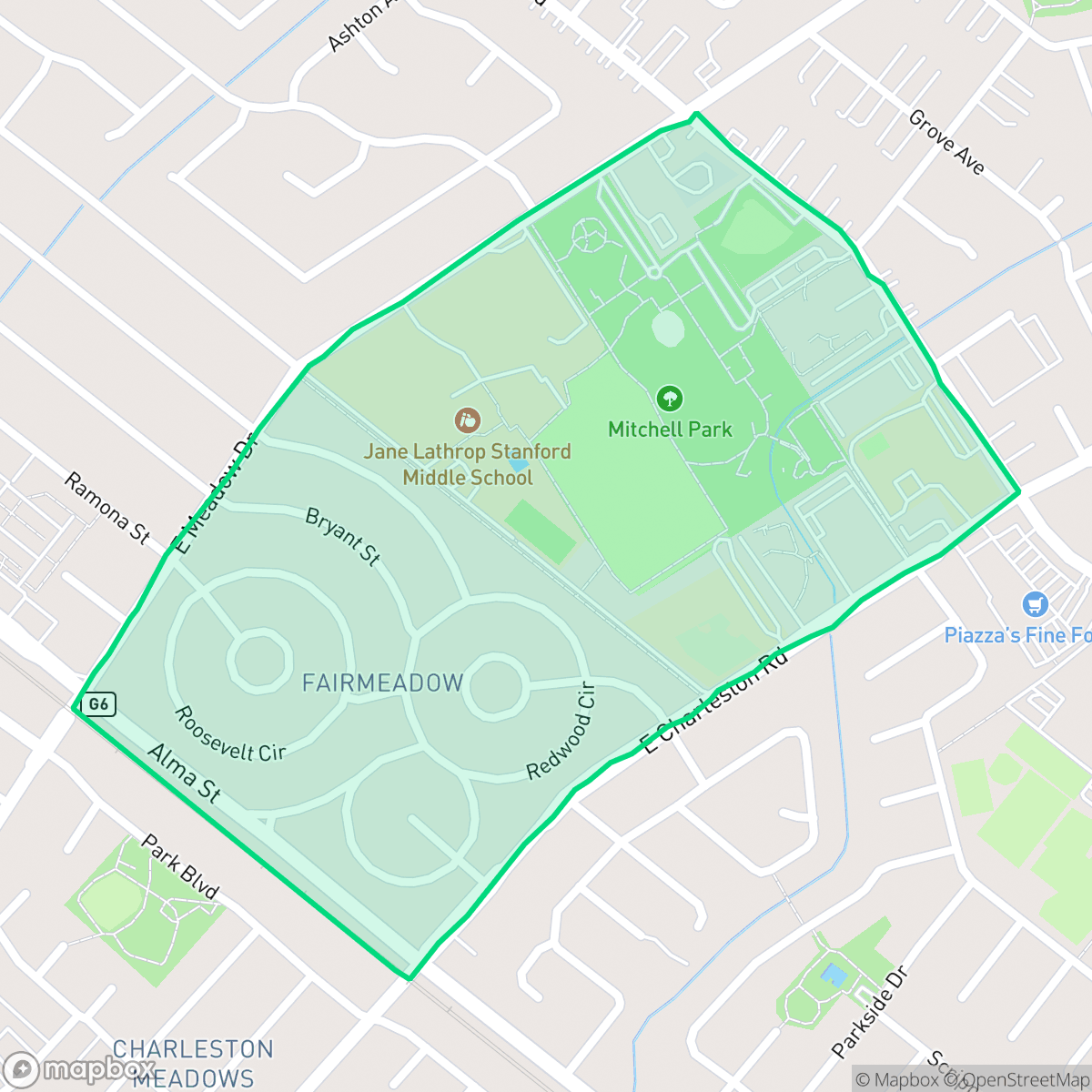
Developed in the early 1950s, the Fairmeadow neighborhood in Palo Alto is one of developer Joseph Eichler's most architecturally significant mid-century modern tracts. Designed by the renowned architectural firms Anshen + Allen and Jones & Emmons, the planned community was named “Subdivision of the Year” by Architectural Forum. Fairmeadow is highly distinct for its unique street layout of concentric, circular roads. Originally designed to slow down traffic, this layout earned the neighborhood its local nickname, “The Circles”. The neighborhood features 167 transitional "California Modern" Eichler homes characterized by post-and-beam construction, low-pitched gables, clerestory windows, and open-air layouts. To maintain a clean, uncluttered aesthetic, the neighborhood was built entirely without overhead utility poles.
The area offers a tranquil, suburban atmosphere defined by its well-manicured properties and extensive green space. With a strong commitment to education, the neighborhood is served by highly rated schools within the Palo Alto Unified School District, including Fairmeadow Elementary and Jane Lathrop Stanford Middle. It maintains a consistent sidewalk network, making it a pedestrian-friendly environment for families and dog owners alike.
Prospective residents should note that the neighborhood experiences elevated noise levels due to its proximity to major roadways, with average sound levels reaching approximately 64 decibels. While the community offers a peaceful aesthetic, the nearby presence of an EPA Superfund site warrants consideration regarding potential environmental impacts on groundwater and soil. It is an ideal location for those prioritizing architectural heritage and academic excellence, provided they are comfortable with the acoustic and environmental trade-offs of the region.
Neighborhood Scores Across 15 Qualities
Residential spacing in Fairmeadow provides a balanced level of separation between homes, aligning with the typical density found across Palo Alto. Neighbors are situated with moderate buffers and visible yards, offering a standard suburban sense of privacy according to iHuus data.
Wide sidewalks and low-traffic cul-de-sacs provide safe, easy movement for pedestrians. According to iHuus data, the sidewalk network and marked crosswalks offer a level of walkability that is roughly comparable to the Palo Alto average.
Large, well-maintained lots and numerous private backyard pools characterize this area. This level of visual appeal is consistent with the broader Palo Alto area.
Continuous sidewalks and nearby large sports parks provide ample space for pets. This area offers more accessible green space and wider walking paths than the Palo Alto average, according to iHuus data.
Residential layouts consist mainly of single-family homes and large school or sports complexes. This area presents a slightly more developed suburban character than the city average, featuring less open land and fewer wooded areas.
Low levels of activity and a reliance on vehicles for most errands characterize this area. While some local cafes and social spots are accessible on foot, the neighborhood is notably less lively than the Palo Alto average.
Steady hum from nearby busy streets characterizes the area, though acoustic comfort remains higher than the Palo Alto average according to iHuus data.
Air quality levels in Fairmeadow typically fluctuate between acceptable and unhealthy, matching the broader Palo Alto average. Residents in sensitive groups should be aware of occasional days with diminished air clarity according to iHuus data.
Light industrial and commercial units exist alongside residential areas, resulting in a higher industrial presence than the Palo Alto average. According to iHuus data, the nearby presence of an EPA Superfund site may present potential concerns regarding soil or groundwater contaminants.
Health insurance coverage among residents is very high, though slightly below the Palo Alto average according to iHuus data.
Voting patterns and census indicators show a deeply liberal political leaning that is consistent with the broader Palo Alto area.
Residents live alongside a balanced mix of young adults, families, and older individuals. This demographic spread is slightly more varied than the typical age distribution seen across Palo Alto.
Flood risk in this area is slightly higher than the Palo Alto average, though a lack of detailed federal studies means the precise level of danger remains undetermined. Residents should remain aware of potential vulnerabilities during extreme weather events according to iHuus data.
Address-Level Insights for Fairmeadow


iHuus Neighborhood Intelligence Insights
Get address-level neighborhood insights for Fairmeadow
- Street-level scores — see how individual blocks compare, not just neighborhood averages
- Micro-zone boundaries — identify quiet pockets, flood boundaries, and walkable clusters before you visit
- 15 dimensions in full — walkability, noise, air quality, school quality, insurance coverage, population age profile, urban/rural index, and more
- Boundary risk alerts — know if your address sits near a block boundary where scores drop, the kind of detail no listing will ever mention
- School insights — individual school ratings and insights, not just district-level data
- Compare before you commit — side-by-side data across neighborhoods, down to block precision
No credit card required
Compare with Any Neighborhood
| Dimension | Fairmeadow | Adobe Meadow - Meadow Park |
|---|---|---|
| 🚶 Walkabilityavg 8.94 | ||
| 🔊 Acoustic Comfortavg 3.51 | ||
| 🤫 Privacy Indexavg 5.96 | ||
| 🎨 Visual Appealavg 7.97 | ||
| 🐕 Dog Friendlinessavg 7.6 | ||
| 🗺️ Urban-Rural Indexavg 6.74 | ||
| ✨ Neighborhood Vibeavg 4.82 | ||
| 🏥 Health Insurance Coverageavg 9.05 | ||
| 🌿 Air Qualityavg 6.03 | ||
| 🏭 Industrial Proximityavg 8.67 | ||
| 🌊 Flood Safetyavg 3.52 | ||
| 🗳️ Ideological Leanavg 9.81 | ||
| 👥 Population Age Profileavg 5.03 | ||
| 🔥 Fire Safety | ||
| 🏫 School Quality |
Fairmeadow Rankings
School Districts Serving Fairmeadow
School Insights for Fairmeadow
Below average outcomes; significant attendance and academic challenges.
School Insights
See what's really behind every school rating near Fairmeadow
- Individual school ratings — each school's own score with outcome context, not just a district average
- Enrollment & class size data — student-to-teacher ratio and how it compares to the state average
- Full demographics breakdown — ethnicity and gender composition for every school in the enrollment zone
- Every school in the district — all schools within the enrollment boundary ranked by rating, not just the closest one
- Grade levels & benchmarks — elementary through high school, with below/above state-average flags
No credit card required