Evergreen Park, Palo Alto
Updated · 1,629 residents
Evergreen Park is a highly walkable community that blends historic residential charm with convenient access to the bustling California Avenue commercial district. Residents benefit from elite educational opportunities within the Palo Alto Unified School District, though the area experiences notable noise from local road traffic.
Key Highlights
About Evergreen Park
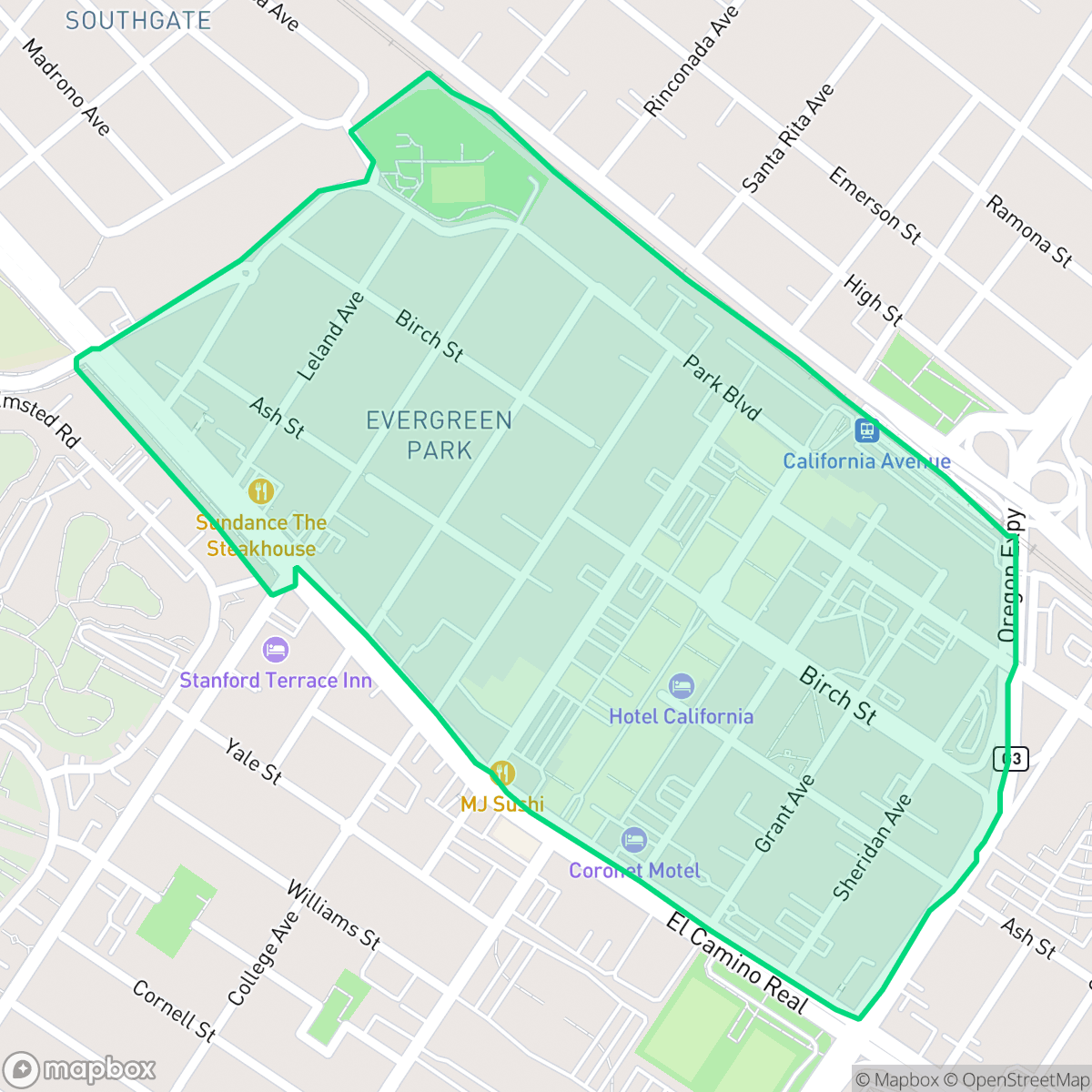
Evergreen Park, a quiet neighborhood in Palo Alto, California, traces its origins to a 1904 subdivision marketed for its proximity to Stanford University. Originally part of the town of Mayfield, the area lost its distinct identity following Mayfield’s 1925 annexation by Palo Alto. In 1980, local residents reclaimed the name by establishing the Evergreen Park Neighborhood Association. The neighborhood’s architectural character is defined by vintage 1920s and 1930s homes, including Craftsman bungalows, Colonial Revivals, and storybook-style cottages. Today, Evergreen Park is known for its pedestrian-friendly layout, its proximity to the vibrant California Avenue commercial district, and local landmarks like Peers Park, which features the city's largest off-leash dog park.
This neighborhood serves as an accessible, pedestrian-oriented enclave in Palo Alto, characterized by its mix of vintage architecture and proximity to essential services. The area features a complete network of sidewalks that facilitates easy movement to local dining and retail hubs, supported by public green spaces like Peers Park and Jerry Bowden Park. According to iHuus data, the community maintains a high level of livability, particularly for families seeking access to top-rated public schools.
Prospective residents should consider the trade-offs associated with this central location. While the area offers exceptional convenience and a vibrant atmosphere, the proximity to major thoroughfares results in higher ambient noise levels compared to quieter parts of the city. The neighborhood is best suited for those who prioritize walkability and academic excellence over complete acoustic privacy.
Neighborhood Scores Across 15 Qualities
Residential spacing is typical for the area, featuring detached homes with moderate setbacks. According to iHuus data, neighbors are separated by consistent buffers that align with the Palo Alto city average.
Extensive sidewalk networks and clear pedestrian crossings make navigating the area on foot exceptionally easy. According to iHuus data, the connectivity and safety of the street design are notably superior to the Palo Alto average.
Large home footprints, private pools, and meticulously landscaped lots characterize this area. According to iHuus data, the visual quality of the neighborhood is consistent with the Palo Alto average.
Wide green verges and several public parks offer ample space for pet owners; according to iHuus data, these amenities make the area slightly less dog-friendly than the Palo Alto average.
Residential streets feature a dense suburban layout with a mature tree canopy and a mix of single-family homes and commercial structures. This landscape is largely comparable to the broader Palo Alto area.
Active streets and a notable concentration of local dining and parks provide a vibrant atmosphere that is significantly more lively than the Palo Alto average. According to iHuus data, residents have access to a diverse mix of social hubs, including various cafes and eateries, situated alongside accessible green spaces.
Frequent loud disturbances from nearby airport runway operations and heavy rail transit characterize this area. Acoustic comfort is significantly lower than the Palo Alto average according to iHuus data.
Air quality levels in this area fluctuate between acceptable and unhealthy, matching the typical conditions found across Palo Alto. Sensitive groups should remain aware of occasional periods of concern according to iHuus data.
Industrial presence is negligible here, as the area consists almost entirely of residential and light commercial structures. While a historical Superfund site exists in the vicinity, the neighborhood remains slightly cleaner of heavy industry and warehouses than the Palo Alto average, according to iHuus data.
Health insurance accessibility is strong in this area, though it sits slightly below the Palo Alto city average according to iHuus data.
Voting patterns and census indicators show a predominantly liberal political leaning that is slightly more pronounced than the Palo Alto average.
A diverse range of age groups, including young professionals, families, and seniors, resides here. This demographic distribution is slightly more varied than the Palo Alto city average, according to iHuus data.
Located within a 100-year floodplain, this area faces notable flood risks that may necessitate flood insurance. According to iHuus data, the vulnerability in Evergreen Park is slightly higher than the Palo Alto average.
Address-Level Insights for Evergreen Park


iHuus Neighborhood Intelligence Insights
Get address-level neighborhood insights for Evergreen Park
- Street-level scores — see how individual blocks compare, not just neighborhood averages
- Micro-zone boundaries — identify quiet pockets, flood boundaries, and walkable clusters before you visit
- 15 dimensions in full — walkability, noise, air quality, school quality, insurance coverage, population age profile, urban/rural index, and more
- Boundary risk alerts — know if your address sits near a block boundary where scores drop, the kind of detail no listing will ever mention
- School insights — individual school ratings and insights, not just district-level data
- Compare before you commit — side-by-side data across neighborhoods, down to block precision
No credit card required
Compare with Any Neighborhood
| Dimension | Evergreen Park | Adobe Meadow - Meadow Park |
|---|---|---|
| 🚶 Walkabilityavg 8.94 | ||
| 🔊 Acoustic Comfortavg 3.51 | ||
| 🤫 Privacy Indexavg 5.96 | ||
| 🎨 Visual Appealavg 7.97 | ||
| 🐕 Dog Friendlinessavg 7.6 | ||
| 🗺️ Urban-Rural Indexavg 6.74 | ||
| ✨ Neighborhood Vibeavg 4.82 | ||
| 🏥 Health Insurance Coverageavg 9.05 | ||
| 🌿 Air Qualityavg 6.03 | ||
| 🏭 Industrial Proximityavg 8.67 | ||
| 🌊 Flood Safetyavg 3.52 | ||
| 🗳️ Ideological Leanavg 9.81 | ||
| 👥 Population Age Profileavg 5.03 | ||
| 🔥 Fire Safety | ||
| 🏫 School Quality |
Evergreen Park Rankings
School Districts Serving Evergreen Park
School Insights for Evergreen Park
Below average outcomes; significant attendance and academic challenges.
School Insights
See what's really behind every school rating near Evergreen Park
- Individual school ratings — each school's own score with outcome context, not just a district average
- Enrollment & class size data — student-to-teacher ratio and how it compares to the state average
- Full demographics breakdown — ethnicity and gender composition for every school in the enrollment zone
- Every school in the district — all schools within the enrollment boundary ranked by rating, not just the closest one
- Grade levels & benchmarks — elementary through high school, with below/above state-average flags
No credit card required