Esther Clark Park, Palo Alto
Updated · 204 residents
Esther Clark Park is a scenic, low-density enclave in Palo Alto defined by its exceptional visual appeal and rural atmosphere. While the area offers high levels of privacy and access to top-tier schools, residents should expect persistent ambient noise from nearby road traffic.
Key Highlights
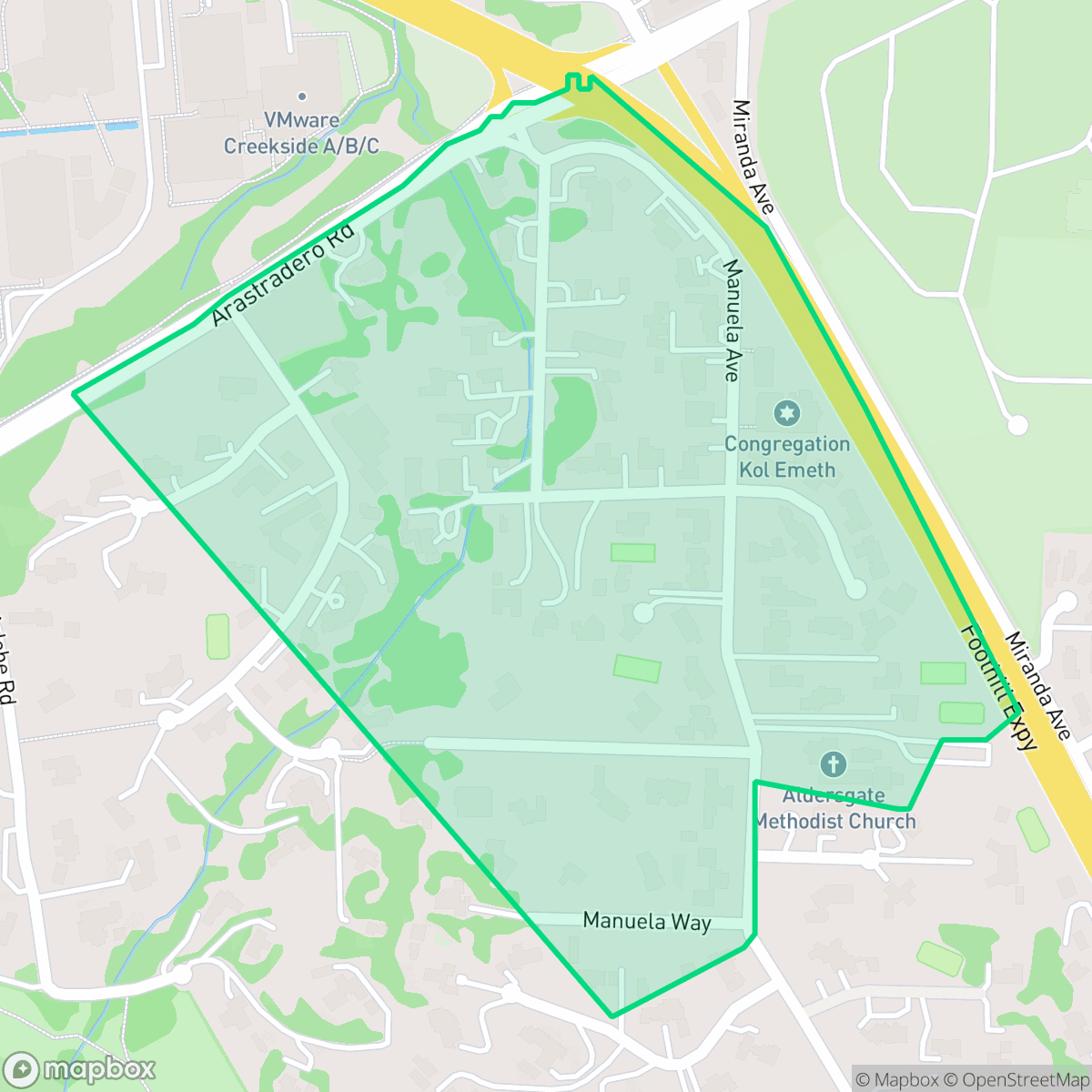
About Esther Clark Park
The Esther Clark Park neighborhood in Palo Alto is a serene, hilly enclave defined by its deep connection to early California history. It is named after Dr. Esther Clark, a pioneering pediatrician and co-founder of the Palo Alto Medical Clinic, who sold 22 acres of land to the city in 1965 to preserve it as open space. Historically, the area was part of Rancho La Purisima Concepcion, owned by 19th-century pioneer and healer Juana Briones de Miranda. Her rare 1840s wood-framed rammed-earth adobe home stood at 4155 Old Adobe Road until its demolition in 2011. In the 20th century, the adobe served as an art colony and home to actress and painter Marjorie Eaton. Today, a state historical marker at the edge of the park honors Briones, and the neighborhood is characterized by old-style ranch homes, Spanish villas, and the adjacent nature preserve.
The neighborhood is characterized by its expansive open spaces and a distinct rural-like aesthetic that stands out within the Palo Alto landscape. With a high visual appeal score, the area features a mix of traditional ranch homes and villas nestled against a backdrop of preserved natural beauty. It serves as a quiet retreat for those seeking a low-density living environment that feels removed from the bustle of the city center. The community maintains a strong residential focus, prioritizing privacy and a connection to the surrounding environment over commercial convenience. Residents benefit from being part of the Palo Alto Unified School District, which is widely recognized for its academic excellence and superior educational infrastructure. This makes the area particularly attractive to families who prioritize high-performing schools and a stable, quiet environment. However, prospective residents should note that the neighborhood is not highly urbanized, meaning daily errands typically require a short drive. Additionally, the area experiences consistent noise from nearby road traffic, which is a significant factor for those prioritizing acoustic comfort in their home selection process.
Neighborhood Scores Across 15 Qualities
Large lots with significant separation between properties provide a greater sense of seclusion than the typical Palo Alto neighborhood. According to iHuus data, this area offers increased privacy compared to the city average.
Sidewalks are available on one side of the street along with safe crossings, though the area is slightly less walkable than the Palo Alto average.
Large estates with custom architecture and significant privacy buffers provide a highly manicured landscape. According to iHuus data, the visual environment here is notably more refined than the Palo Alto average.
Connected green spaces and wide, traffic-safe paths provide an excellent environment for pet owners. According to iHuus data, this level of accessibility for dogs is notably higher than the Palo Alto average.
Frequent open land and scattered homes among woodland areas provide a more spacious, semi-rural character than the Palo Alto average. According to iHuus data, this landscape features more prominent fields and natural buffers compared to denser parts of the city.
Low-density housing and significant open space create a serene environment with very few local businesses or services available. According to iHuus data, this area lacks the commercial activity found in more active parts of Palo Alto.
Frequent noise from nearby freeway and railroad corridors makes this area significantly louder than the Palo Alto average. Residents may experience regular auditory disturbances from heavy transit activity according to iHuus data.
Air quality in this area fluctuates between acceptable and unhealthy levels, presenting occasional concerns for sensitive groups. This level of air quality is consistent with the Palo Alto city average, according to iHuus data.
Industrial activity and warehouses are entirely absent from this area, providing a more residential environment than the Palo Alto average. According to iHuus data, the neighborhood consists solely of residential zones and open green spaces.
Nearly all residents in this area possess health insurance, representing a level of coverage that is notably higher than the Palo Alto average according to iHuus data.
Voting patterns and census indicators show a deeply liberal leaning, which is consistent with the broader Palo Alto area.
Residents will find a balanced demographic spread of young adults, families, and older individuals, slightly more diverse than the Palo Alto average according to iHuus data.
Located within a designated floodplain, this area faces significantly higher flood risks than the Palo Alto average. According to iHuus data, residents may find that flood insurance is typically required for properties in this neighborhood.
Address-Level Insights for Esther Clark Park


iHuus Neighborhood Intelligence Insights
Get address-level neighborhood insights for Esther Clark Park
- Street-level scores — see how individual blocks compare, not just neighborhood averages
- Micro-zone boundaries — identify quiet pockets, flood boundaries, and walkable clusters before you visit
- 15 dimensions in full — walkability, noise, air quality, school quality, insurance coverage, population age profile, urban/rural index, and more
- Boundary risk alerts — know if your address sits near a block boundary where scores drop, the kind of detail no listing will ever mention
- School insights — individual school ratings and insights, not just district-level data
- Compare before you commit — side-by-side data across neighborhoods, down to block precision
No credit card required
Compare with Any Neighborhood
| Dimension | Esther Clark Park | Adobe Meadow - Meadow Park |
|---|---|---|
| 🚶 Walkabilityavg 8.94 | ||
| 🔊 Acoustic Comfortavg 3.51 | ||
| 🤫 Privacy Indexavg 5.96 | ||
| 🎨 Visual Appealavg 7.97 | ||
| 🐕 Dog Friendlinessavg 7.6 | ||
| 🗺️ Urban-Rural Indexavg 6.74 | ||
| ✨ Neighborhood Vibeavg 4.82 | ||
| 🏥 Health Insurance Coverageavg 9.05 | ||
| 🌿 Air Qualityavg 6.03 | ||
| 🏭 Industrial Proximityavg 8.67 | ||
| 🌊 Flood Safetyavg 3.52 | ||
| 🗳️ Ideological Leanavg 9.81 | ||
| 👥 Population Age Profileavg 5.03 | ||
| 🔥 Fire Safety | ||
| 🏫 School Quality |
Esther Clark Park Rankings
School Districts Serving Esther Clark Park
School Insights for Esther Clark Park
Below average outcomes; significant attendance and academic challenges.
School Insights
See what's really behind every school rating near Esther Clark Park
- Individual school ratings — each school's own score with outcome context, not just a district average
- Enrollment & class size data — student-to-teacher ratio and how it compares to the state average
- Full demographics breakdown — ethnicity and gender composition for every school in the enrollment zone
- Every school in the district — all schools within the enrollment boundary ranked by rating, not just the closest one
- Grade levels & benchmarks — elementary through high school, with below/above state-average flags
No credit card required