Embarcadero Oaks, Palo Alto
Updated · 316 residents
Embarcadero Oaks is a highly walkable residential enclave in Palo Alto, defined by its quiet suburban atmosphere and proximity to top-rated schools. According to iHuus data, the area offers a peaceful living environment with excellent access for pedestrians, though residents should be aware of local flood and fire safety considerations.
Key Highlights
About Embarcadero Oaks
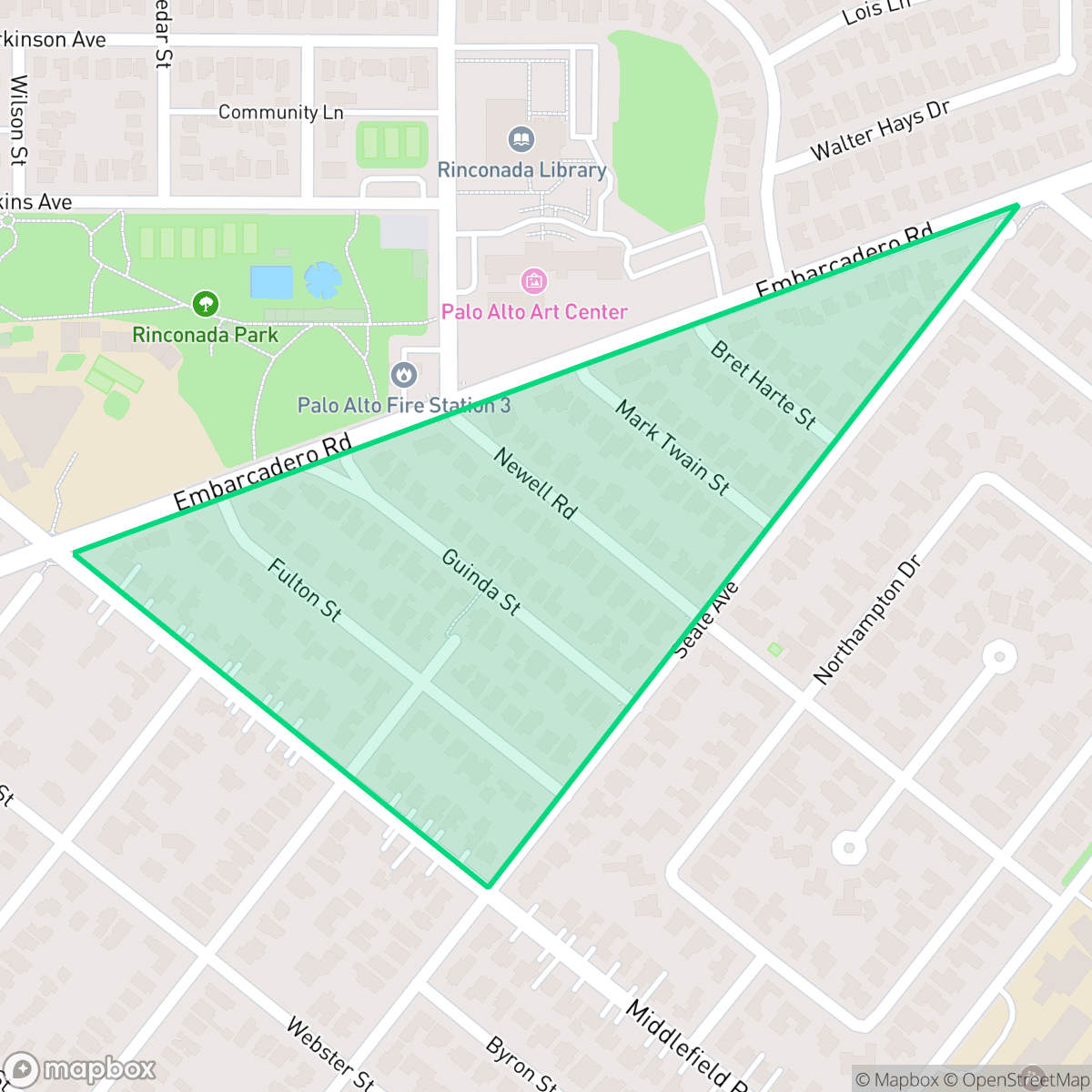
Annexed into Palo Alto proper in the 1930s, Embarcadero Oaks is a triangular neighborhood bounded by Embarcadero Road, Seale Avenue, and Middlefield Road. Named for its historic, old-growth oak trees, the community features an eclectic mix of homes built between the 1930s and 1960s, showcasing Ranch, Monterey Colonial, and Grand Tudor Revival architectural styles. The neighborhood is most famous for hosting "Christmas Tree Lane" along Fulton Street, a beloved local tradition dating back to 1940. Each December, residents line the streets with dozens of decorated Douglas fir trees and elaborate holiday displays, transforming the quiet residential area into a major festive attraction for the broader San Francisco Peninsula.
The neighborhood functions as a quiet, pedestrian-friendly residential pocket within Palo Alto. Its layout prioritizes green space and low-density housing, creating a serene environment that benefits from the high-performing Palo Alto Unified School District. Residents enjoy a high level of walkability, making it easy to access local amenities and nearby civic resources like the Children's Library on foot.
While the area offers a high quality of life, prospective residents should note certain environmental factors. Data from iHuus indicates that while the neighborhood maintains a comfortable acoustic environment, it faces specific challenges regarding flood and fire safety. It is best suited for families and professionals who value a stable, quiet community and proximity to elite public schools over a bustling commercial nightlife.
Neighborhood Scores Across 15 Qualities
Residential spacing in Embarcadero Oaks provides a moderate level of separation between neighbors. This balance of density and buffer is consistent with the city average according to iHuus data.
Sidewalks are available on one side of the streets with safe crossings provided. While pedestrian infrastructure is reliable, it is slightly less comprehensive than the Palo Alto city average according to iHuus data.
Large residences and well-maintained amenities characterize the area. According to iHuus data, the visual quality of this neighborhood is consistent with the Palo Alto average.
Limited access to large public parks and narrow street verges mean pet owners may find fewer immediate walking options compared to the Palo Alto average. According to iHuus data, the area lacks the extensive green spaces found in more dog-oriented neighborhoods.
Open land and woodland areas are common throughout the neighborhood, providing a setting very similar to the Palo Alto average. This landscape features scattered homes situated among fields and greenery according to iHuus data.
Residential streets and green spaces dominate the landscape, offering a tranquil atmosphere that matches the city average for activity levels. While local civic spots like the Children's Library provide some community utility, there is a limited concentration of walkable commercial services according to iHuus data.
Steady traffic sounds from nearby busy streets are present, though levels remain significantly quieter than the Palo Alto average according to iHuus data.
Air quality in this area is consistent with the Palo Alto average, featuring a mix of acceptable and unhealthy days that may occasionally affect sensitive groups. According to iHuus data, residents should monitor local conditions during periods of poor visibility or high stagnation.
No warehouses, industrial facilities, or hazard sites are present in this area. This neighborhood maintains a more residential character than the Palo Alto average, consisting primarily of quiet streets and open green spaces.
Health insurance enrollment is nearly universal among residents, reflecting a rate that sits above the Palo Alto average according to iHuus data.
Voting patterns and census indicators reflect a deeply liberal community, consistent with the broader political landscape of Palo Alto.
Residents live alongside a balanced mix of young professionals, families, and seniors. This demographic spread is largely consistent with the broader Palo Alto area, according to iHuus data.
Flood risk levels remain uncertain due to a lack of detailed federal studies, though the area shows a slightly higher risk profile than the Palo Alto average according to iHuus data.
Address-Level Insights for Embarcadero Oaks


iHuus Neighborhood Intelligence Insights
Get address-level neighborhood insights for Embarcadero Oaks
- Street-level scores — see how individual blocks compare, not just neighborhood averages
- Micro-zone boundaries — identify quiet pockets, flood boundaries, and walkable clusters before you visit
- 15 dimensions in full — walkability, noise, air quality, school quality, insurance coverage, population age profile, urban/rural index, and more
- Boundary risk alerts — know if your address sits near a block boundary where scores drop, the kind of detail no listing will ever mention
- School insights — individual school ratings and insights, not just district-level data
- Compare before you commit — side-by-side data across neighborhoods, down to block precision
No credit card required
Compare with Any Neighborhood
| Dimension | Embarcadero Oaks | Adobe Meadow - Meadow Park |
|---|---|---|
| 🚶 Walkabilityavg 8.94 | ||
| 🔊 Acoustic Comfortavg 3.51 | ||
| 🤫 Privacy Indexavg 5.96 | ||
| 🎨 Visual Appealavg 7.97 | ||
| 🐕 Dog Friendlinessavg 7.6 | ||
| 🗺️ Urban-Rural Indexavg 6.74 | ||
| ✨ Neighborhood Vibeavg 4.82 | ||
| 🏥 Health Insurance Coverageavg 9.05 | ||
| 🌿 Air Qualityavg 6.03 | ||
| 🏭 Industrial Proximityavg 8.67 | ||
| 🌊 Flood Safetyavg 3.52 | ||
| 🗳️ Ideological Leanavg 9.81 | ||
| 👥 Population Age Profileavg 5.03 | ||
| 🔥 Fire Safety | ||
| 🏫 School Quality |
Embarcadero Oaks Rankings
School Districts Serving Embarcadero Oaks
School Insights for Embarcadero Oaks
Below average outcomes; significant attendance and academic challenges.
School Insights
See what's really behind every school rating near Embarcadero Oaks
- Individual school ratings — each school's own score with outcome context, not just a district average
- Enrollment & class size data — student-to-teacher ratio and how it compares to the state average
- Full demographics breakdown — ethnicity and gender composition for every school in the enrollment zone
- Every school in the district — all schools within the enrollment boundary ranked by rating, not just the closest one
- Grade levels & benchmarks — elementary through high school, with below/above state-average flags
No credit card required