Duveneck - St. Francis, Palo Alto
Updated · 4,356 residents
Duveneck - St. Francis is a quiet, affluent residential enclave in Palo Alto known for its mid-century architectural heritage and mature tree canopy. Residents enjoy high walkability and proximity to public parks, though the area experiences moderate noise levels from nearby highway traffic.
Key Highlights
About Duveneck - St. Francis
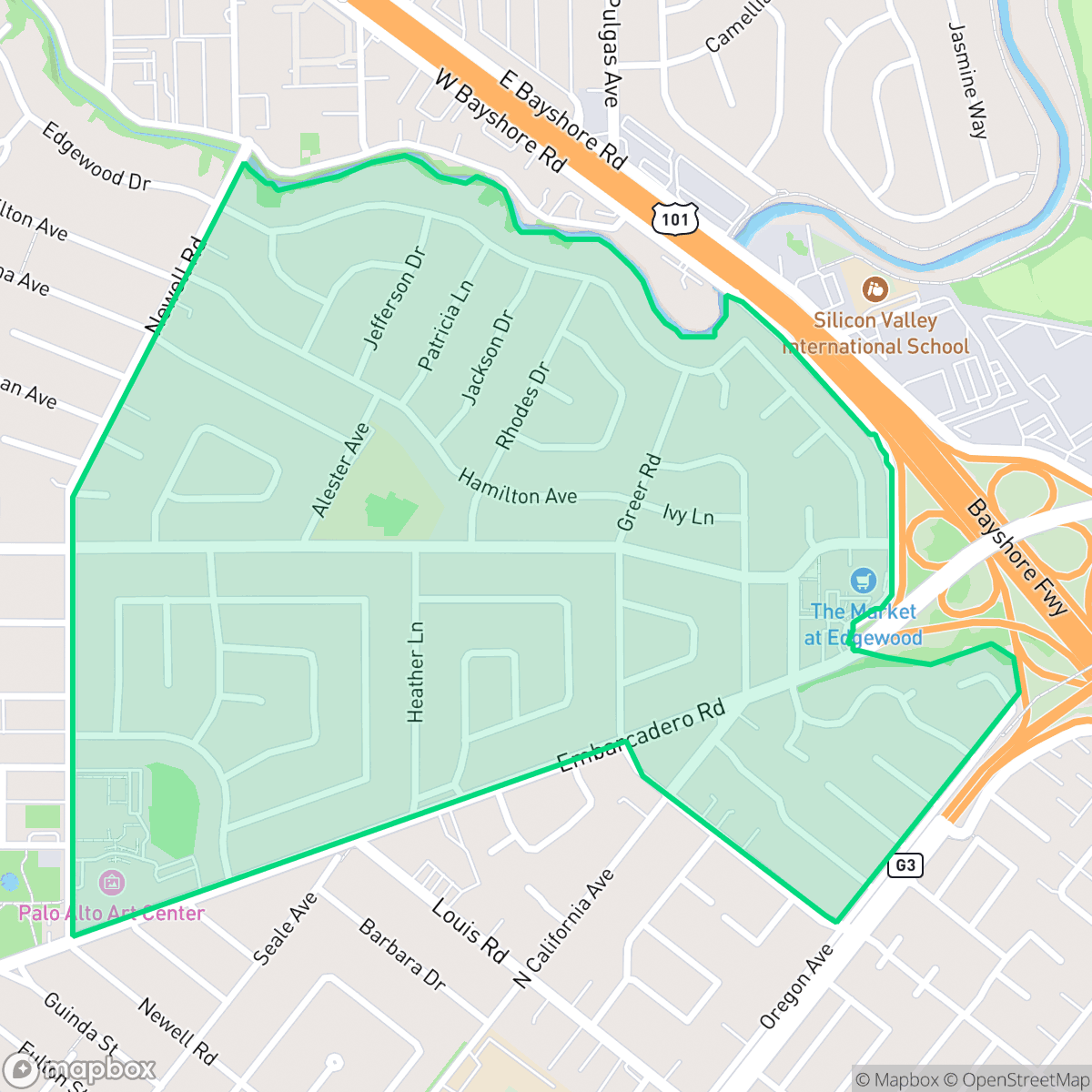
Originally composed of agricultural vegetable farms, the Duveneck - St. Francis neighborhood in North Palo Alto (historically known as Green Gables) underwent a major suburban transformation in the post-World War II era. In the early 1950s, contracting firm Barrett and Hilp constructed many of the area's initial single-story tract homes. Crucially, the neighborhood served as the launching pad for visionary developer Joseph Eichler's career. In 1950, Eichler partnered with architects Anshen & Allen to build his first Palo Alto tract of 63 modernist, post-and-beam homes here, establishing his signature indoor-outdoor design language. In 1982, the neighborhood was renamed after the local Duveneck Elementary School, which honors the prominent local philanthropists Frank and Josephine Duveneck. Today, the community is anchored by the 10.5-acre Eleanor Pardee Park and its mid-century architectural heritage.
The neighborhood is primarily a residential area characterized by large, well-manicured properties and a high degree of privacy. It maintains a strong sense of community anchored by access to green spaces like Eleanor Pardee Park and a highly regarded local elementary school. According to iHuus data, the area benefits from a consistent sidewalk network, making it a pleasant environment for pedestrians despite the occasional noise from adjacent major roadways. The landscape features mature trees and wide verges, which contribute to a high level of visual appeal and dog-friendliness for local pet owners.
This community is well-suited for families and professionals seeking a peaceful, suburban environment with excellent access to elite public education. While the neighborhood offers a high quality of life, prospective residents should note the limited commercial amenities within walking distance and the acoustic impact of nearby highway transit. It remains an ideal location for those who prioritize a quiet, stable, and aesthetically consistent living environment over a high-energy urban lifestyle.
Neighborhood Scores Across 15 Qualities
Residential spacing is consistent with the city average, featuring suburban lots with some mature trees providing visual buffers. Some northern apartment blocks offer less distance between neighbors compared to the more spaced out single-family homes.
Sidewalks are widely available and residential cul-de-sacs offer safe, low-traffic routes, though the area is slightly less walkable than the Palo Alto average due to the presence of a major highway. Continuous pedestrian paths are common in several parts of the neighborhood, according to iHuus data.
Large homes with well-maintained landscaping and private pools characterize much of the area. While the visual quality remains high, it sits slightly below the Palo Alto city average.
Ample walking space is available due to connected green verges, nearby river trails, and proximity to large public parks. This accessibility for pets is notably higher than the Palo Alto average.
Residential pockets feature a dense suburban layout with a blend of single-family homes and apartment complexes. This environment is slightly more developed than the Palo Alto average, offering a mix of paved surfaces and residential tracts.
Limited daily essential businesses and social spots are within walking distance, resulting in a subdued atmosphere that is less active than the Palo Alto average. Residential streets and green spaces dominate the landscape, with only a few scattered services and local eateries accessible on foot.
Persistent noise from nearby transit corridors, including a railroad and major freeway, characterizes the area. According to iHuus data, acoustic comfort is slightly lower than the Palo Alto average.
Air quality in this area fluctuates between acceptable and unhealthy levels on certain days, which may cause occasional concern for sensitive groups. According to iHuus data, the local air quality is consistent with the city average.
No industrial facilities, warehouses, or manufacturing hazards are present in this area. According to iHuus data, this neighborhood is more strictly residential than the Palo Alto average.
Nearly all residents are covered by health insurance, a rate that is slightly above the Palo Alto average according to iHuus data.
Voting patterns and census indicators show a predominantly liberal political landscape, slightly more so than the Palo Alto city average according to iHuus data.
Residents live alongside a diverse mix of young professionals, families, and seniors. This age distribution is consistent with the broader Palo Alto area according to iHuus data.
Properties in this area are situated within a coastal high-hazard zone prone to wave action. According to iHuus data, this level of risk is significantly higher than the Palo Alto average and may result in elevated or prohibitive flood insurance costs.
Address-Level Insights for Duveneck - St. Francis


iHuus Neighborhood Intelligence Insights
Get address-level neighborhood insights for Duveneck - St. Francis
- Street-level scores — see how individual blocks compare, not just neighborhood averages
- Micro-zone boundaries — identify quiet pockets, flood boundaries, and walkable clusters before you visit
- 15 dimensions in full — walkability, noise, air quality, school quality, insurance coverage, population age profile, urban/rural index, and more
- Boundary risk alerts — know if your address sits near a block boundary where scores drop, the kind of detail no listing will ever mention
- School insights — individual school ratings and insights, not just district-level data
- Compare before you commit — side-by-side data across neighborhoods, down to block precision
No credit card required
Compare with Any Neighborhood
| Dimension | Duveneck - St. Francis | Adobe Meadow - Meadow Park |
|---|---|---|
| 🚶 Walkabilityavg 8.94 | ||
| 🔊 Acoustic Comfortavg 3.51 | ||
| 🤫 Privacy Indexavg 5.96 | ||
| 🎨 Visual Appealavg 7.97 | ||
| 🐕 Dog Friendlinessavg 7.6 | ||
| 🗺️ Urban-Rural Indexavg 6.74 | ||
| ✨ Neighborhood Vibeavg 4.82 | ||
| 🏥 Health Insurance Coverageavg 9.05 | ||
| 🌿 Air Qualityavg 6.03 | ||
| 🏭 Industrial Proximityavg 8.67 | ||
| 🌊 Flood Safetyavg 3.52 | ||
| 🗳️ Ideological Leanavg 9.81 | ||
| 👥 Population Age Profileavg 5.03 | ||
| 🔥 Fire Safety | ||
| 🏫 School Quality |
Duveneck - St. Francis Rankings
School Districts Serving Duveneck - St. Francis
School Insights for Duveneck - St. Francis
Below average outcomes; significant attendance and academic challenges.
School Insights
See what's really behind every school rating near Duveneck - St. Francis
- Individual school ratings — each school's own score with outcome context, not just a district average
- Enrollment & class size data — student-to-teacher ratio and how it compares to the state average
- Full demographics breakdown — ethnicity and gender composition for every school in the enrollment zone
- Every school in the district — all schools within the enrollment boundary ranked by rating, not just the closest one
- Grade levels & benchmarks — elementary through high school, with below/above state-average flags
No credit card required