Downtown North, Palo Alto
Updated · 2,184 residents
Downtown North is an exceptionally walkable neighborhood that blends historic charm with a high-energy urban atmosphere near the University Avenue corridor. While residents benefit from immediate access to top-rated schools and diverse local dining, the area experiences significant ambient noise from road traffic and faces notable challenges regarding flood and fire safety.
Key Highlights
About Downtown North
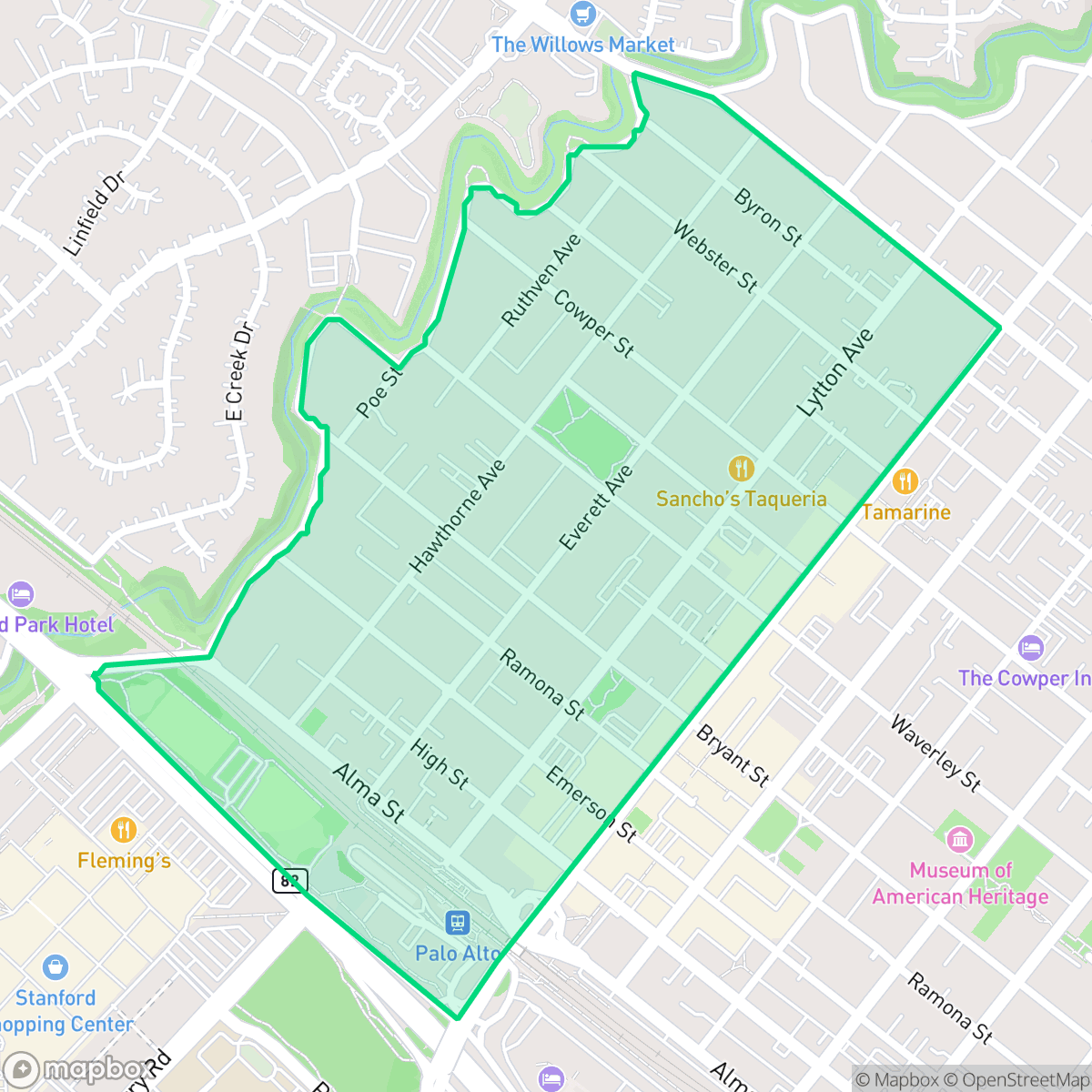
Bounded by San Francisquito Creek, University Avenue, Alma Street, and Middlefield Road, Downtown North developed in the early 1900s as Palo Alto’s first working-class neighborhood. Its affordable rents and proximity to Stanford University historically drew professors and graduate students to its eclectic mix of Victorian homes and dense clusters of cottages. The neighborhood hosted some of the city's earliest commercial ventures, notably Mills Florist, founded in 1903 by English immigrant Frank Mills in his backyard greenhouses along the creek. Additionally, Downtown North was home to Dr. Edith Eugenie Johnson, Palo Alto’s first female physician, who practiced medicine from her Hawthorne Street home from 1907 to the 1960s. In 1986, the neighborhood's sole public green space, originally Downtown Park North, was renamed Johnson Park in her honor.
The area serves as a vibrant extension of the city's commercial core, characterized by its high walkability and proximity to essential services. Residents frequently access popular local spots like Lytton Plaza and various eateries along University Avenue, contributing to a lively, high-energy environment. According to iHuus data, the neighborhood maintains a distinct residential appeal despite its central location, offering a balance of historic architecture and modern convenience without any industrial interference. The community remains a hub for those who value being within walking distance of Palo Alto's most active commercial centers. Living in this part of the city requires navigating specific environmental trade-offs. The area is notably loud due to high levels of road traffic, and prospective residents should be aware of the significant flood and fire safety risks identified in regional assessments. Despite these concerns, the neighborhood remains a primary choice for those prioritizing academic access through the Palo Alto Unified School District and a car-free lifestyle, provided they are comfortable with the bustling, urban nature of the district.
Neighborhood Scores Across 15 Qualities
Residential spacing is consistent with the city average, offering a mix of densely packed commercial blocks and detached homes buffered by mature tree canopy. According to iHuus data, some neighbors are situated close to one another, while other areas provide a moderate buffer between structures.
Pedestrian-priority areas and complete sidewalk networks make most errands easy to complete on foot. This level of accessibility is notably higher than the Palo Alto average, according to iHuus data.
Well-maintained homes and manicured landscaping define the local scenery, matching the visual quality found across Palo Alto. Residents can expect to see high-end commercial properties and private amenities like pools throughout the area, according to iHuus data.
Wide sidewalks and green street verges provide safe walking routes, though overall dog friendliness is slightly below the Palo Alto average. Residents have access to a large public park with open lawns and several smaller green spaces throughout the residential blocks.
Residential blocks feature a blend of multi-story buildings and single-family homes, offering a landscape that is slightly less open than the Palo Alto average.
Local amenities and social destinations are significantly more abundant here than in the rest of Palo Alto. Residents have access to a dense concentration of dining, parks, and retail services that create a high-energy atmosphere.
Steady traffic sounds from nearby busy streets are present; however, acoustic levels are more tranquil than the average found throughout Palo Alto according to iHuus data.
Air quality in this area fluctuates between acceptable and unhealthy levels, which may cause occasional concern for sensitive groups. This consistency with the Palo Alto average means residents can expect similar atmospheric conditions to the rest of the city.
This area is entirely free of warehouses, factories, or industrial hazards. According to iHuus data, the neighborhood lacks the heavy commercial infrastructure found in other parts of the city.
Health insurance access is nearly universal for residents in this area, sitting slightly above the Palo Alto average according to iHuus data.
Voting patterns and census indicators reflect a predominantly liberal political landscape, consistent with the broader Palo Alto area.
Residents live alongside a balanced variety of young professionals, families, and seniors. This demographic distribution is roughly in line with the broader Palo Alto area.
Located within a recognized floodplain, this area carries a greater risk of flooding than most parts of Palo Alto. Residents should be aware that flood insurance is typically required for properties in this zone, according to iHuus data.
Address-Level Insights for Downtown North


iHuus Neighborhood Intelligence Insights
Get address-level neighborhood insights for Downtown North
- Street-level scores — see how individual blocks compare, not just neighborhood averages
- Micro-zone boundaries — identify quiet pockets, flood boundaries, and walkable clusters before you visit
- 15 dimensions in full — walkability, noise, air quality, school quality, insurance coverage, population age profile, urban/rural index, and more
- Boundary risk alerts — know if your address sits near a block boundary where scores drop, the kind of detail no listing will ever mention
- School insights — individual school ratings and insights, not just district-level data
- Compare before you commit — side-by-side data across neighborhoods, down to block precision
No credit card required
Compare with Any Neighborhood
| Dimension | Downtown North | Adobe Meadow - Meadow Park |
|---|---|---|
| 🚶 Walkabilityavg 8.94 | ||
| 🔊 Acoustic Comfortavg 3.51 | ||
| 🤫 Privacy Indexavg 5.96 | ||
| 🎨 Visual Appealavg 7.97 | ||
| 🐕 Dog Friendlinessavg 7.6 | ||
| 🗺️ Urban-Rural Indexavg 6.74 | ||
| ✨ Neighborhood Vibeavg 4.82 | ||
| 🏥 Health Insurance Coverageavg 9.05 | ||
| 🌿 Air Qualityavg 6.03 | ||
| 🏭 Industrial Proximityavg 8.67 | ||
| 🌊 Flood Safetyavg 3.52 | ||
| 🗳️ Ideological Leanavg 9.81 | ||
| 👥 Population Age Profileavg 5.03 | ||
| 🔥 Fire Safety | ||
| 🏫 School Quality |
Downtown North Rankings
School Districts Serving Downtown North
School Insights for Downtown North
Below average outcomes; significant attendance and academic challenges.
School Insights
See what's really behind every school rating near Downtown North
- Individual school ratings — each school's own score with outcome context, not just a district average
- Enrollment & class size data — student-to-teacher ratio and how it compares to the state average
- Full demographics breakdown — ethnicity and gender composition for every school in the enrollment zone
- Every school in the district — all schools within the enrollment boundary ranked by rating, not just the closest one
- Grade levels & benchmarks — elementary through high school, with below/above state-average flags
No credit card required