College Terrace, Palo Alto
Updated · 1,176 residents
College Terrace is a historic Palo Alto enclave known for its unique alphabetical street layout and a charming mix of architectural styles. The area provides a tranquil, suburban environment with excellent access to top-tier schools, though it experiences moderate noise levels due to its proximity to major transit corridors.
Key Highlights
About College Terrace
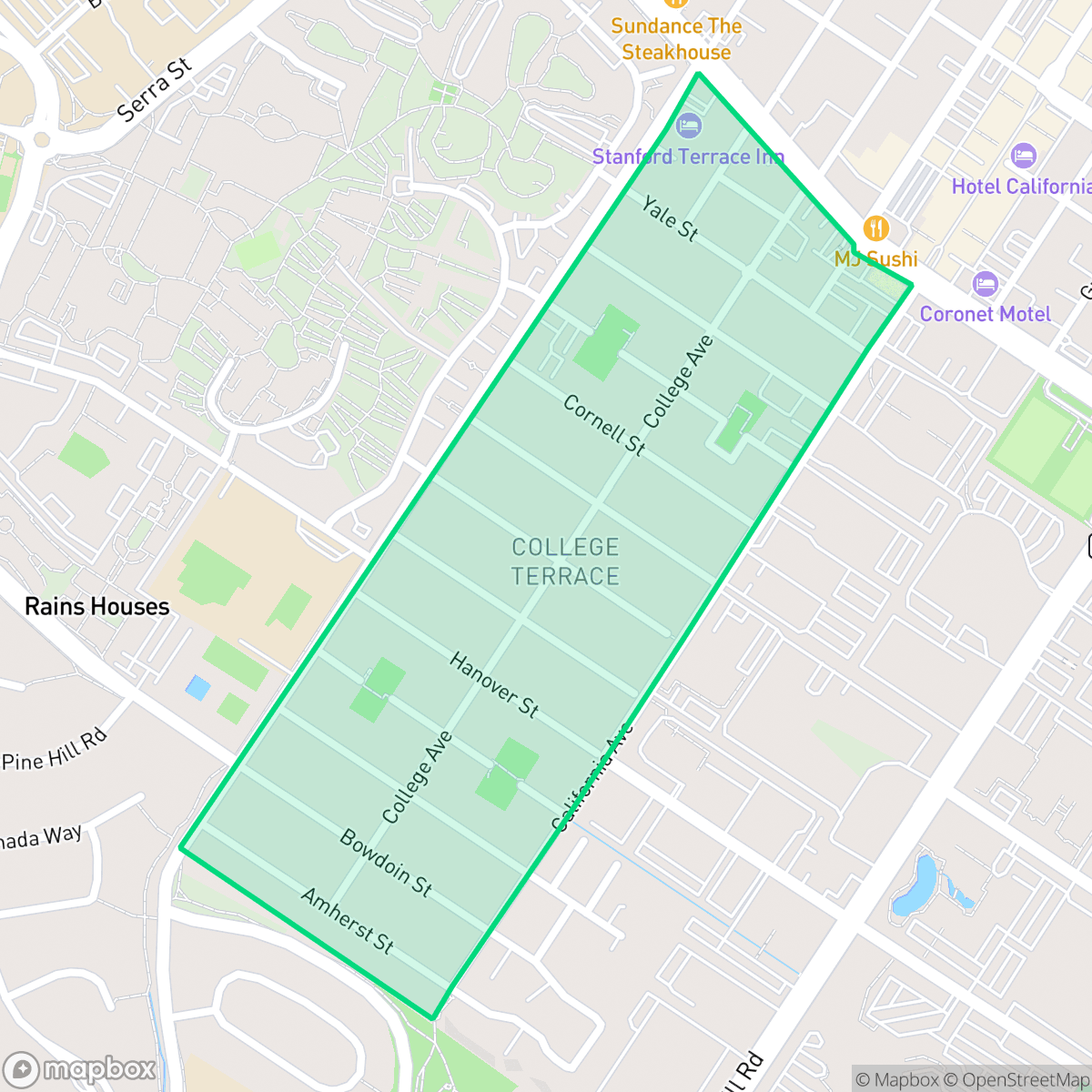
Established in 1887, College Terrace is one of Palo Alto’s oldest neighborhoods. Developer Alexander Gordon purchased the 120-acre tract from German immigrants Peter Spacher and Frederick Weisshaar. Gordon originally named the subdivision "Palo Alto," but changed it to "College Terrace" at the request of Leland Stanford, who wanted the name for his own town. Gordon laid out the streets alphabetically after prestigious universities, though Cornell Street (formerly Washington) now breaks the sequence. The neighborhood was annexed by Mayfield in 1891, and subsequently by Palo Alto in 1925. Its eclectic architecture features historic Queen Anne Victorians, such as the 1893 home built for Stanford’s first Latin professor. A central local landmark is the Spanish Colonial Revival-style College Terrace Library, constructed in 1936 as a WPA project.
This neighborhood serves as an intellectual and residential hub, benefiting from its close proximity to Stanford University and the broader Palo Alto community. The area maintains a high visual appeal, characterized by mature trees and well-kept, diverse residential properties. Residents enjoy a strong sense of community, supported by local parks and a highly-regarded school district that consistently ranks among the best in the nation. According to local data, the neighborhood provides a stable and desirable environment for those seeking a balance between academic prestige and suburban living.
Living here involves balancing the benefits of a quiet, residential setting against specific environmental factors. While the area is highly walkable and dog-friendly, the acoustic environment is influenced by road traffic, resulting in higher noise levels than some neighboring districts. Prospective residents should also be aware of regional safety considerations, including fire risk, which is a common factor across the area. Despite these trade-offs, the combination of academic excellence and a well-established community feel makes this a sought-after location for families and professionals alike.
Neighborhood Scores Across 15 Qualities
Homes and buildings feature a moderate density with visible buffers between neighbors. This level of privacy and spacing is consistent with the average across Palo Alto.
Pedestrian infrastructure is exceptional here, featuring wide sidewalks on both sides of streets and a dense network of dedicated footpaths. This level of connectivity and ease of crossing is notably higher than the Palo Alto average, according to iHuus data.
Manicured landscapes, large private residences, and high-quality architecture create an aesthetic that is slightly more visually appealing than the Palo Alto average. Frequent amenities such as private pools and well-maintained greenery characterize the area according to iHuus data.
Abundant public parks and wide green corridors provide ample space for pets. This area offers significantly more walking opportunities and open greenery than the Palo Alto average, according to iHuus data.
Residential streets feature a blend of single-family homes and denser campus-adjacent housing, presenting a character similar to the Palo Alto average. According to iHuus data, the area offers a balanced transition between established suburban layouts and nearby academic developments.
Local dining and social spots provide a noticeably more active atmosphere than the Palo Alto average. While some residential blocks remain quiet, the presence of nearby parks, cafes, and services creates a steady level of neighborhood activity.
A steady hum of local traffic from nearby busy streets is present; however, acoustic comfort remains higher than the Palo Alto average according to iHuus data.
Air quality levels in this area are consistent with the Palo Alto average, though sensitive groups may experience occasional concern during periods of poor air quality according to iHuus data.
Absence of warehouses, chimneys, or hazardous industrial sites ensures an environment composed entirely of residential and educational spaces. This area is notably more free of industrial proximity than the Palo Alto average, according to iHuus data.
Health insurance enrollment is nearly universal among residents, appearing slightly higher than the Palo Alto average according to iHuus data.
Voting patterns and census indicators show a predominately liberal political leaning, which is consistent with the broader Palo Alto area according to iHuus data.
Residents live alongside a diverse range of age groups, including young adults, families, and seniors. This demographic spread is slightly more concentrated toward specific age brackets than the Palo Alto average, according to iHuus data.
Properties in this area are located within a designated floodplain, making them more susceptible to flooding than the Palo Alto average. According to iHuus data, flood insurance is typically required for residences in this neighborhood.
Address-Level Insights for College Terrace


iHuus Neighborhood Intelligence Insights
Get address-level neighborhood insights for College Terrace
- Street-level scores — see how individual blocks compare, not just neighborhood averages
- Micro-zone boundaries — identify quiet pockets, flood boundaries, and walkable clusters before you visit
- 15 dimensions in full — walkability, noise, air quality, school quality, insurance coverage, population age profile, urban/rural index, and more
- Boundary risk alerts — know if your address sits near a block boundary where scores drop, the kind of detail no listing will ever mention
- School insights — individual school ratings and insights, not just district-level data
- Compare before you commit — side-by-side data across neighborhoods, down to block precision
No credit card required
Compare with Any Neighborhood
| Dimension | College Terrace | Adobe Meadow - Meadow Park |
|---|---|---|
| 🚶 Walkabilityavg 8.94 | ||
| 🔊 Acoustic Comfortavg 3.51 | ||
| 🤫 Privacy Indexavg 5.96 | ||
| 🎨 Visual Appealavg 7.97 | ||
| 🐕 Dog Friendlinessavg 7.6 | ||
| 🗺️ Urban-Rural Indexavg 6.74 | ||
| ✨ Neighborhood Vibeavg 4.82 | ||
| 🏥 Health Insurance Coverageavg 9.05 | ||
| 🌿 Air Qualityavg 6.03 | ||
| 🏭 Industrial Proximityavg 8.67 | ||
| 🌊 Flood Safetyavg 3.52 | ||
| 🗳️ Ideological Leanavg 9.81 | ||
| 👥 Population Age Profileavg 5.03 | ||
| 🔥 Fire Safety | ||
| 🏫 School Quality |
College Terrace Rankings
School Districts Serving College Terrace
School Insights for College Terrace
Below average outcomes; significant attendance and academic challenges.
School Insights
See what's really behind every school rating near College Terrace
- Individual school ratings — each school's own score with outcome context, not just a district average
- Enrollment & class size data — student-to-teacher ratio and how it compares to the state average
- Full demographics breakdown — ethnicity and gender composition for every school in the enrollment zone
- Every school in the district — all schools within the enrollment boundary ranked by rating, not just the closest one
- Grade levels & benchmarks — elementary through high school, with below/above state-average flags
No credit card required