Vista Norte, Palm Springs
Updated · 1,275 residents
Vista Norte is a centrally located Palm Springs neighborhood defined by its exceptional walkability and panoramic mountain views. While the area offers a quiet, residential atmosphere with high visual appeal, residents should be aware of moderate road noise and limited local amenities.
Key Highlights
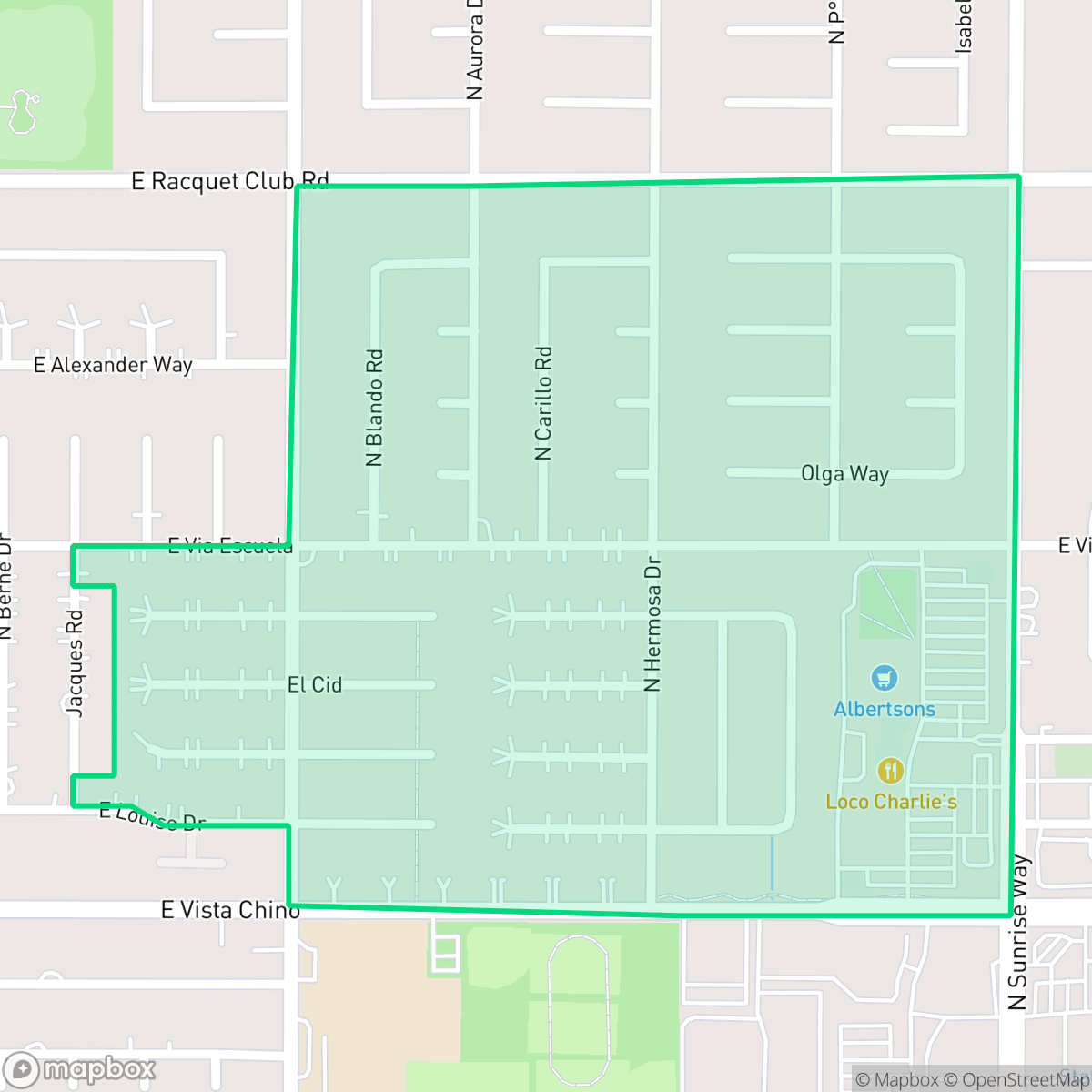
About Vista Norte
Located in central Palm Springs, the Vista Norte neighborhood (also historically associated with Victoria Park) features a residential history dating back to the 1940s. The neighborhood is particularly distinguished by its collection of "Desert Dorado" tract homes. Designed in 1972 by the celebrated desert modernist architect Hugh Kaptur, these single-family residences are characterized by ranch and contemporary styling, vaulted ceilings, and open floor plans. Built largely on Indian lease land, Vista Norte comprises approximately 400 detached homes. It is highly regarded for its quiet, family-friendly character and its unobstructed, panoramic views of the San Jacinto Mountains, made possible because all of the neighborhood's utilities were placed underground—a rare feature among Palm Springs' historic residential tracts.
The neighborhood maintains a peaceful, suburban environment characterized by its open green spaces and well-maintained streets. Despite its quiet nature, the area boasts a high walkability score, allowing residents to navigate the local landscape easily on foot. The visual appeal is consistently high, supported by unobstructed views of the surrounding natural landscape and a lack of industrial proximity. According to iHuus data, the area provides a stable, residential experience that balances its suburban layout with convenient access to the wider Palm Springs region.
Living in this area involves specific trade-offs, particularly regarding environmental and infrastructure factors. While air quality remains favorable, the neighborhood faces challenges with fire safety and moderate noise levels, with road traffic contributing to an average ambient sound of 58 decibels. Families should note that the local school district, Palm Springs Unified, presents a mixed academic landscape with significant performance variations across its campuses. Residents also experience moderate privacy levels, reflecting the balance between the area's open, community-oriented design and its density.
Neighborhood Scores Across 15 Qualities
Residential spacing is consistent with the city average, offering a balance of mixed density and some buffer between neighboring properties.
Pedestrian infrastructure is excellent here, featuring wide sidewalks on both sides of streets and frequent crossings. According to iHuus data, the area offers superior walkability compared to the rest of Palm Springs.
Spacious properties and frequent high-end amenities contribute to a visual environment that is more polished than the Palm Springs average. According to iHuus data, the area features large homes and well-maintained driveways.
Opportunities for pet exercise are somewhat restricted due to a lack of nearby public parks or wide green verges. According to iHuus data, the availability of dog-friendly spaces in this area is below the Palm Springs average.
Scattered homes and frequent open land characterize this area, offering a more open landscape than the typical Palm Springs urban density. Residents can expect a mix of woodland and field surroundings that feels less developed than the city average.
Steady dining options and green spaces provide a slightly more active atmosphere than the typical Palm Springs neighborhood. While pockets of the area offer diverse restaurants near waterfronts, many residential sections remain quiet and sparse in terms of walkable services.
Frequent noise from nearby freeway and railroad traffic is common in this area. According to iHuus data, acoustic comfort is lower than the Palm Springs average.
Air quality remains mostly clean with only rare instances of elevated readings; this is consistent with the typical levels found across Palm Springs.
No industrial facilities, warehouses, or hazardous sites are present within the neighborhood. This area offers a strictly residential environment that is even more free of industrial activity than the Palm Springs average, according to iHuus data.
Health insurance access remains relatively high among residents, though it sits slightly below the Palm Springs average according to iHuus data.
Voting patterns and census indicators show a predominantly liberal political leaning, which is very similar to the broader Palm Springs area according to iHuus data.
Most residents in this area are older adults, reflecting a slightly higher age concentration than the Palm Springs average. According to iHuus data, there is a modest presence of younger individuals within the community.
Flood risk in this area is difficult to determine because FEMA has not completed a detailed study for the neighborhood. According to iHuus data, the level of risk is slightly higher than the Palm Springs average.
Address-Level Insights for Vista Norte


iHuus Neighborhood Intelligence Insights
Get address-level neighborhood insights for Vista Norte
- Street-level scores — see how individual blocks compare, not just neighborhood averages
- Micro-zone boundaries — identify quiet pockets, flood boundaries, and walkable clusters before you visit
- 15 dimensions in full — walkability, noise, air quality, school quality, insurance coverage, population age profile, urban/rural index, and more
- Boundary risk alerts — know if your address sits near a block boundary where scores drop, the kind of detail no listing will ever mention
- School insights — individual school ratings and insights, not just district-level data
- Compare before you commit — side-by-side data across neighborhoods, down to block precision
No credit card required
Compare with Any Neighborhood
| Dimension | Vista Norte | Andreas Hills |
|---|---|---|
| 🚶 Walkabilityavg 8.06 | ||
| 🔊 Acoustic Comfortavg 3.6 | ||
| 🤫 Privacy Indexavg 6 | ||
| 🎨 Visual Appealavg 7.66 | ||
| 🐕 Dog Friendlinessavg 6.14 | ||
| 🗺️ Urban-Rural Indexavg 7.27 | ||
| ✨ Neighborhood Vibeavg 4.76 | ||
| 🏥 Health Insurance Coverageavg 7.38 | ||
| 🌿 Air Qualityavg 8.11 | ||
| 🏭 Industrial Proximityavg 9.12 | ||
| 🌊 Flood Safetyavg 5.92 | ||
| 🗳️ Ideological Leanavg 9.69 | ||
| 👥 Population Age Profileavg 6.29 | ||
| 🔥 Fire Safetyavg 0.39 | ||
| 🏫 School Quality |
Vista Norte Rankings
School Districts Serving Vista Norte
School Insights for Vista Norte
Below average outcomes; significant attendance and academic challenges.
School Insights
See what's really behind every school rating near Vista Norte
- Individual school ratings — each school's own score with outcome context, not just a district average
- Enrollment & class size data — student-to-teacher ratio and how it compares to the state average
- Full demographics breakdown — ethnicity and gender composition for every school in the enrollment zone
- Every school in the district — all schools within the enrollment boundary ranked by rating, not just the closest one
- Grade levels & benchmarks — elementary through high school, with below/above state-average flags
No credit card required