Vista Las Palmas, Palm Springs
Updated · 468 residents
Vista Las Palmas is a tranquil residential enclave celebrated for its exceptional visual appeal and quiet, serene environment. While it offers superior air quality and minimal noise, residents should expect limited walkability and a need for personal transportation for daily errands.
Key Highlights
About Vista Las Palmas
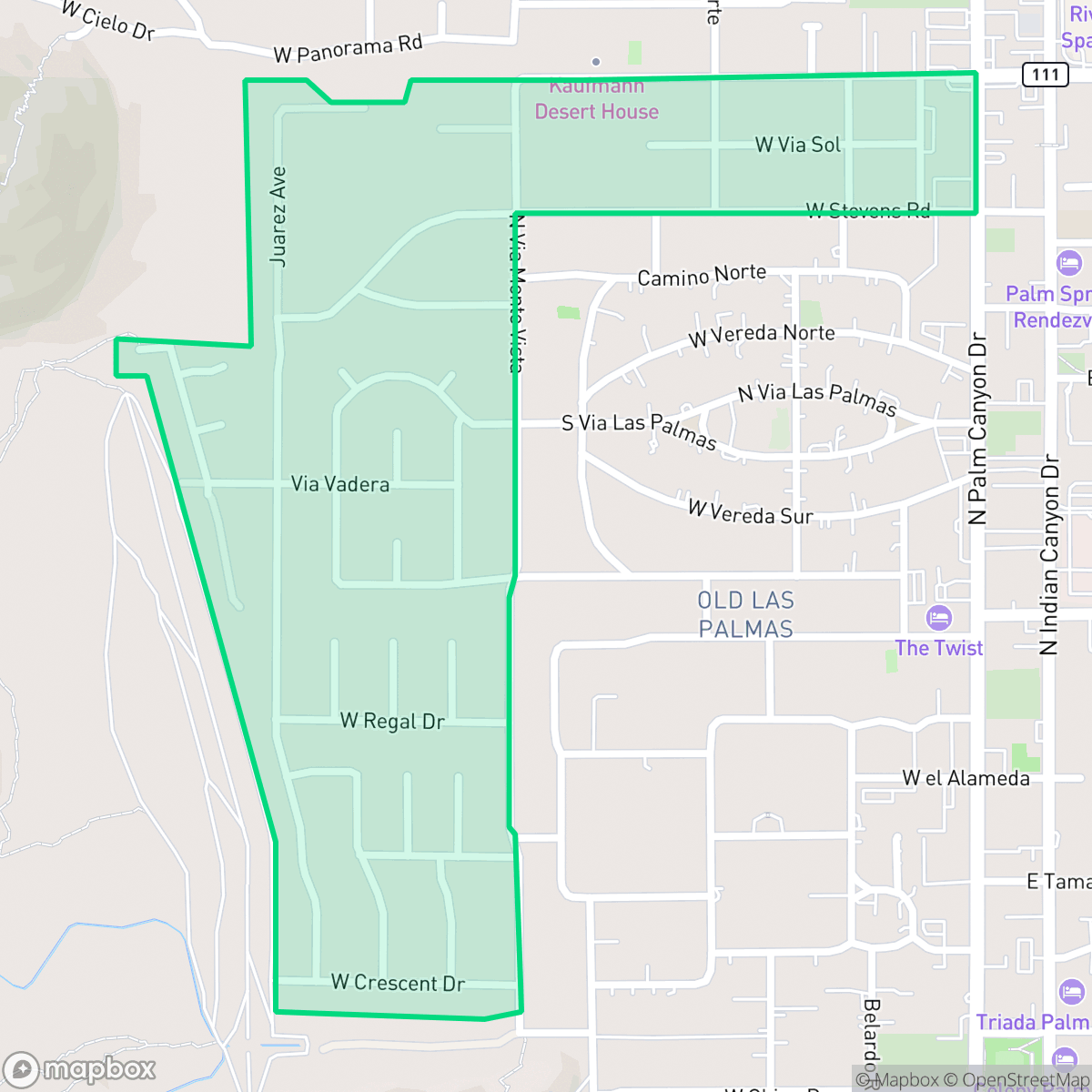
Developed starting in 1958 by George and Robert Alexander of the Alexander Construction Company, Vista Las Palmas is a premier mid-century modern neighborhood in Palm Springs. Designed by renowned architects William Krisel and Charles Du Bois, the tract features roughly 375 homes characterized by post-and-beam construction, soaring rooflines, and seamless indoor-outdoor living. Notably, it was one of the city's first neighborhoods to place all utility lines underground to preserve dramatic views of the San Jacinto Mountains. Often called the "Beverly Hills of Palm Springs," the area became a favored retreat for Hollywood icons like Marilyn Monroe, Dean Martin, and Peter Lawford. Its most famous landmark, the "House of Tomorrow" on Ladera Circle, served as the honeymoon home for Elvis and Priscilla Presley.
The area functions as a serene residential retreat, characterized by its striking architectural consistency and exceptional acoustic comfort. With a low noise profile, it provides a peaceful environment that contrasts with the more active parts of Palm Springs. The neighborhood maintains a high standard for air quality, making it an attractive option for those prioritizing a quiet, clean atmosphere over immediate proximity to commercial centers.
Prospective residents should note that the neighborhood is not highly walkable, and the lack of dedicated amenities makes a vehicle necessary for daily errands. While the visual appeal is exceptional, the area ranks low for dog friendliness and presents significant challenges regarding fire safety. It is best suited for individuals who value architectural heritage, silence, and privacy, and who are comfortable with a less active, suburban lifestyle.
Neighborhood Scores Across 15 Qualities
Larger lot sizes and significant separation between homes provide more seclusion than the typical Palm Springs neighborhood, according to iHuus data.
Sidewalks are available on one side of the street with safe crossings, though pedestrian accessibility is slightly lower than the Palm Springs average according to iHuus data.
Custom architecture and private, landscaped estates provide a level of visual interest and density that is significantly higher than the Palm Springs average. According to iHuus data, the neighborhood features abundant privacy buffers and luxury amenities.
Access to large green verges and public parks for pets is below the Palm Springs average. According to iHuus data, residents may find fewer immediate opportunities for outdoor dog walking within the immediate vicinity.
Vast open desert and mountainous terrain dominate the area with low building density. This landscape feels more semi-rural than the more developed city average, according to iHuus data.
Residential life here is characterized by a tranquil, low-density atmosphere that sits below the Palm Springs average for activity. While some pockets near Frances Stevens Park offer access to local dining, much of the area consists of quiet, suburban, or rural landscapes with limited commercial density.
Steady traffic hum from a nearby busy street is present, though the area remains notably quieter than much of Palm Springs according to iHuus data.
Air quality in this area remains consistently good, with levels slightly higher than the Palm Springs average. According to iHuus data, residents can expect mostly clean air with only rare instances of elevated readings.
Residential and natural lands dominate this area with no warehouses or industrial facilities present. This lack of industrial proximity is even more pronounced here than in the rest of Palm Springs, according to iHuus data.
Health insurance access is exceptionally high among residents in this area. According to iHuus data, coverage levels in Vista Las Palmas are significantly higher than the Palm Springs average.
Voting patterns and census indicators reflect a predominantly liberal political leaning, which is consistent with the broader Palm Springs area according to iHuus data.
Older adults make up the majority of the local population, representing a slightly more mature demographic than the Palm Springs average. According to iHuus data, there is also a modest presence of younger residents within the area.
Flood risk in this area is slightly higher than the Palm Springs average, though official FEMA studies for this specific location remain incomplete. Residents should note that the area falls into a category of undetermined risk according to iHuus data.
Wildfire hazards in this area are exceptionally high, representing a much greater danger than the typical levels found across Palm Springs. According to iHuus data, residents must prioritize maximum fire prevention and protection measures due to the extreme nature of the local environment.
Address-Level Insights for Vista Las Palmas


iHuus Neighborhood Intelligence Insights
Get address-level neighborhood insights for Vista Las Palmas
- Street-level scores — see how individual blocks compare, not just neighborhood averages
- Micro-zone boundaries — identify quiet pockets, flood boundaries, and walkable clusters before you visit
- 15 dimensions in full — walkability, noise, air quality, school quality, insurance coverage, population age profile, urban/rural index, and more
- Boundary risk alerts — know if your address sits near a block boundary where scores drop, the kind of detail no listing will ever mention
- School insights — individual school ratings and insights, not just district-level data
- Compare before you commit — side-by-side data across neighborhoods, down to block precision
No credit card required
Compare with Any Neighborhood
| Dimension | Vista Las Palmas | Andreas Hills |
|---|---|---|
| 🚶 Walkabilityavg 8.06 | ||
| 🔊 Acoustic Comfortavg 3.6 | ||
| 🤫 Privacy Indexavg 6 | ||
| 🎨 Visual Appealavg 7.66 | ||
| 🐕 Dog Friendlinessavg 6.14 | ||
| 🗺️ Urban-Rural Indexavg 7.27 | ||
| ✨ Neighborhood Vibeavg 4.76 | ||
| 🏥 Health Insurance Coverageavg 7.38 | ||
| 🌿 Air Qualityavg 8.11 | ||
| 🏭 Industrial Proximityavg 9.12 | ||
| 🌊 Flood Safetyavg 5.92 | ||
| 🗳️ Ideological Leanavg 9.69 | ||
| 👥 Population Age Profileavg 6.29 | ||
| 🔥 Fire Safetyavg 0.39 | ||
| 🏫 School Quality |
Vista Las Palmas Rankings
School Districts Serving Vista Las Palmas
School Insights for Vista Las Palmas
Below average outcomes; significant attendance and academic challenges.
School Insights
See what's really behind every school rating near Vista Las Palmas
- Individual school ratings — each school's own score with outcome context, not just a district average
- Enrollment & class size data — student-to-teacher ratio and how it compares to the state average
- Full demographics breakdown — ethnicity and gender composition for every school in the enrollment zone
- Every school in the district — all schools within the enrollment boundary ranked by rating, not just the closest one
- Grade levels & benchmarks — elementary through high school, with below/above state-average flags
No credit card required