Twin Palms, Palm Springs
Updated · 773 residents
Twin Palms is a distinctive residential enclave in south Palm Springs known for its preserved Desert Modernist architecture and lush, tree-lined streets. According to iHuus data, the area offers a high quality of life with excellent dog-friendliness and strong community health insurance coverage, though residents remain reliant on personal vehicles for daily errands.
Key Highlights
About Twin Palms
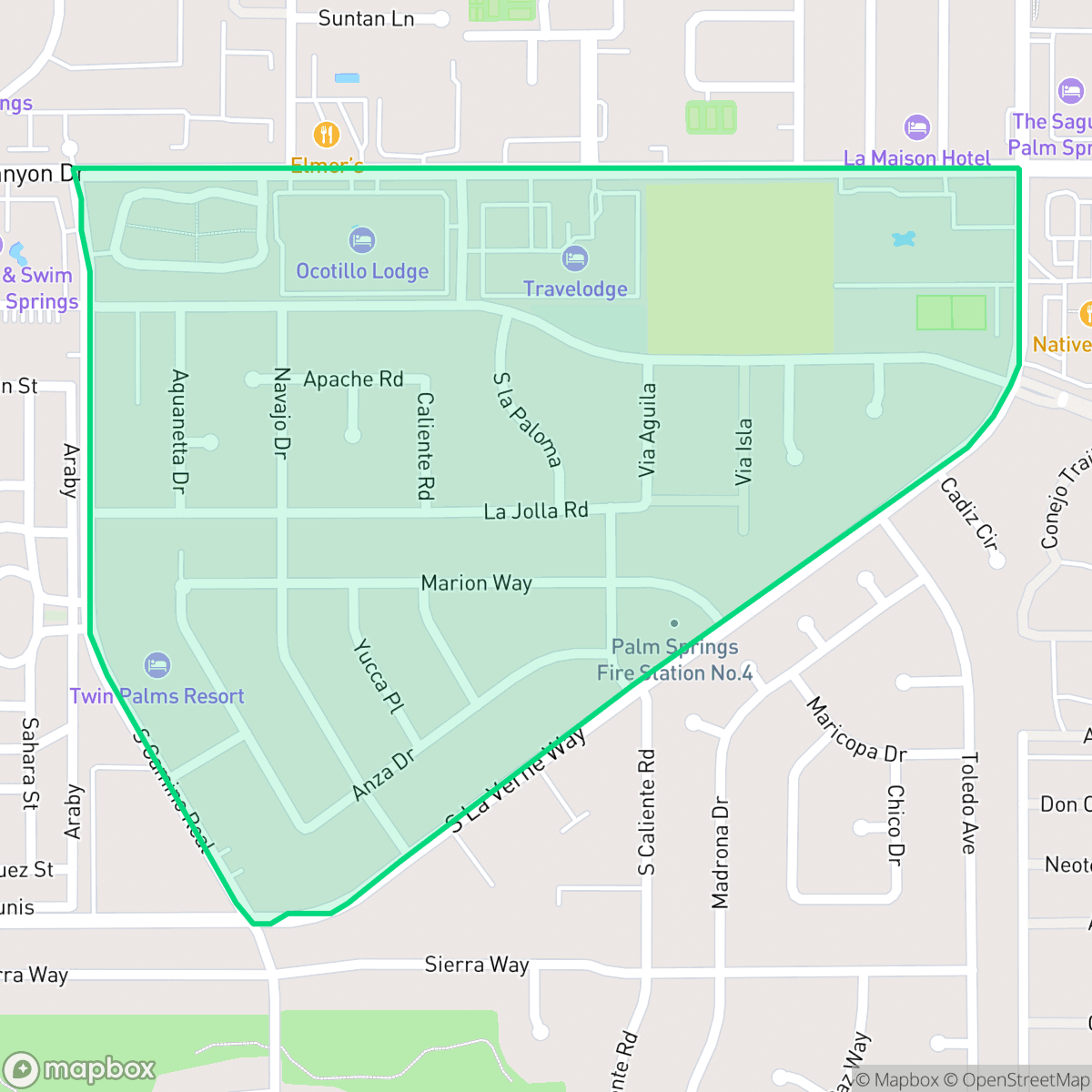
Located on the south side of Palm Springs, the Twin Palms neighborhood is celebrated as the city’s first modern housing tract. Originally carved from the historic Smoke Tree Ranch, the area inherited a 1930s planning restriction limiting structures to a single story. Developed between 1957 and 1959 by the Alexander Construction Company and designed by architect William Krisel, the subdivision was initially named Smoke Tree Valley Estates. It was renamed Twin Palms because each home was sold with two palm trees in its front yard. Krisel utilized a standardized 40-by-40-foot floor plan but varied the facades, orientations, and rooflines—introducing the iconic butterfly roof—to avoid tract monotony. Defined by Desert Modernism features like clerestory windows and open carports, the neighborhood sits adjacent to the historic Ocotillo Lodge, another Krisel-designed landmark.
The neighborhood maintains a vibrant yet quiet residential atmosphere, characterized by its well-maintained green spaces and a consistent architectural aesthetic. It functions as a cohesive community where residents benefit from high levels of health insurance coverage and a welcoming environment for pet owners. While the area is not highly walkable for all daily needs, its location provides a balanced, suburban lifestyle that residents find engaging and visually appealing. The area is predominantly residential, maintaining a distinct separation from industrial zones to preserve its quiet character.
Prospective residents should note that the area experiences moderate road traffic noise, which averages 57 decibels. While the neighborhood boasts high visual appeal and good air quality, it faces significant challenges regarding fire safety, which is a common concern in the region. Families should also consider that local schools within the Palm Springs Unified School District currently face academic inconsistencies, despite recent investments in facility upgrades and vocational programs. According to iHuus data, the area remains a stable, desirable location for those seeking a unique architectural heritage combined with modern suburban amenities.
Neighborhood Scores Across 15 Qualities
Residential spacing is mixed with some buffers between neighbors, mirroring the typical density found across Palm Springs. According to iHuus data, property layouts provide a moderate level of seclusion from adjacent homes.
Pedestrian transit is efficient due to safe crossings and the presence of sidewalks on one side of the streets. This ease of movement is slightly higher than the average found throughout Palm Springs.
Large homes and frequent upscale amenities contribute to a high level of visual appeal that sits above the Palm Springs average. According to iHuus data, the area features spacious driveways and well-maintained properties.
Limited access to large green spaces and public parks makes pet walking slightly less convenient than in other parts of Palm Springs, according to iHuus data.
Open land and scattered residences provide a more open atmosphere than the more densely developed parts of Palm Springs. According to iHuus data, this area features more frequent patches of greenery and less urban density compared to the city average.
A mix of quiet residential streets and active commercial pockets offers various dining options, though the area remains largely car-dependent. This level of activity is slightly higher than the Palm Springs average according to iHuus data.
Steady traffic sounds from a nearby busy street are present, though acoustic levels are notably calmer than the Palm Springs city average according to iHuus data.
Air quality remains consistently high and mostly clean, with readings that are nearly identical to the Palm Springs average. According to iHuus data, residents can expect very rare instances of elevated pollutants.
Industrial activity and heavy warehouses are entirely absent from this area, providing a quiet environment that is even more residential than the Palm Springs average. According to iHuus data, the landscape consists solely of residential streets and light commercial spaces with no detected hazard sites.
Health insurance access is exceptionally high in this area, significantly surpassing the Palm Springs average according to iHuus data.
Voting patterns and census indicators show a highly liberal political leaning that is slightly more pronounced than the Palm Springs city average, according to iHuus data.
Older adults comprise the majority of the population here, representing a higher concentration of seniors than the Palm Springs average according to iHuus data.
Residual flood risk exists due to the area's location within a 500-year floodplain, though safety levels are slightly higher than the Palm Springs average according to iHuus data.
Address-Level Insights for Twin Palms


iHuus Neighborhood Intelligence Insights
Get address-level neighborhood insights for Twin Palms
- Street-level scores — see how individual blocks compare, not just neighborhood averages
- Micro-zone boundaries — identify quiet pockets, flood boundaries, and walkable clusters before you visit
- 15 dimensions in full — walkability, noise, air quality, school quality, insurance coverage, population age profile, urban/rural index, and more
- Boundary risk alerts — know if your address sits near a block boundary where scores drop, the kind of detail no listing will ever mention
- School insights — individual school ratings and insights, not just district-level data
- Compare before you commit — side-by-side data across neighborhoods, down to block precision
No credit card required
Compare with Any Neighborhood
| Dimension | Twin Palms | Andreas Hills |
|---|---|---|
| 🚶 Walkabilityavg 8.06 | ||
| 🔊 Acoustic Comfortavg 3.6 | ||
| 🤫 Privacy Indexavg 6 | ||
| 🎨 Visual Appealavg 7.66 | ||
| 🐕 Dog Friendlinessavg 6.14 | ||
| 🗺️ Urban-Rural Indexavg 7.27 | ||
| ✨ Neighborhood Vibeavg 4.76 | ||
| 🏥 Health Insurance Coverageavg 7.38 | ||
| 🌿 Air Qualityavg 8.11 | ||
| 🏭 Industrial Proximityavg 9.12 | ||
| 🌊 Flood Safetyavg 5.92 | ||
| 🗳️ Ideological Leanavg 9.69 | ||
| 👥 Population Age Profileavg 6.29 | ||
| 🔥 Fire Safetyavg 0.39 | ||
| 🏫 School Quality |
Twin Palms Rankings
School Districts Serving Twin Palms
School Insights for Twin Palms
Below average outcomes; significant attendance and academic challenges.
School Insights
See what's really behind every school rating near Twin Palms
- Individual school ratings — each school's own score with outcome context, not just a district average
- Enrollment & class size data — student-to-teacher ratio and how it compares to the state average
- Full demographics breakdown — ethnicity and gender composition for every school in the enrollment zone
- Every school in the district — all schools within the enrollment boundary ranked by rating, not just the closest one
- Grade levels & benchmarks — elementary through high school, with below/above state-average flags
No credit card required