The Mesa, Palm Springs
Updated · 621 residents
The Mesa is a distinctive Palm Springs neighborhood defined by its dramatic mountain backdrop and eclectic architectural heritage. While the area maintains a lively social atmosphere, it remains primarily residential with a balance of green spaces and quiet streets.
Key Highlights
About The Mesa
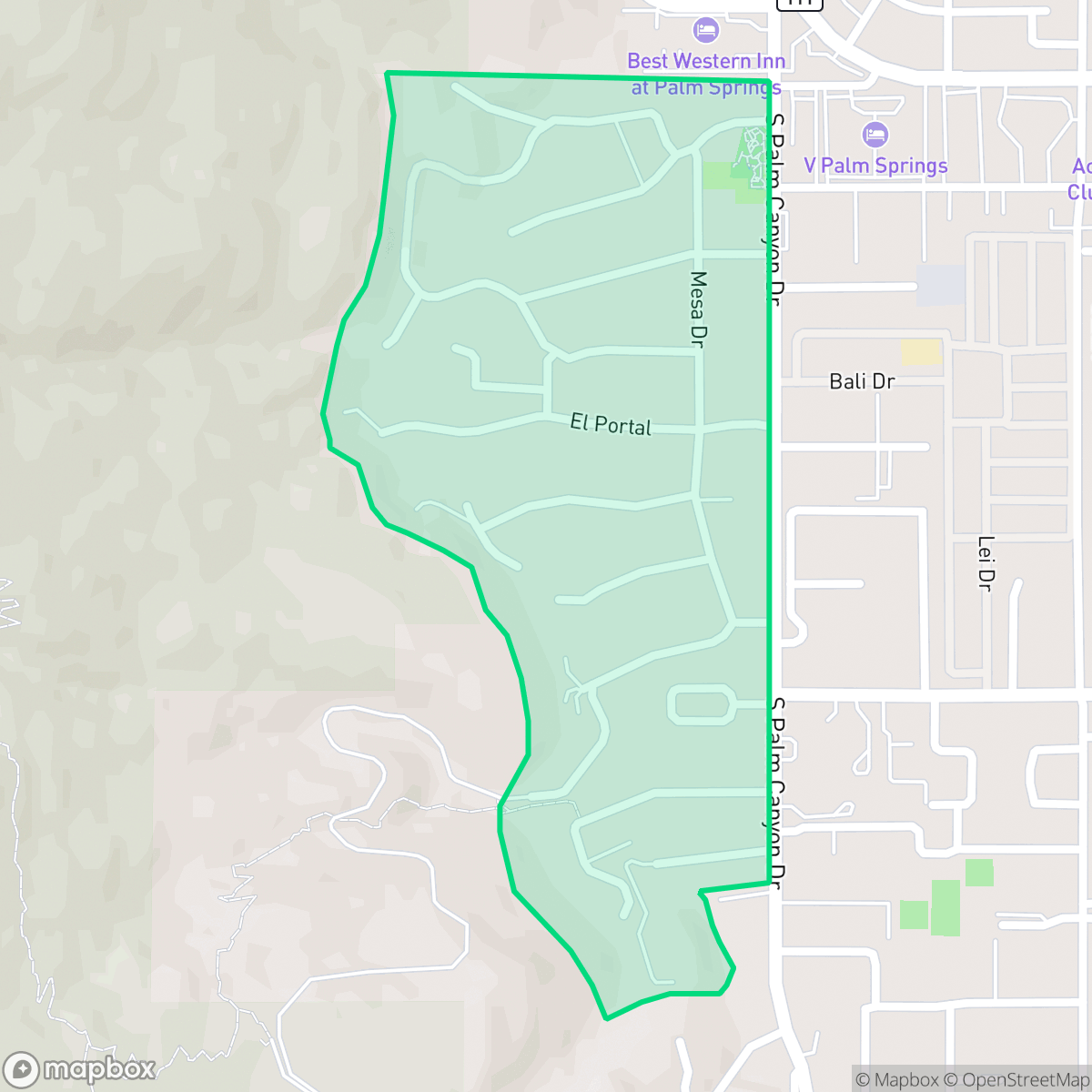
Nestled against the San Jacinto Mountains, The Mesa was envisioned in the 1920s by Los Angeles businessman Edmond Fulford as an exclusive, single-gated community. A rustic stone gatehouse remains near El Portal and South Palm Canyon Drive as a symbol of his dream and is depicted on local street signs. Known for its undulating, secluded topography, the neighborhood boasts an eclectic architectural mix. Notable properties include King Gillette’s 1923 Class 1 historic Spanish estate, the 1930s Streamline Moderne "Ship of the Desert" home, and mid-century modern designs by Donald Wexler. Historically a private sanctuary for Hollywood stars, The Mesa has been home to residents like Natalie Wood, Robert Wagner, Johnny Mercer, Sonny Bono, and Barry Manilow. The historic Moorten Botanical Garden also sits at its base.
The neighborhood serves as a scenic, residential enclave where the landscape is characterized by undulating terrain and proximity to the San Jacinto Mountains. According to iHuus data, the area sustains a lively social and leisure environment that distinguishes it from quieter surrounding districts. The architecture remains a defining feature, blending historic estates with mid-century modern designs that contribute to its high visual appeal and unique character.
Prospective residents should note that while the neighborhood provides a moderate level of walkability, it remains largely car-dependent for daily errands. Acoustic comfort is influenced by road traffic, which averages 57 decibels across the area. While the community benefits from high health insurance coverage and excellent air quality, it faces significant fire safety challenges that are common to the region. The area is best suited for those who value a blend of historical charm and an active, community-oriented atmosphere.
Neighborhood Scores Across 15 Qualities
Residential spacing is consistent with the Palm Springs average, providing a mix of open areas and some buffers between properties. According to iHuus data, neighbors are neither overly dense nor exceptionally isolated.
Sidewalks are available on one side of the street and safe crossings are provided. This level of accessibility is slightly lower than the average found throughout Palm Springs.
Large residences and frequent high-end amenities contribute to a visual environment that is more aesthetically pleasing than the Palm Springs average. According to iHuus data, the area features spacious driveways and well-maintained properties.
Access to public parks and open green spaces is slightly better than the Palm Springs average. Residents can find sufficient areas for pet walking, though highly manicured or expansive green verges are not ubiquitous throughout the area.
Open land and scattered homes provide a sense of space, though the area is slightly less dense than the Palm Springs average. Residents can expect a landscape characterized by frequent open areas and vegetation.
Active pockets of dining and botanical gardens offer more social variety than the Palm Springs average, though much of the area remains quiet and car-dependent. According to iHuus data, the landscape shifts between lively residential blocks and more tranquil, rural-feeling spaces.
Steady hum from nearby busy streets defines the acoustic environment. This level of noise is notably higher than the average for Palm Springs, according to iHuus data.
Air quality in this area is generally clean with only infrequent periods of elevated readings. According to iHuus data, the air quality here is very similar to the Palm Springs average.
No warehouses, industrial facilities, or hazard sites are present within the neighborhood. This area offers a more residential environment than the Palm Springs average, consisting primarily of quiet streets and open green spaces.
Health insurance access is exceptionally high in The Mesa, significantly surpassing the Palm Springs average according to iHuus data.
Voting patterns and census indicators show a very strong liberal leaning, which is slightly more pronounced than the average seen across Palm Springs.
Older adults comprise the majority of the population, representing a notably higher proportion of seniors than the Palm Springs average. According to iHuus data, there is a modest presence of younger residents in the area.
Some residual flood risk exists within this area due to its location in the 500-year floodplain; however, safety levels remain higher than the Palm Springs average according to iHuus data.
Wildfire hazards in this area are severe; residents must implement maximum protection measures due to a fire risk that is on par with the rest of Palm Springs.
Address-Level Insights for The Mesa


iHuus Neighborhood Intelligence Insights
Get address-level neighborhood insights for The Mesa
- Street-level scores — see how individual blocks compare, not just neighborhood averages
- Micro-zone boundaries — identify quiet pockets, flood boundaries, and walkable clusters before you visit
- 15 dimensions in full — walkability, noise, air quality, school quality, insurance coverage, population age profile, urban/rural index, and more
- Boundary risk alerts — know if your address sits near a block boundary where scores drop, the kind of detail no listing will ever mention
- School insights — individual school ratings and insights, not just district-level data
- Compare before you commit — side-by-side data across neighborhoods, down to block precision
No credit card required
Compare with Any Neighborhood
| Dimension | The Mesa | Andreas Hills |
|---|---|---|
| 🚶 Walkabilityavg 8.06 | ||
| 🔊 Acoustic Comfortavg 3.6 | ||
| 🤫 Privacy Indexavg 6 | ||
| 🎨 Visual Appealavg 7.66 | ||
| 🐕 Dog Friendlinessavg 6.14 | ||
| 🗺️ Urban-Rural Indexavg 7.27 | ||
| ✨ Neighborhood Vibeavg 4.76 | ||
| 🏥 Health Insurance Coverageavg 7.38 | ||
| 🌿 Air Qualityavg 8.11 | ||
| 🏭 Industrial Proximityavg 9.12 | ||
| 🌊 Flood Safetyavg 5.92 | ||
| 🗳️ Ideological Leanavg 9.69 | ||
| 👥 Population Age Profileavg 6.29 | ||
| 🔥 Fire Safetyavg 0.39 | ||
| 🏫 School Quality |
The Mesa Rankings
School Districts Serving The Mesa
School Insights for The Mesa
Below average outcomes; significant attendance and academic challenges.
School Insights
See what's really behind every school rating near The Mesa
- Individual school ratings — each school's own score with outcome context, not just a district average
- Enrollment & class size data — student-to-teacher ratio and how it compares to the state average
- Full demographics breakdown — ethnicity and gender composition for every school in the enrollment zone
- Every school in the district — all schools within the enrollment boundary ranked by rating, not just the closest one
- Grade levels & benchmarks — elementary through high school, with below/above state-average flags
No credit card required