Tahquitz River Estates, Palm Springs
Updated · 1,759 residents
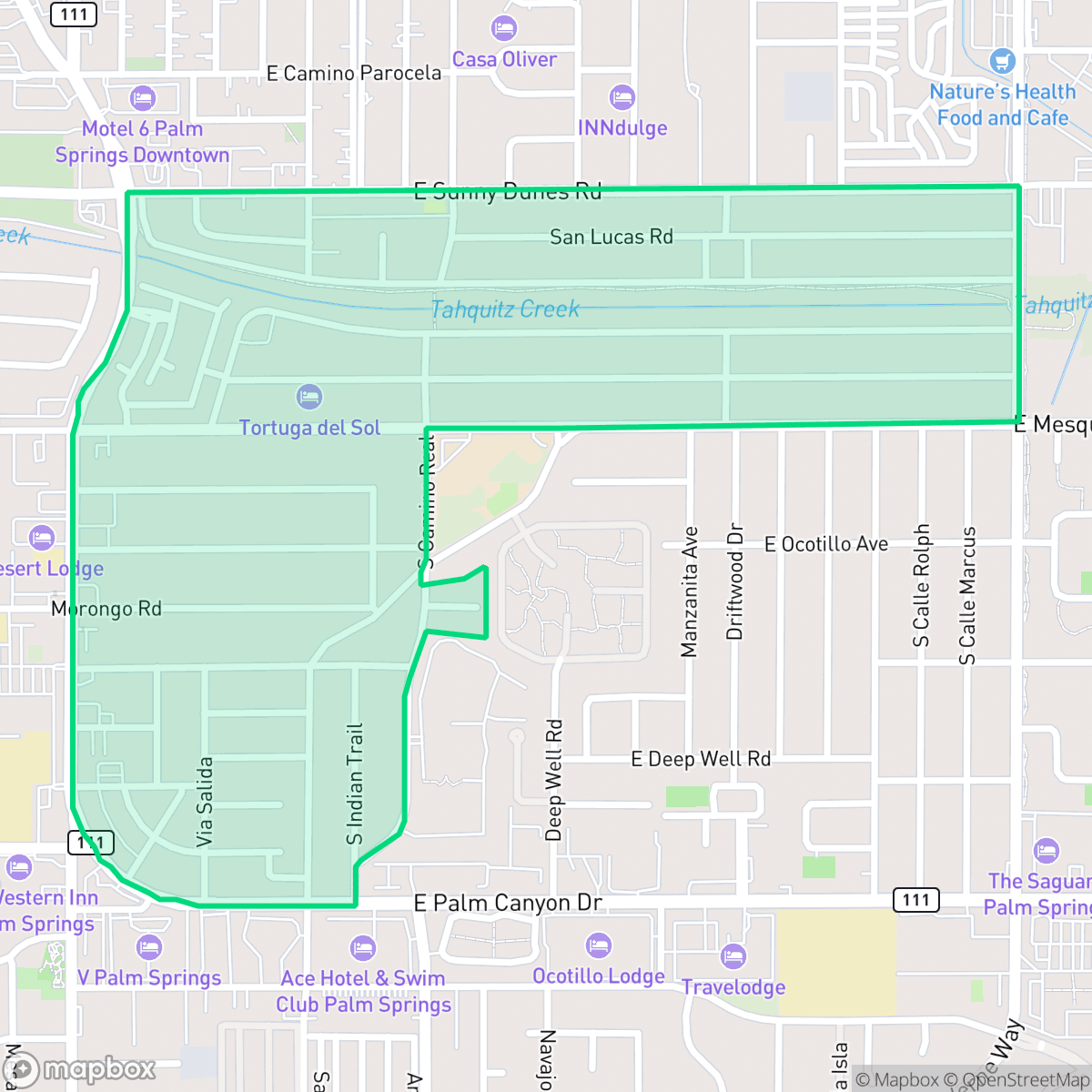
Tahquitz River Estates is a highly walkable neighborhood in Palm Springs defined by its distinct mid-century architecture and lush green spaces. Residents enjoy convenient access to local landmarks like the Moorten Botanical Garden and popular dining spots, though the area experiences noticeable road traffic noise.
Key Highlights
About Tahquitz River Estates
Originally subdivided in the 1930s as Palos Verdes Estates—noted for its charming Spanish Revival bungalows—the Tahquitz River Estates neighborhood in Palm Springs underwent a major transformation in 1947. To facilitate development, Southern California developer Paul Trousdale tamed the flood-prone Tahquitz Creek by carving a 200-foot diversion channel. Trousdale then partnered with architect Allen Siple to construct over 200 mid-century modern and ranch-style homes. Characterized by painted brick, angled roofs, and expansive glass, these iconic postwar residences became known locally as "Trousdales". Today, bisected by the Tahquitz Creek corridor, this eclectic neighborhood is one of the city's largest, functioning as a living museum of architecture that spans nearly 90 years of desert design history.
The neighborhood functions as a vibrant residential hub that balances suburban comfort with access to established local amenities. Beyond its architectural legacy, the community is characterized by a strong sense of civic engagement and high rates of health insurance coverage. Residents have convenient access to popular destinations such as Mr. Lyons Steakhouse and Gabino's Creperie, contributing to a lively atmosphere that distinguishes it from quieter surrounding areas.
Prospective residents should note that while the area offers high walkability and excellent air quality, acoustic comfort is impacted by road traffic. It is a predominantly residential environment with limited industrial presence, though it faces significant fire safety risks typical of the region. According to iHuus data, the area maintains a consistent ideological alignment, making it a stable choice for those seeking a socially active and engaged community.
Neighborhood Scores Across 15 Qualities
Residential spacing varies throughout the area, with some neighbors situated close together near multi-family units. This level of privacy is slightly lower than the Palm Springs average due to the presence of shared walls in certain sections.
A grid system with sidewalks provides accessible routes, though high traffic volume on major arterials can impact pedestrian comfort. This area offers a level of walkability that is slightly higher than the Palm Springs average.
Standard suburban housing and apartment structures define much of the landscape, though visual variety is slightly below the Palm Springs average. Residential views consist primarily of shared pools and boxy roof geometries.
Public park access is minimal within the area, as most greenery consists of private yards or narrow residential verges. According to iHuus data, this provides fewer dedicated spaces for walking dogs compared to the Palm Springs average.
Open land and scattered homes provide a more semi-rural atmosphere than the more densely developed areas of Palm Springs. According to iHuus data, the landscape features a low-density mix of woodland and fields interspersed with residential pockets.
A variety of local dining and social hubs provide more activity than the typical Palm Springs neighborhood, though the layout remains largely car-dependent. Residents can find diverse amenities such as cafes and galleries near green spaces, according to iHuus data.
Local traffic from a nearby busy street creates a consistent level of ambient noise. This acoustic profile is slightly higher than the typical experience found elsewhere in Palm Springs, according to iHuus data.
Air quality remains consistently high with rare instances of elevated readings. This level of cleanliness is largely consistent with the typical air quality found throughout Palm Springs.
Industrial activity is nonexistent in this area, providing a setting free from warehouses or heavy manufacturing. According to iHuus data, this neighborhood maintains a higher level of separation from industrial hazards than the rest of Palm Springs.
Health insurance accessibility is notably higher here than the Palm Springs average, according to iHuus data. Most residents in the area maintain active health coverage.
Voting patterns and census indicators show a deeply liberal leaning that is even more pronounced than the Palm Springs average, according to iHuus data.
Older adults represent the majority of the community, though a modest number of younger residents also reside here. This age distribution is slightly higher than the Palm Springs average, according to iHuus data.
Residual flood risk exists within this area due to its location in a 500 year floodplain, though safety levels are notably higher than the Palm Springs average according to iHuus data.
Address-Level Insights for Tahquitz River Estates


iHuus Neighborhood Intelligence Insights
Get address-level neighborhood insights for Tahquitz River Estates
- Street-level scores — see how individual blocks compare, not just neighborhood averages
- Micro-zone boundaries — identify quiet pockets, flood boundaries, and walkable clusters before you visit
- 15 dimensions in full — walkability, noise, air quality, school quality, insurance coverage, population age profile, urban/rural index, and more
- Boundary risk alerts — know if your address sits near a block boundary where scores drop, the kind of detail no listing will ever mention
- School insights — individual school ratings and insights, not just district-level data
- Compare before you commit — side-by-side data across neighborhoods, down to block precision
No credit card required
Compare with Any Neighborhood
| Dimension | Tahquitz River Estates | Andreas Hills |
|---|---|---|
| 🚶 Walkabilityavg 8.06 | ||
| 🔊 Acoustic Comfortavg 3.6 | ||
| 🤫 Privacy Indexavg 6 | ||
| 🎨 Visual Appealavg 7.66 | ||
| 🐕 Dog Friendlinessavg 6.14 | ||
| 🗺️ Urban-Rural Indexavg 7.27 | ||
| ✨ Neighborhood Vibeavg 4.76 | ||
| 🏥 Health Insurance Coverageavg 7.38 | ||
| 🌿 Air Qualityavg 8.11 | ||
| 🏭 Industrial Proximityavg 9.12 | ||
| 🌊 Flood Safetyavg 5.92 | ||
| 🗳️ Ideological Leanavg 9.69 | ||
| 👥 Population Age Profileavg 6.29 | ||
| 🔥 Fire Safetyavg 0.39 | ||
| 🏫 School Quality |
Tahquitz River Estates Rankings
School Districts Serving Tahquitz River Estates
School Insights for Tahquitz River Estates
Below average outcomes; significant attendance and academic challenges.
School Insights
See what's really behind every school rating near Tahquitz River Estates
- Individual school ratings — each school's own score with outcome context, not just a district average
- Enrollment & class size data — student-to-teacher ratio and how it compares to the state average
- Full demographics breakdown — ethnicity and gender composition for every school in the enrollment zone
- Every school in the district — all schools within the enrollment boundary ranked by rating, not just the closest one
- Grade levels & benchmarks — elementary through high school, with below/above state-average flags
No credit card required