Sunrise Vista Chino, Palm Springs
Updated · 481 residents
Sunrise Vista Chino is a quiet residential enclave in north-central Palm Springs, characterized by its significant collection of mid-century modern architecture. While the area offers high visual appeal and excellent air quality, residents should be prepared for noticeable noise levels from local road traffic. The neighborhood maintains a stable, mature demographic with strong access to health insurance coverage.
Key Highlights
About Sunrise Vista Chino
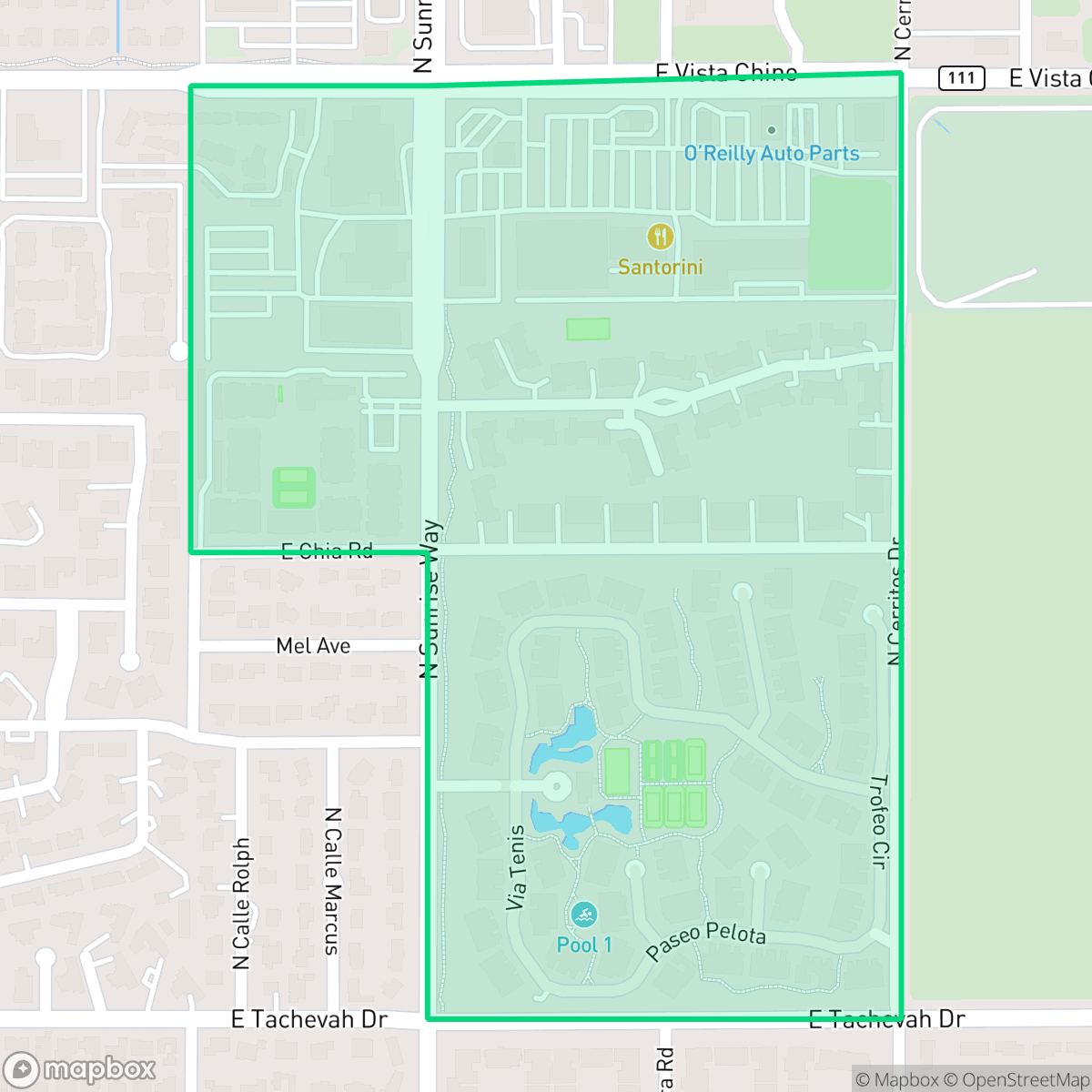
Located in north-central Palm Springs, the Sunrise Vista Chino neighborhood is a quiet residential enclave defined by its mid-century modern and contemporary architecture. A central landmark of the neighborhood is the Sagewood Condominiums, a low-density complex built in 1972. Designed by legendary modernist architect Donald Wexler with landscaping by David Hamilton, Sagewood is celebrated as one of Wexler's finest multi-family projects and was recommended for Historic District designation in 2026. The neighborhood also features Philip Caplin Vista Sunrise homes, Ranch Club Estates, and the Sunrise Racquet Club. Its primary thoroughfare, Vista Chino, honors Pedro Chino, a revered Cahuilla shaman and tribal leader. This rich blend of indigenous heritage and mid-century design shapes the unique cultural identity of Sunrise Vista Chino.
The neighborhood serves as a peaceful residential hub, defined by its architectural legacy and a focus on community stability. It is a purely residential environment, free from industrial activity, making it well-suited for those who prioritize a settled pace of life and an appreciation for mid-century design. The area is marked by a mature population and high levels of health insurance coverage, contributing to a stable social environment that reflects the broader values of the Palm Springs community.
Prospective residents should note that the area has lower walkability compared to the city average, meaning that most daily errands and dining options require a vehicle. The neighborhood also experiences elevated noise levels, primarily due to road traffic on surrounding thoroughfares. While the area benefits from strong flood safety, fire safety remains a significant consideration for the region. Additionally, families should be aware that the local school district presents academic inconsistencies, which may necessitate further research into specific school performance within the Palm Springs Unified system.
Neighborhood Scores Across 15 Qualities
Housing density remains average for Palm Springs, providing a moderate buffer between neighbors and mixed spacing across the area.
Sidewalks and safe crossings are available along many streets, though walking accessibility is slightly lower than the Palm Springs average. Most local trips are manageable on foot, according to iHuus data.
Spacious properties and premium amenities characterize the area, providing a visual environment that is slightly more polished than the Palm Springs average.
Limited access to public parks and narrow green spaces means pet owners may find fewer immediate walking options compared to the Palm Springs average, according to iHuus data.
Scattered homes and frequent open land characterize this area, providing a more open landscape than the typical Palm Springs urban setting. According to iHuus data, this neighborhood features more woodland and fields than the city average.
Serene, suburban surroundings offer a peaceful atmosphere but provide fewer local amenities than the typical Palm Springs neighborhood. While walkable paths exist, most dining and essential services require driving due to the low density of nearby businesses.
Frequent noise from nearby major roadways and transit paths is a common feature here, making the acoustic environment slightly more disruptive than the Palm Springs average, according to iHuus data.
Air quality remains consistently high with infrequent periods of poor circulation. This level of cleanliness is roughly in line with the broader Palm Springs area, according to iHuus data.
Industrial activity and nearby hazard sites are non-existent here, offering a more residential environment than most of Palm Springs. According to iHuus data, the area consists solely of residential streets and light commercial zones with no detectable warehouses or industrial facilities.
Health insurance enrollment rates in this area are slightly above the Palm Springs average, according to iHuus data.
Voting patterns and census indicators reflect a deeply liberal political leaning that is slightly more pronounced than the Palm Springs average.
Older adults comprise the majority of the population here, representing a slightly more mature demographic than the Palm Springs average. According to iHuus data, there is a modest presence of younger residents within the community.
Residual flood risk exists within this area due to its location in the 500-year floodplain, though safety levels are notably higher than the Palm Springs average according to iHuus data.
Address-Level Insights for Sunrise Vista Chino


iHuus Neighborhood Intelligence Insights
Get address-level neighborhood insights for Sunrise Vista Chino
- Street-level scores — see how individual blocks compare, not just neighborhood averages
- Micro-zone boundaries — identify quiet pockets, flood boundaries, and walkable clusters before you visit
- 15 dimensions in full — walkability, noise, air quality, school quality, insurance coverage, population age profile, urban/rural index, and more
- Boundary risk alerts — know if your address sits near a block boundary where scores drop, the kind of detail no listing will ever mention
- School insights — individual school ratings and insights, not just district-level data
- Compare before you commit — side-by-side data across neighborhoods, down to block precision
No credit card required
Compare with Any Neighborhood
| Dimension | Sunrise Vista Chino | Andreas Hills |
|---|---|---|
| 🚶 Walkabilityavg 8.06 | ||
| 🔊 Acoustic Comfortavg 3.6 | ||
| 🤫 Privacy Indexavg 6 | ||
| 🎨 Visual Appealavg 7.66 | ||
| 🐕 Dog Friendlinessavg 6.14 | ||
| 🗺️ Urban-Rural Indexavg 7.27 | ||
| ✨ Neighborhood Vibeavg 4.76 | ||
| 🏥 Health Insurance Coverageavg 7.38 | ||
| 🌿 Air Qualityavg 8.11 | ||
| 🏭 Industrial Proximityavg 9.12 | ||
| 🌊 Flood Safetyavg 5.92 | ||
| 🗳️ Ideological Leanavg 9.69 | ||
| 👥 Population Age Profileavg 6.29 | ||
| 🔥 Fire Safetyavg 0.39 | ||
| 🏫 School Quality |
Sunrise Vista Chino Rankings
School Districts Serving Sunrise Vista Chino
School Insights for Sunrise Vista Chino
Below average outcomes; significant attendance and academic challenges.
School Insights
See what's really behind every school rating near Sunrise Vista Chino
- Individual school ratings — each school's own score with outcome context, not just a district average
- Enrollment & class size data — student-to-teacher ratio and how it compares to the state average
- Full demographics breakdown — ethnicity and gender composition for every school in the enrollment zone
- Every school in the district — all schools within the enrollment boundary ranked by rating, not just the closest one
- Grade levels & benchmarks — elementary through high school, with below/above state-average flags
No credit card required