Sunrise Park, Palm Springs
Updated · 1,768 residents
Sunrise Park is a highly walkable central Palm Springs neighborhood known for its vibrant social atmosphere and convenient access to local leisure hubs. The area balances a lively suburban feel with proximity to urban amenities, though residents should expect moderate noise levels from nearby road traffic.
Key Highlights
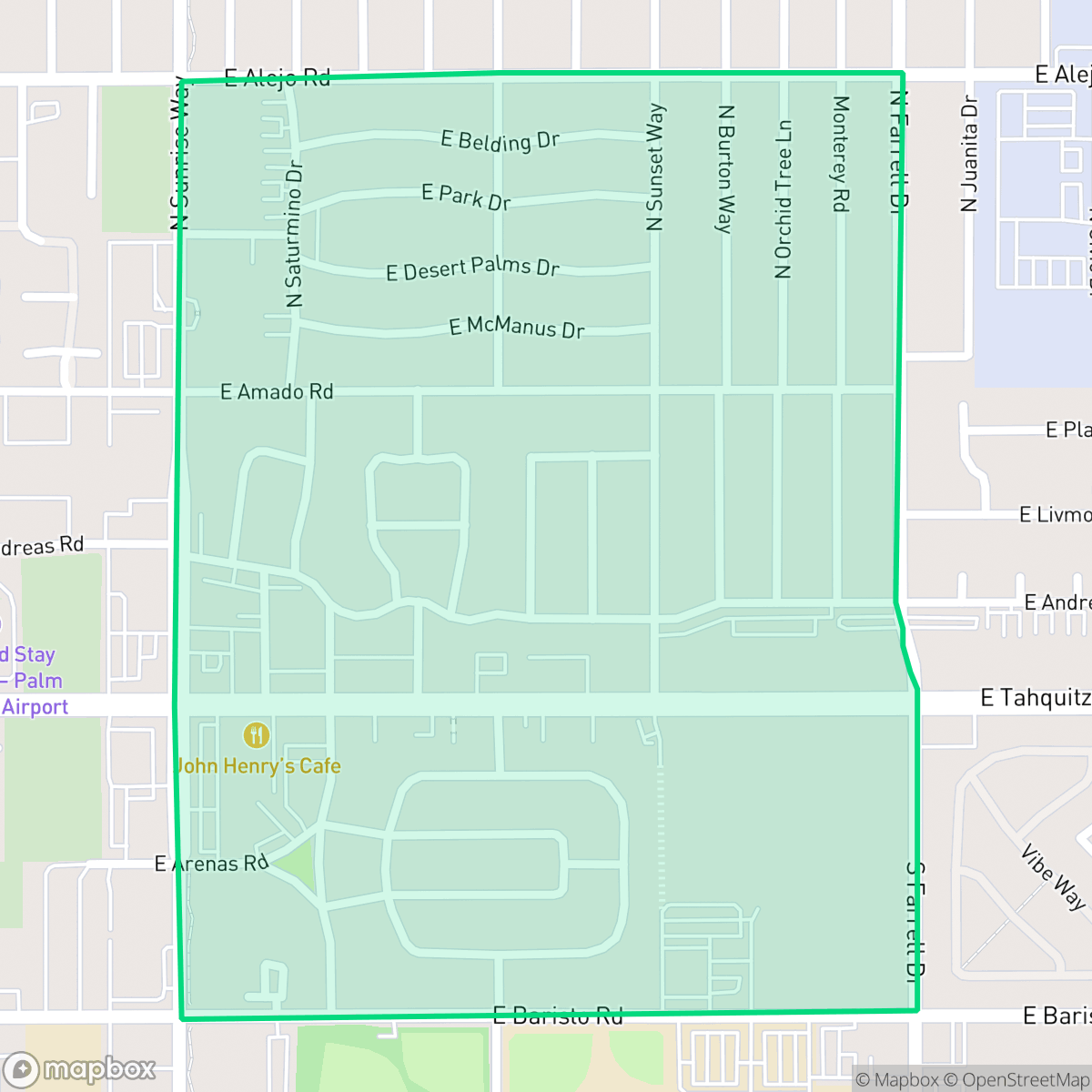
About Sunrise Park
Established in the early 1950s as Desert Palms Estates, Sunrise Park in central Palm Springs is a premier showcase of midcentury modern residential architecture. The neighborhood features a rich mix of designs ranging from Atomic Ranch to late 1960s mod, characterized by butterfly roofs, post-and-beam construction, and clerestory windows. It is famous for the friendly rivalry between prominent midcentury developers Alexander Construction Company—which built the "Enchanted Homes" tract designed by Palmer & Krisel—and Jack Meiselman, developer of "Palm Lane Estates". Renowned architects William Cody and Hugh Kaptur chose Sunrise Park for their personal family residences, while other notable residents included hotelier Conrad Hilton and PBS host Huell Howser. The neighborhood is anchored by its namesake 38-acre public park, which opened in 1976 and houses the Palm Springs Public Library.
The neighborhood functions as a dense, walkable suburban enclave in the heart of Palm Springs. It supports an active lifestyle with a variety of leisure destinations and social spots, maintaining a higher level of daily activity than many surrounding areas. The layout effectively balances quiet residential streets with accessible commercial hubs, making it a practical choice for those who prioritize proximity to city amenities over total seclusion. The area is characterized by a strong sense of community and a distinct ideological alignment, reflecting the progressive nature of the local population.
Prospective residents should consider several livability trade-offs, including moderate noise levels primarily generated by road traffic. While the community offers significant cultural and architectural appeal, it is served by the Palm Springs Unified School District, which exhibits significant academic variability across its campuses. Furthermore, according to iHuus data, the area is situated in a zone with elevated environmental risks regarding fire and flood safety. These factors, combined with lower health insurance coverage rates in the vicinity, are important considerations for those evaluating the long-term sustainability of the location.
Neighborhood Scores Across 15 Qualities
Residential spacing is typical for Palm Springs, offering a mix of open areas and some buffer between properties. According to iHuus data, this level of density is consistent with the city average.
Pedestrian movement is easy due to wide sidewalks on both sides of the street and ample crossings. This area offers superior accessibility for walkers compared to the Palm Springs average, according to iHuus data.
Large residences and frequent upscale amenities characterize the area. According to iHuus data, the visual landscape is more aesthetically pleasing than the typical Palm Springs neighborhood.
Opportunities for dog walking are somewhat limited by a lack of wide green verges or direct park access. According to iHuus data, the availability of pet-friendly infrastructure in Sunrise Park is below the Palm Springs average.
Open land and scattered homes create a more spacious environment than most of Palm Springs. According to iHuus data, this area features more greenery and less dense development than the city average.
Social spots and leisure destinations are more concentrated here than in the rest of Palm Springs. Residents can find a mix of quiet, green residential streets and active pockets near local amenities and parks.
Steady noise from nearby busy streets is present, though acoustic levels remain more tranquil than the average for Palm Springs. According to iHuus data, residents may notice a consistent hum from local traffic throughout the day.
Air quality in this area remains consistently good with only rare instances of elevated readings. This level of air clarity is nearly identical to the overall Palm Springs average according to iHuus data.
Industrial presence is minimal, consisting primarily of quiet streets and open green spaces with only occasional light commercial activity. This area maintains a slightly higher level of industrial separation than the Palm Springs average, according to iHuus data.
Health insurance accessibility in Sunrise Park is lower than the Palm Springs average. According to iHuus data, a significant portion of the resident population lacks coverage.
Voting patterns and census indicators reflect a very strong liberal leaning that is slightly more pronounced than the Palm Springs average, according to iHuus data.
Residents live alongside a balanced distribution of young adults, families, and seniors. This demographic spread in Sunrise Park is consistent with the overall age profile found throughout Palm Springs.
Flood risk in this area is notably higher than the Palm Springs average, as there is currently a lack of detailed federal flood studies for this specific location. Residents should exercise caution because official risk assessments for the neighborhood remain incomplete according to iHuus data.
Address-Level Insights for Sunrise Park


iHuus Neighborhood Intelligence Insights
Get address-level neighborhood insights for Sunrise Park
- Street-level scores — see how individual blocks compare, not just neighborhood averages
- Micro-zone boundaries — identify quiet pockets, flood boundaries, and walkable clusters before you visit
- 15 dimensions in full — walkability, noise, air quality, school quality, insurance coverage, population age profile, urban/rural index, and more
- Boundary risk alerts — know if your address sits near a block boundary where scores drop, the kind of detail no listing will ever mention
- School insights — individual school ratings and insights, not just district-level data
- Compare before you commit — side-by-side data across neighborhoods, down to block precision
No credit card required
Compare with Any Neighborhood
| Dimension | Sunrise Park | Andreas Hills |
|---|---|---|
| 🚶 Walkabilityavg 8.06 | ||
| 🔊 Acoustic Comfortavg 3.6 | ||
| 🤫 Privacy Indexavg 6 | ||
| 🎨 Visual Appealavg 7.66 | ||
| 🐕 Dog Friendlinessavg 6.14 | ||
| 🗺️ Urban-Rural Indexavg 7.27 | ||
| ✨ Neighborhood Vibeavg 4.76 | ||
| 🏥 Health Insurance Coverageavg 7.38 | ||
| 🌿 Air Qualityavg 8.11 | ||
| 🏭 Industrial Proximityavg 9.12 | ||
| 🌊 Flood Safetyavg 5.92 | ||
| 🗳️ Ideological Leanavg 9.69 | ||
| 👥 Population Age Profileavg 6.29 | ||
| 🔥 Fire Safetyavg 0.39 | ||
| 🏫 School Quality |
Sunrise Park Rankings
School Districts Serving Sunrise Park
School Insights for Sunrise Park
Below average outcomes; significant attendance and academic challenges.
School Insights
See what's really behind every school rating near Sunrise Park
- Individual school ratings — each school's own score with outcome context, not just a district average
- Enrollment & class size data — student-to-teacher ratio and how it compares to the state average
- Full demographics breakdown — ethnicity and gender composition for every school in the enrollment zone
- Every school in the district — all schools within the enrollment boundary ranked by rating, not just the closest one
- Grade levels & benchmarks — elementary through high school, with below/above state-average flags
No credit card required