Ranch Club, Palm Springs
Updated · 982 residents
Ranch Club is a serene, mid-century modern enclave in Palm Springs known for its preserved architectural character and quiet, residential atmosphere. The area offers a balanced lifestyle with walkable paths and high air quality, though residents should expect moderate noise levels from road traffic and aviation.
Key Highlights
About Ranch Club
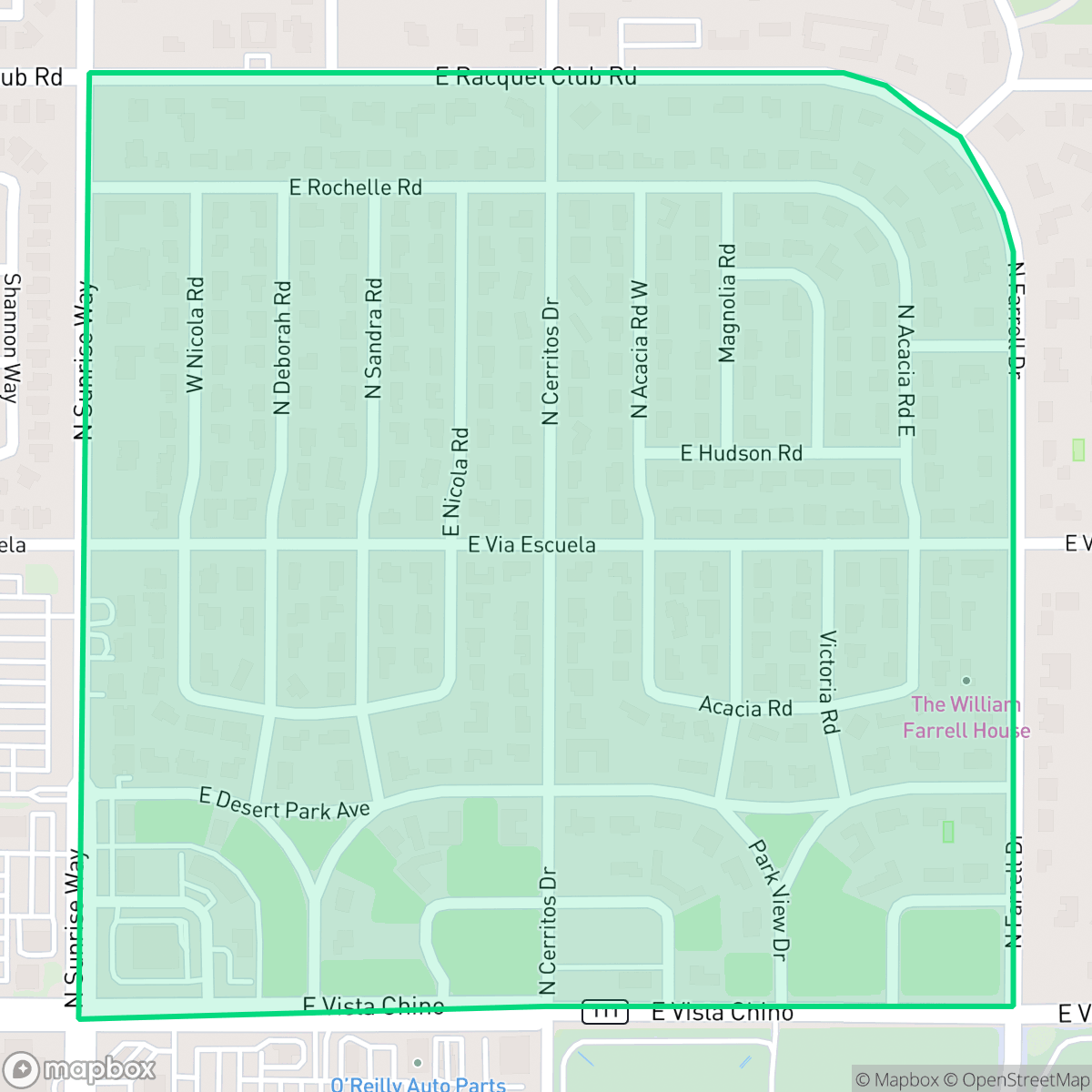
The Ranch Club Estates neighborhood in Palm Springs, California, originated in the late 1950s around the Ranch Club, then the city's largest social club. Developer Noel Clarke envisioned a master-planned community of up to 1,000 homes on the tract. In 1957, contractor Tom Sills commissioned a young, renowned mid-century modern architect, Hugh Kaptur, to design the residences. Kaptur created five distinct models—the "Spur," "Lariat," "Saddle," "Prairie," and "Sombrero"—characterized by low-set profiles, gently sloped roofs, post-and-beam construction, and central masonry facades. Following Clarke’s sudden death in 1965, development halted with only about 300 of the planned homes completed, leaving a highly preserved pocket of classic mid-century modern desert architecture.
The neighborhood is defined by its low-density residential layout and abundance of open green spaces, creating a tranquil environment that stands apart from the busier sections of Palm Springs. It maintains a strong sense of community, supported by high levels of health insurance coverage among residents. While the area is largely quiet, the proximity to major transit corridors contributes to a baseline of ambient noise from road traffic and overhead flight paths.
Prospective residents will find a neighborhood that prioritizes a peaceful, suburban lifestyle over high-intensity urban activity. According to iHuus data, the area is well-suited for those who value architectural heritage and a slower pace of life, though it may be less ideal for those seeking high-density amenities or extensive pet-friendly infrastructure. While the school district serving the area faces academic challenges, the neighborhood itself remains a stable, well-maintained pocket of the city.
Neighborhood Scores Across 15 Qualities
Residential spacing provides a moderate level of separation between neighbors, aligning with the typical density found throughout Palm Springs. This balance of mixed spacing offers some buffer between properties without the isolation of more remote areas.
Safe crossings and sidewalks on one side of the street make navigating the area easy on foot. This level of walkability is slightly above the Palm Springs average according to iHuus data.
Large residential lots and frequent upscale amenities contribute to a visual environment that is more polished than the Palm Springs average, according to iHuus data.
Limited access to public parks and a lack of wide green verges make this area less ideal for dog owners compared to the Palm Springs average. According to iHuus data, residents may find fewer opportunities for outdoor pet walking within the immediate neighborhood.
Open land and scattered homes characterize this area, offering a setting that is very similar to the broader Palm Springs average. Residents can expect a landscape defined by periodic patches of woodland and field imagery, according to iHuus data.
Low density and significant open space create a tranquil setting, though the area lacks the commercial activity and social density found in other parts of Palm Springs. Most daily needs require a vehicle as few businesses are within walking distance.
Frequent noise from nearby transit corridors and flight paths is more prominent here than in other parts of Palm Springs. According to iHuus data, residents may experience higher levels of acoustic disturbance compared to the city average.
Air quality remains mostly clean with only rare instances of elevated readings, performing very similarly to the Palm Springs average according to iHuus data.
Industrial activity and warehouse facilities are entirely absent from this area. According to iHuus data, this neighborhood offers a cleaner environment than the Palm Springs average due to the lack of any detected industrial sites or hazards.
Health insurance accessibility is strong in this area, sitting above the Palm Springs average according to iHuus data.
Voting patterns and census indicators show a deeply liberal political leaning that is consistent with the rest of Palm Springs. According to iHuus data, residents in this area share the same political profile as the city average.
A varied mix of young adults, families, and older residents characterizes this area. This demographic distribution is roughly in line with the overall Palm Springs average, according to iHuus data.
Flood risk in this area is notably lower than the Palm Springs average, though some residual risk remains due to the neighborhood's location within a 500-year floodplain according to iHuus data.
Address-Level Insights for Ranch Club


iHuus Neighborhood Intelligence Insights
Get address-level neighborhood insights for Ranch Club
- Street-level scores — see how individual blocks compare, not just neighborhood averages
- Micro-zone boundaries — identify quiet pockets, flood boundaries, and walkable clusters before you visit
- 15 dimensions in full — walkability, noise, air quality, school quality, insurance coverage, population age profile, urban/rural index, and more
- Boundary risk alerts — know if your address sits near a block boundary where scores drop, the kind of detail no listing will ever mention
- School insights — individual school ratings and insights, not just district-level data
- Compare before you commit — side-by-side data across neighborhoods, down to block precision
No credit card required
Compare with Any Neighborhood
| Dimension | Ranch Club | Andreas Hills |
|---|---|---|
| 🚶 Walkabilityavg 8.06 | ||
| 🔊 Acoustic Comfortavg 3.6 | ||
| 🤫 Privacy Indexavg 6 | ||
| 🎨 Visual Appealavg 7.66 | ||
| 🐕 Dog Friendlinessavg 6.14 | ||
| 🗺️ Urban-Rural Indexavg 7.27 | ||
| ✨ Neighborhood Vibeavg 4.76 | ||
| 🏥 Health Insurance Coverageavg 7.38 | ||
| 🌿 Air Qualityavg 8.11 | ||
| 🏭 Industrial Proximityavg 9.12 | ||
| 🌊 Flood Safetyavg 5.92 | ||
| 🗳️ Ideological Leanavg 9.69 | ||
| 👥 Population Age Profileavg 6.29 | ||
| 🔥 Fire Safetyavg 0.39 | ||
| 🏫 School Quality |
Ranch Club Rankings
School Districts Serving Ranch Club
School Insights for Ranch Club
Below average outcomes; significant attendance and academic challenges.
School Insights
See what's really behind every school rating near Ranch Club
- Individual school ratings — each school's own score with outcome context, not just a district average
- Enrollment & class size data — student-to-teacher ratio and how it compares to the state average
- Full demographics breakdown — ethnicity and gender composition for every school in the enrollment zone
- Every school in the district — all schools within the enrollment boundary ranked by rating, not just the closest one
- Grade levels & benchmarks — elementary through high school, with below/above state-average flags
No credit card required