Racquet Club West, Palm Springs
Updated · 716 residents
Racquet Club West is a vibrant Palm Springs neighborhood defined by its midcentury modern legacy and a lively, accessible atmosphere. While residents benefit from high health insurance coverage and a walkable environment, the area experiences notable noise levels primarily due to road traffic.
Key Highlights
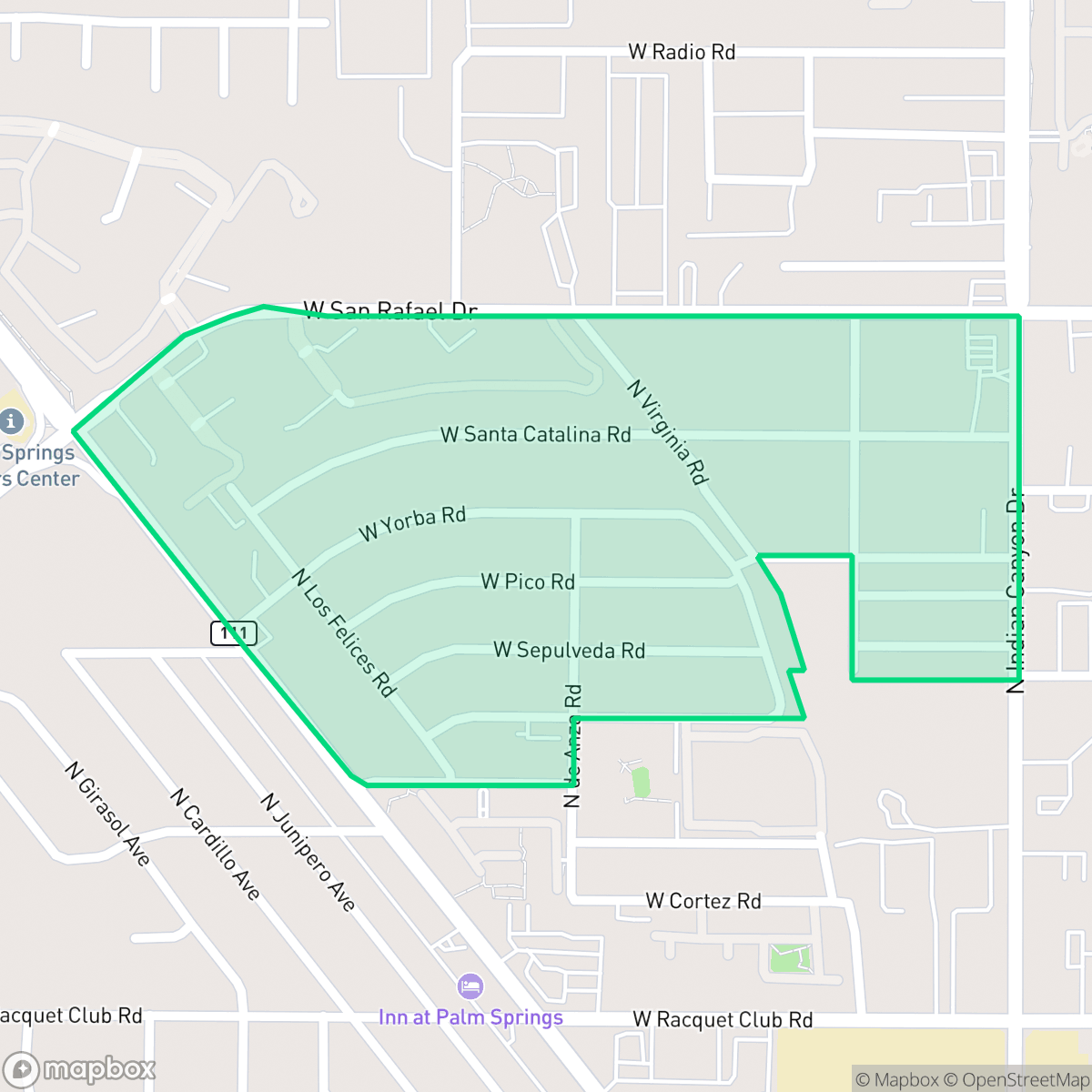
About Racquet Club West
The Racquet Club West neighborhood in Palm Springs, CA, is historically defined by its association with the adjacent Palm Springs Racquet Club, a legendary resort founded in 1934 by actors Charlie Farrell and Ralph Bellamy that served as a secluded haven for Hollywood's elite. The neighborhood's most celebrated architectural landmark is the Racquet Club Cottages West (now Racquet Club Garden Villas), constructed in 1959–1960. Designed by master midcentury architect William F. Cody and built by developer Paul Trousdale, this 3.2-acre enclave features Cody’s signature post-and-beam construction, floor-to-ceiling glass, and distinctive "tennis net" patterned concrete breeze blocks. Complemented by Phil Shipley's lush, stream-accented landscape architecture, the complex was designated a City of Palm Springs Historic District in 2013, epitomizing the neighborhood's rich midcentury modern heritage.
The neighborhood maintains a distinct character that balances its historical architectural significance with a modern, active lifestyle. Residents enjoy a high level of connectivity to local amenities, including nearby coffee shops and cultural galleries, which contribute to a more energetic vibe than found in many surrounding areas. The streets are characterized by a blend of residential charm and open green spaces, fostering a sense of community that is supported by excellent local health insurance coverage. While the area is highly regarded for its visual appeal and walkability, prospective residents should be aware of the acoustic environment, as road traffic noise is a consistent factor in daily life.
This area is particularly well-suited for those who value proximity to the cultural heart of Palm Springs and appreciate the aesthetic legacy of midcentury design. It is an ideal choice for individuals who prioritize health resources and a walkable urban lifestyle over absolute quiet. While it offers a strong sense of place, those sensitive to noise or seeking extensive private outdoor space for pets may find the trade-offs worth considering against the benefits of its central, lively location.
Neighborhood Scores Across 15 Qualities
Residential spacing offers a balanced level of seclusion with some buffer between neighboring properties. This degree of privacy is consistent with the average found across Palm Springs.
Sidewalks and safe crossings allow for easy pedestrian movement, though the area is slightly less walkable than the Palm Springs average according to iHuus data.
Large residences and frequent upscale amenities characterize the landscape, providing a level of visual appeal that is slightly higher than the Palm Springs average.
Access to expansive green spaces and public parks is somewhat restricted in this area, falling below the typical availability found elsewhere in Palm Springs.
Open desert landscapes and low-density residential pockets define this area. According to iHuus data, this setting is slightly less rural than the typical Palm Springs environment.
Residential streets offer a balanced mix of green space and local services, mirroring the typical activity levels found across Palm Springs. According to iHuus data, the area provides a consistent, everyday atmosphere with a blend of quiet suburban blocks and accessible local destinations.
Persistent noise from nearby freeways and flight paths makes this area significantly louder than the Palm Springs average. According to iHuus data, residents can expect frequent acoustic disturbances from heavy transit and aircraft.
Air quality remains consistently clear with only rare instances of elevated readings. This level of cleanliness is largely consistent with the broader Palm Springs area, according to iHuus data.
Industrial presence is nonexistent in this area, as the landscape consists entirely of residential and natural desert land use. According to iHuus data, this neighborhood matches the city average for having no detected warehouses, manufacturing facilities, or hazardous sites.
Health insurance accessibility is notably higher here than the Palm Springs average, according to iHuus data. This indicates a larger proportion of the resident population has access to medical coverage.
Voting patterns and census indicators show a very strong liberal leaning, which is slightly more pronounced than the Palm Springs average.
Residents live alongside a varied demographic of young adults, families, and seniors. This age distribution is slightly more varied than the typical profile found across Palm Springs, according to iHuus data.
Residual flood risk exists within this area as it sits within a 500-year floodplain. This level of safety is notably higher than the Palm Springs average, according to iHuus data.
Significant fire hazards exist in this area, representing a much higher risk level than the rest of Palm Springs. Residents should prioritize enhanced mitigation measures and remain vigilant according to iHuus data.
Address-Level Insights for Racquet Club West


iHuus Neighborhood Intelligence Insights
Get address-level neighborhood insights for Racquet Club West
- Street-level scores — see how individual blocks compare, not just neighborhood averages
- Micro-zone boundaries — identify quiet pockets, flood boundaries, and walkable clusters before you visit
- 15 dimensions in full — walkability, noise, air quality, school quality, insurance coverage, population age profile, urban/rural index, and more
- Boundary risk alerts — know if your address sits near a block boundary where scores drop, the kind of detail no listing will ever mention
- School insights — individual school ratings and insights, not just district-level data
- Compare before you commit — side-by-side data across neighborhoods, down to block precision
No credit card required
Compare with Any Neighborhood
| Dimension | Racquet Club West | Andreas Hills |
|---|---|---|
| 🚶 Walkabilityavg 8.06 | ||
| 🔊 Acoustic Comfortavg 3.6 | ||
| 🤫 Privacy Indexavg 6 | ||
| 🎨 Visual Appealavg 7.66 | ||
| 🐕 Dog Friendlinessavg 6.14 | ||
| 🗺️ Urban-Rural Indexavg 7.27 | ||
| ✨ Neighborhood Vibeavg 4.76 | ||
| 🏥 Health Insurance Coverageavg 7.38 | ||
| 🌿 Air Qualityavg 8.11 | ||
| 🏭 Industrial Proximityavg 9.12 | ||
| 🌊 Flood Safetyavg 5.92 | ||
| 🗳️ Ideological Leanavg 9.69 | ||
| 👥 Population Age Profileavg 6.29 | ||
| 🔥 Fire Safetyavg 0.39 | ||
| 🏫 School Quality |
Racquet Club West Rankings
School Districts Serving Racquet Club West
School Insights for Racquet Club West
Below average outcomes; significant attendance and academic challenges.
School Insights
See what's really behind every school rating near Racquet Club West
- Individual school ratings — each school's own score with outcome context, not just a district average
- Enrollment & class size data — student-to-teacher ratio and how it compares to the state average
- Full demographics breakdown — ethnicity and gender composition for every school in the enrollment zone
- Every school in the district — all schools within the enrollment boundary ranked by rating, not just the closest one
- Grade levels & benchmarks — elementary through high school, with below/above state-average flags
No credit card required