Racquet Club Estates, Palm Springs
Updated · 1,270 residents
Racquet Club Estates is an exceptionally walkable neighborhood in Palm Springs, recognized for its vibrant mid-century modern aesthetic and lively local atmosphere. While the area offers convenient access to popular dining destinations and green spaces, residents should be aware of elevated noise levels primarily stemming from road traffic.
Key Highlights
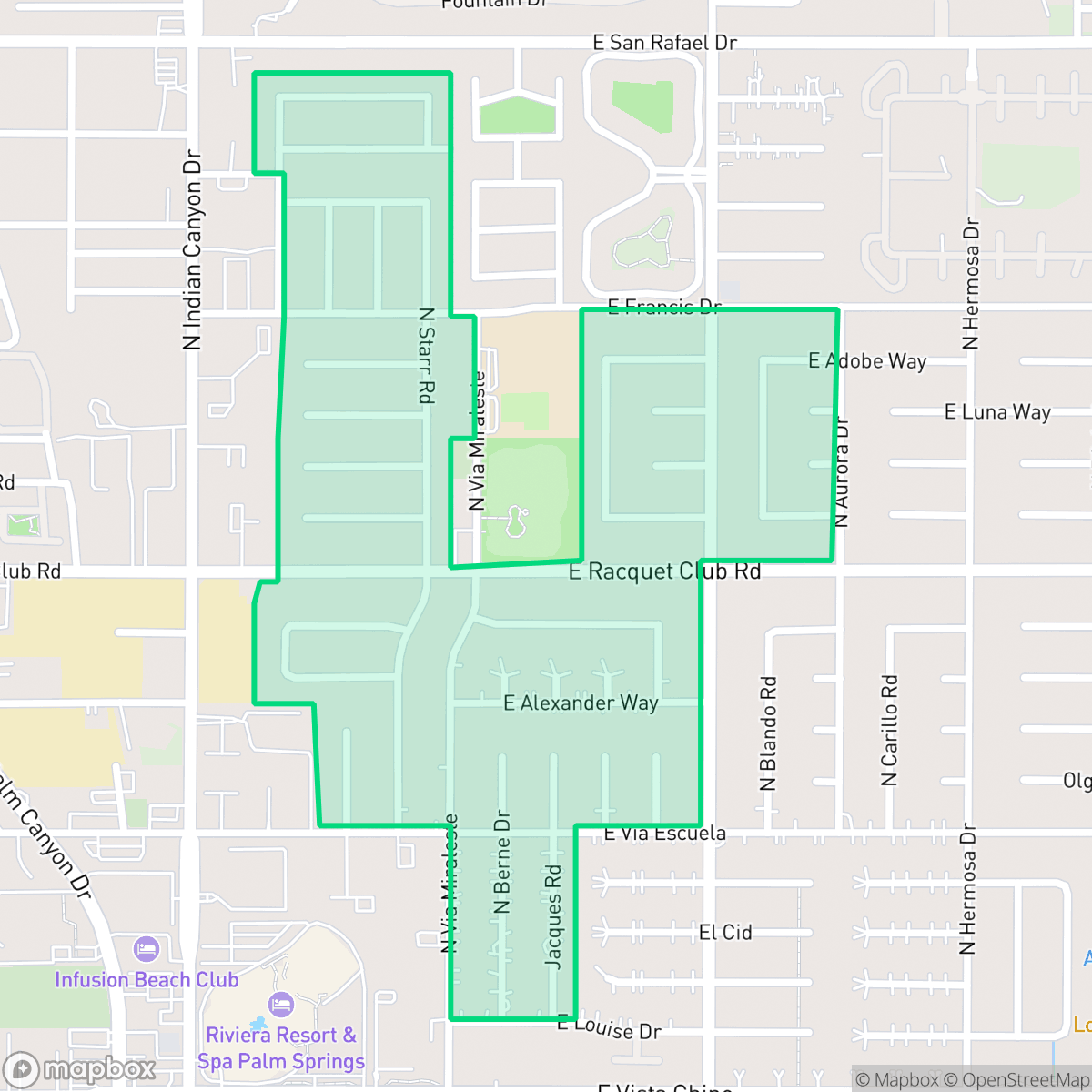
About Racquet Club Estates
Developed between 1959 and 1962, the Racquet Club Estates neighborhood in Palm Springs was built to capitalize on the popularity of the nearby Palm Springs Racquet Club, a famous celebrity hangout founded in 1934 by actors Charlie Farrell and Ralph Bellamy. The neighborhood stands as a premier showcase of mid-century modern tract housing. It features over 500 homes, primarily constructed by the Alexander Construction Company and designed by architect William Krisel. Other notable homes in the area were designed by Jack Meiselman and Donald Wexler, who built a series of pioneering all-steel prefabricated homes. Characterized by iconic butterfly roofs, post-and-beam construction, and clerestory windows, these residences popularized indoor-outdoor desert living for post-war vacationers and Hollywood stars.
The neighborhood serves as a focal point for mid-century modern design, blending historical architectural significance with a contemporary, active lifestyle. Residents benefit from high walkability and close proximity to established local favorites such as Billy Reed's Palm Springs and Boozehounds. The area maintains a distinctively residential feel, characterized by open green spaces and a consistent, lively social environment that draws both long-term residents and visitors interested in the city's unique architectural heritage.
Prospective residents should consider several livability trade-offs when evaluating the area. According to iHuus data, the neighborhood experiences significant acoustic challenges, with average noise levels reaching 65 decibels due to road traffic. Additionally, the area faces specific environmental concerns regarding flood and fire safety that warrant attention. While the local school district offers modern facilities and career-focused programs, academic performance varies significantly across the region. This neighborhood is best suited for individuals who prioritize architectural character and pedestrian accessibility over absolute quiet or environmental risk mitigation.
Neighborhood Scores Across 15 Qualities
Residential spacing is consistent with the Palm Springs average, offering a balance of proximity to neighbors and some buffer between properties.
Pedestrian infrastructure is well developed here, featuring wide sidewalks and frequent crossings that surpass the Palm Springs average. Residents can navigate the area easily on foot due to the presence of pedestrian-priority zones.
Large residential properties and premium amenities define the local landscape, offering a visual quality that is slightly higher than the Palm Springs average according to iHuus data.
Limited access to direct public parks and narrow street verges make pet walking less convenient than in other parts of Palm Springs, according to iHuus data.
Open land and scattered homes provide a more spread out environment than the typical Palm Springs urban density. This area features more frequent patches of undeveloped space compared to the city average.
Diverse dining and leisure spots provide more activity than the typical Palm Springs neighborhood. While some pockets remain quiet and residential, there is a notable presence of local cafes, galleries, and social venues within the area.
Persistent noise from nearby transit corridors and flight paths characterizes this area. According to iHuus data, acoustic comfort in this neighborhood is lower than the Palm Springs average.
Air quality remains consistently high with rare instances of elevated readings, performing nearly in line with the Palm Springs average according to iHuus data.
Industrial activity is absent from this area, providing a setting that is even more residential than the Palm Springs average. Residents can expect a landscape free from warehouses, manufacturing facilities, or nearby hazard sites.
Health insurance access is notably higher here than the Palm Springs average, according to iHuus data. This level of coverage indicates a more stable access to medical services for the local population.
Voting patterns and census indicators reflect a predominantly liberal political leaning, which is slightly more pronounced than the Palm Springs city average.
A diverse range of age groups resides here, including young adults, families, and seniors. This age distribution is largely in line with the broader Palm Springs area, according to iHuus data.
Flood risk levels in this area remain undetermined due to a lack of detailed federal studies; this level of uncertainty is roughly in line with the Palm Springs average according to iHuus data.
Wildfire hazards in this area are significantly higher than the Palm Springs average. Residents must prioritize rigorous fire prevention and maximum protection measures according to iHuus data.
Address-Level Insights for Racquet Club Estates


iHuus Neighborhood Intelligence Insights
Get address-level neighborhood insights for Racquet Club Estates
- Street-level scores — see how individual blocks compare, not just neighborhood averages
- Micro-zone boundaries — identify quiet pockets, flood boundaries, and walkable clusters before you visit
- 15 dimensions in full — walkability, noise, air quality, school quality, insurance coverage, population age profile, urban/rural index, and more
- Boundary risk alerts — know if your address sits near a block boundary where scores drop, the kind of detail no listing will ever mention
- School insights — individual school ratings and insights, not just district-level data
- Compare before you commit — side-by-side data across neighborhoods, down to block precision
No credit card required
Compare with Any Neighborhood
| Dimension | Racquet Club Estates | Andreas Hills |
|---|---|---|
| 🚶 Walkabilityavg 8.06 | ||
| 🔊 Acoustic Comfortavg 3.6 | ||
| 🤫 Privacy Indexavg 6 | ||
| 🎨 Visual Appealavg 7.66 | ||
| 🐕 Dog Friendlinessavg 6.14 | ||
| 🗺️ Urban-Rural Indexavg 7.27 | ||
| ✨ Neighborhood Vibeavg 4.76 | ||
| 🏥 Health Insurance Coverageavg 7.38 | ||
| 🌿 Air Qualityavg 8.11 | ||
| 🏭 Industrial Proximityavg 9.12 | ||
| 🌊 Flood Safetyavg 5.92 | ||
| 🗳️ Ideological Leanavg 9.69 | ||
| 👥 Population Age Profileavg 6.29 | ||
| 🔥 Fire Safetyavg 0.39 | ||
| 🏫 School Quality |
Racquet Club Estates Rankings
School Districts Serving Racquet Club Estates
School Insights for Racquet Club Estates
Below average outcomes; significant attendance and academic challenges.
School Insights
See what's really behind every school rating near Racquet Club Estates
- Individual school ratings — each school's own score with outcome context, not just a district average
- Enrollment & class size data — student-to-teacher ratio and how it compares to the state average
- Full demographics breakdown — ethnicity and gender composition for every school in the enrollment zone
- Every school in the district — all schools within the enrollment boundary ranked by rating, not just the closest one
- Grade levels & benchmarks — elementary through high school, with below/above state-average flags
No credit card required