Old Las Palmas, Palm Springs
Updated · 841 residents
Old Las Palmas is a visually striking residential enclave in Palm Springs known for its high concentration of mid-century architecture and lush, tree-lined streets. The area offers high walkability to nearby dining and parks, though residents should expect moderate noise levels from local road traffic.
Key Highlights
About Old Las Palmas
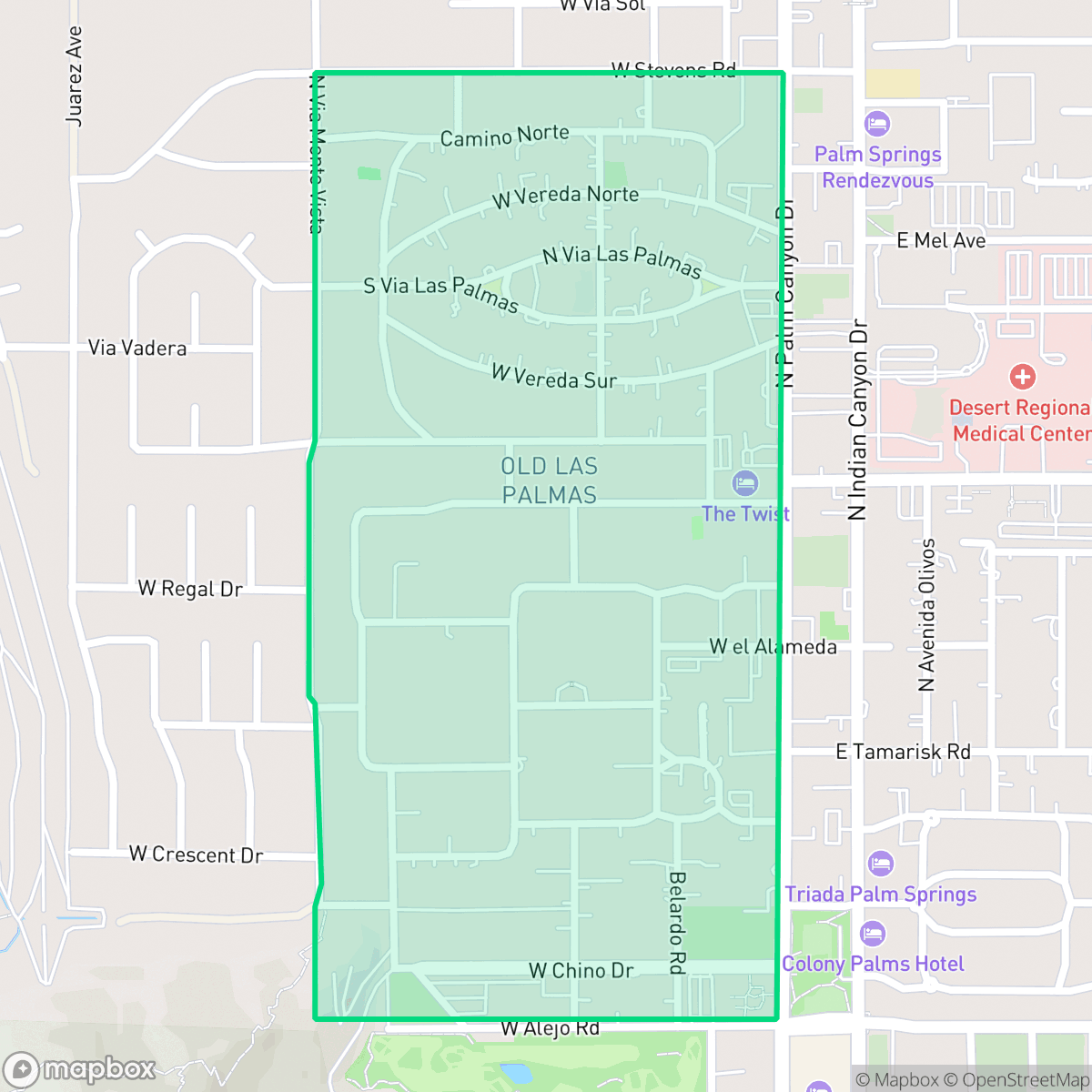
Originally a mid-1920s citrus grove, the Old Las Palmas neighborhood in Palm Springs was acquired by Prescott Stevens and developed by builder Alvah Hicks. Its distinctive curvilinear streets were inspired by the landscape design principles of Frederick Law Olmsted. The neighborhood evolved into a premier residential enclave featuring Spanish Colonial Revival, Ranch, and Mid-Century Modern estates designed by legendary architects like Donald Wexler and E. Stewart Williams. It is anchored on the south by the historic 1930 Our Lady of Solitude Church, designed by Albert Martin. Renowned for holding the city's highest concentration of celebrity properties, Old Las Palmas has served as a private desert sanctuary for Hollywood icons including Clark Gable, Liberace, and Dinah Shore, whose mid-century estate is currently owned by Leonardo DiCaprio.
The neighborhood serves as a quiet, predominantly residential hub where the aesthetic is defined by well-maintained landscapes and diverse architectural styles. Residents benefit from strong walkability, with easy access to the vibrant dining scene near Frances Stevens Park. According to iHuus data, the area maintains a high standard of visual appeal and is notably dog-friendly compared to the city average, making it a desirable location for those who prioritize outdoor aesthetics and pedestrian-friendly streets.
While the area offers significant benefits, prospective residents should consider the trade-offs. The acoustic environment is marked by moderate road traffic noise, and the region faces challenges regarding fire safety. Families with school-aged children should note that the local school district exhibits inconsistent academic performance across its campuses. Overall, the neighborhood is best suited for individuals or couples who value historic character and a walkable lifestyle in a central Palm Springs location.
Neighborhood Scores Across 15 Qualities
Large lot sizes and significant separation between properties provide a greater sense of seclusion than the typical Palm Springs neighborhood. According to iHuus data, this area offers more privacy than the city average.
Sidewalks are available on one side of the street with safe crossings provided. According to iHuus data, this level of pedestrian accessibility is slightly lower than the average for Palm Springs.
Custom architecture and expansive privacy buffers create a highly scenic environment that is notably more aesthetically pleasing than the Palm Springs average. According to iHuus data, the low-density landscape features significant luxury amenities and mature greenery.
Limited access to public parks and a lack of wide, grassy verges make it less ideal for dog owners compared to the rest of Palm Springs. According to iHuus data, the area provides fewer natural opportunities for off-leash exercise or casual strolls with pets.
Open land and scattered homes amidst greenery provide a more tranquil, less dense environment than the Palm Springs average. Residents will find more frequent pockets of woodland and field space compared to the more urbanized parts of the city.
Residential streets and green spaces provide a tranquil atmosphere that is more subdued than the Palm Springs average. While certain pockets near local parks offer accessible dining, much of the area remains a quiet, low-density landscape with limited commercial activity.
A steady hum from nearby busy streets is present, though acoustic comfort remains higher than the Palm Springs average according to iHuus data.
Air quality is consistently good with rare instances of elevated readings. According to iHuus data, the air quality in this area is slightly better than the Palm Springs average.
No warehouses, industrial facilities, or hazard sites are present within the neighborhood. This area is more strictly residential than the Palm Springs average, consisting primarily of quiet streets and open green spaces.
Health insurance access among residents is exceptionally high, significantly surpassing the Palm Springs average according to iHuus data.
Voting patterns and census indicators reflect a deeply liberal community, aligning closely with the broader political landscape of Palm Springs.
Older adults represent the majority of the population, creating a demographic profile that is slightly more aged than the Palm Springs average. According to iHuus data, there is a modest presence of younger residents within the community.
Flood risk in this area is slightly above the Palm Springs average, though the lack of a detailed FEMA study means the precise level of danger remains undetermined. Residents should remain aware of potential drainage issues during heavy desert storms.
Wildfire danger is exceptionally high in this area, presenting a more severe hazard than the typical Palm Springs neighborhood. Residents must prioritize rigorous fire prevention and maximum protection measures according to iHuus data.
Address-Level Insights for Old Las Palmas


iHuus Neighborhood Intelligence Insights
Get address-level neighborhood insights for Old Las Palmas
- Street-level scores — see how individual blocks compare, not just neighborhood averages
- Micro-zone boundaries — identify quiet pockets, flood boundaries, and walkable clusters before you visit
- 15 dimensions in full — walkability, noise, air quality, school quality, insurance coverage, population age profile, urban/rural index, and more
- Boundary risk alerts — know if your address sits near a block boundary where scores drop, the kind of detail no listing will ever mention
- School insights — individual school ratings and insights, not just district-level data
- Compare before you commit — side-by-side data across neighborhoods, down to block precision
No credit card required
Compare with Any Neighborhood
| Dimension | Old Las Palmas | Andreas Hills |
|---|---|---|
| 🚶 Walkabilityavg 8.06 | ||
| 🔊 Acoustic Comfortavg 3.6 | ||
| 🤫 Privacy Indexavg 6 | ||
| 🎨 Visual Appealavg 7.66 | ||
| 🐕 Dog Friendlinessavg 6.14 | ||
| 🗺️ Urban-Rural Indexavg 7.27 | ||
| ✨ Neighborhood Vibeavg 4.76 | ||
| 🏥 Health Insurance Coverageavg 7.38 | ||
| 🌿 Air Qualityavg 8.11 | ||
| 🏭 Industrial Proximityavg 9.12 | ||
| 🌊 Flood Safetyavg 5.92 | ||
| 🗳️ Ideological Leanavg 9.69 | ||
| 👥 Population Age Profileavg 6.29 | ||
| 🔥 Fire Safetyavg 0.39 | ||
| 🏫 School Quality |
Old Las Palmas Rankings
School Districts Serving Old Las Palmas
School Insights for Old Las Palmas
Below average outcomes; significant attendance and academic challenges.
School Insights
See what's really behind every school rating near Old Las Palmas
- Individual school ratings — each school's own score with outcome context, not just a district average
- Enrollment & class size data — student-to-teacher ratio and how it compares to the state average
- Full demographics breakdown — ethnicity and gender composition for every school in the enrollment zone
- Every school in the district — all schools within the enrollment boundary ranked by rating, not just the closest one
- Grade levels & benchmarks — elementary through high school, with below/above state-average flags
No credit card required