Movie Colony East, Palm Springs
Updated · 1,760 residents
Movie Colony East is a serene, residential enclave in Palm Springs defined by its significant mid-century modern architecture and quiet, tree-lined streets. While the area offers high walkability and abundant green space, it maintains a sparse, suburban atmosphere with limited commercial density.
Key Highlights
About Movie Colony East
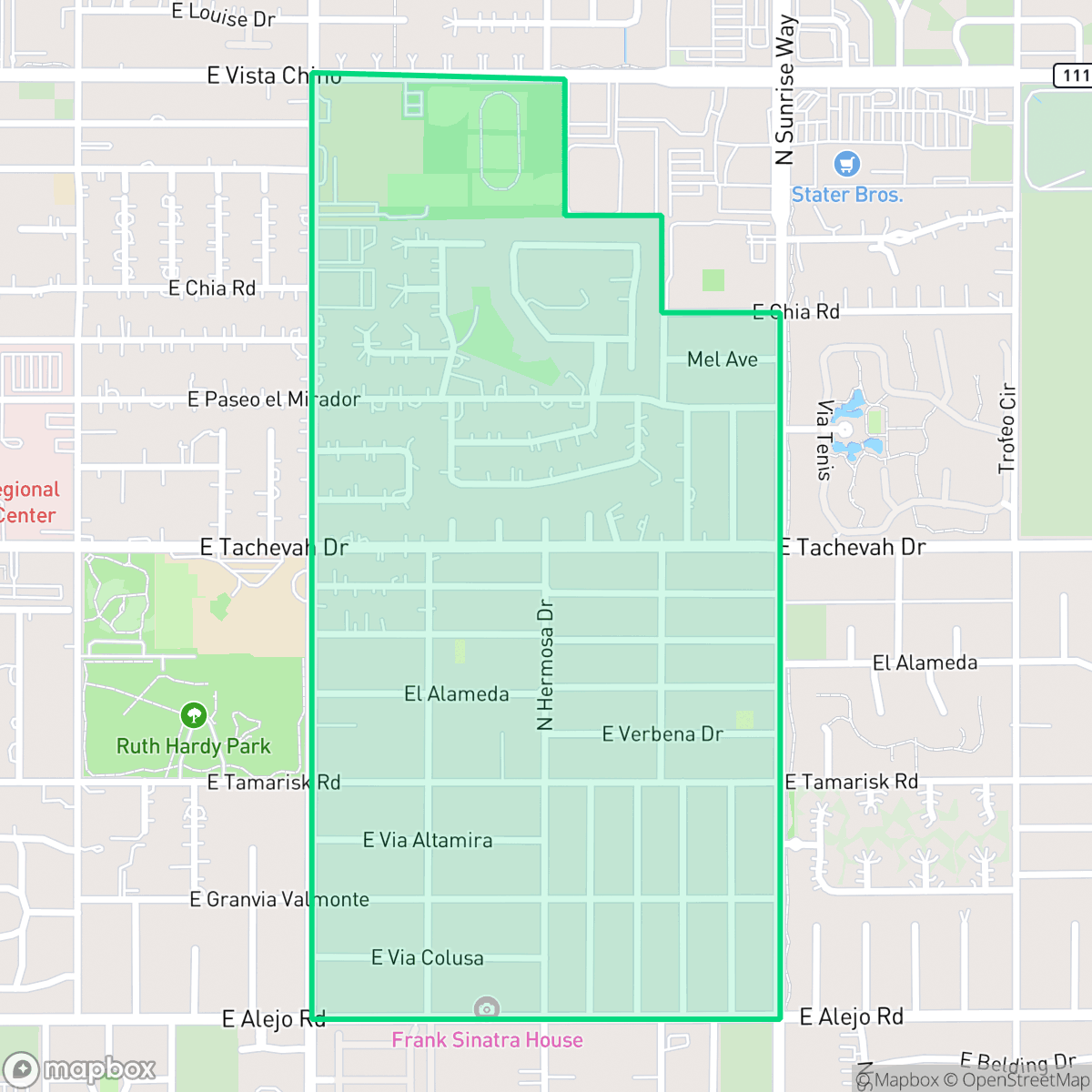
Developed starting in the late 1930s as an eastward expansion of the adjacent Movie Colony, the Movie Colony East neighborhood in Palm Springs grew rapidly during the postwar era. Its proximity to the El Mirador Hotel and Ruth Hardy Park made it a favored, secluded retreat for Hollywood stars and studio executives. Architecturally, the neighborhood transitions from early Spanish Colonial Revival homes to iconic mid-century modern designs. It is home to highly significant architectural landmarks, most notably Frank Sinatra’s 1947 "Twin Palms" estate, designed by E. Stewart Williams. Additionally, the neighborhood features the preserved personal residences of legendary desert modernist architects Donald Wexler and E. Stewart Williams, both built in 1955.
The neighborhood functions as a quiet residential retreat, characterized by its low-density layout and proximity to expansive parkland. It provides a peaceful living environment where residents can easily navigate the area on foot, despite the lack of immediate commercial amenities. The area maintains a consistent visual appeal, with well-maintained streets and a strong sense of community identity rooted in its preservation of desert modernist design.
Prospective residents should consider the trade-offs of living in this location, which include a moderate acoustic environment impacted by road traffic. While the neighborhood is highly desirable for its aesthetic and architectural heritage, families should note that local schools within the Palm Springs Unified School District currently face challenges with academic consistency. Additionally, the area requires awareness regarding environmental safety, particularly concerning fire risk, which is a common factor across many parts of the region.
Neighborhood Scores Across 15 Qualities
Residential spacing provides a moderate level of separation between neighbors, consistent with the typical density found throughout Palm Springs. Some buffers exist between properties, though homes are not isolated from the surrounding community.
Pedestrian navigation is easy due to safe crossings and sidewalks present on one side of the street. This level of walkability sits slightly above the Palm Springs average, according to iHuus data.
Large residential properties and frequent upscale amenities contribute to a landscape that is more visually appealing than the Palm Springs average. According to iHuus data, the area features spacious driveways and well-maintained surroundings.
Limited green verges and park access make walking pets slightly less convenient than in other parts of Palm Springs. According to iHuus data, the availability of dedicated outdoor spaces for dogs is slightly below the city average.
Open land and scattered homes provide a more tranquil, spread-out setting than the more densely developed areas of Palm Springs. This landscape offers more frequent views of fields and woodland compared to the city average.
Suburban streets and green spaces create a low-density, peaceful environment. According to iHuus data, the area is slightly less active than the typical Palm Springs neighborhood due to a sparse selection of nearby businesses and services.
Steady traffic sounds from a nearby busy street are noticeable, though the acoustic environment remains more tranquil than the Palm Springs average according to iHuus data.
Air quality remains consistently high with rare instances of elevated readings, performing closely to the Palm Springs average according to iHuus data.
No warehouses, industrial facilities, or hazard sites are present within the neighborhood. This area is more strictly residential than the Palm Springs average, consisting of quiet streets and open green spaces.
Health insurance access is more prevalent here than in the rest of Palm Springs. According to iHuus data, a significant portion of the resident population maintains coverage.
Voting patterns and census indicators reflect a deeply liberal political leaning that is slightly more pronounced than the Palm Springs average. According to iHuus data, the area maintains a very consistent progressive ideological profile.
Residents will find a community primarily composed of older adults, with a slightly higher concentration of seniors compared to the rest of Palm Springs.
Flood risk in this area is relatively low, though some residual risk exists within the 500-year floodplain. According to iHuus data, the safety level here is notably higher than the Palm Springs average.
Address-Level Insights for Movie Colony East


iHuus Neighborhood Intelligence Insights
Get address-level neighborhood insights for Movie Colony East
- Street-level scores — see how individual blocks compare, not just neighborhood averages
- Micro-zone boundaries — identify quiet pockets, flood boundaries, and walkable clusters before you visit
- 15 dimensions in full — walkability, noise, air quality, school quality, insurance coverage, population age profile, urban/rural index, and more
- Boundary risk alerts — know if your address sits near a block boundary where scores drop, the kind of detail no listing will ever mention
- School insights — individual school ratings and insights, not just district-level data
- Compare before you commit — side-by-side data across neighborhoods, down to block precision
No credit card required
Compare with Any Neighborhood
| Dimension | Movie Colony East | Andreas Hills |
|---|---|---|
| 🚶 Walkabilityavg 8.06 | ||
| 🔊 Acoustic Comfortavg 3.6 | ||
| 🤫 Privacy Indexavg 6 | ||
| 🎨 Visual Appealavg 7.66 | ||
| 🐕 Dog Friendlinessavg 6.14 | ||
| 🗺️ Urban-Rural Indexavg 7.27 | ||
| ✨ Neighborhood Vibeavg 4.76 | ||
| 🏥 Health Insurance Coverageavg 7.38 | ||
| 🌿 Air Qualityavg 8.11 | ||
| 🏭 Industrial Proximityavg 9.12 | ||
| 🌊 Flood Safetyavg 5.92 | ||
| 🗳️ Ideological Leanavg 9.69 | ||
| 👥 Population Age Profileavg 6.29 | ||
| 🔥 Fire Safetyavg 0.39 | ||
| 🏫 School Quality |
Movie Colony East Rankings
School Districts Serving Movie Colony East
School Insights for Movie Colony East
Below average outcomes; significant attendance and academic challenges.
School Insights
See what's really behind every school rating near Movie Colony East
- Individual school ratings — each school's own score with outcome context, not just a district average
- Enrollment & class size data — student-to-teacher ratio and how it compares to the state average
- Full demographics breakdown — ethnicity and gender composition for every school in the enrollment zone
- Every school in the district — all schools within the enrollment boundary ranked by rating, not just the closest one
- Grade levels & benchmarks — elementary through high school, with below/above state-average flags
No credit card required