Los Compadres, Palm Springs
Updated · 1,132 residents
Los Compadres is a serene residential enclave in south Palm Springs defined by its spacious lots and diverse architectural styles, including mid-century modern and California ranch homes. The area offers a quiet, suburban atmosphere with high air quality and a peaceful acoustic environment, making it a desirable retreat from the city center.
Key Highlights
About Los Compadres
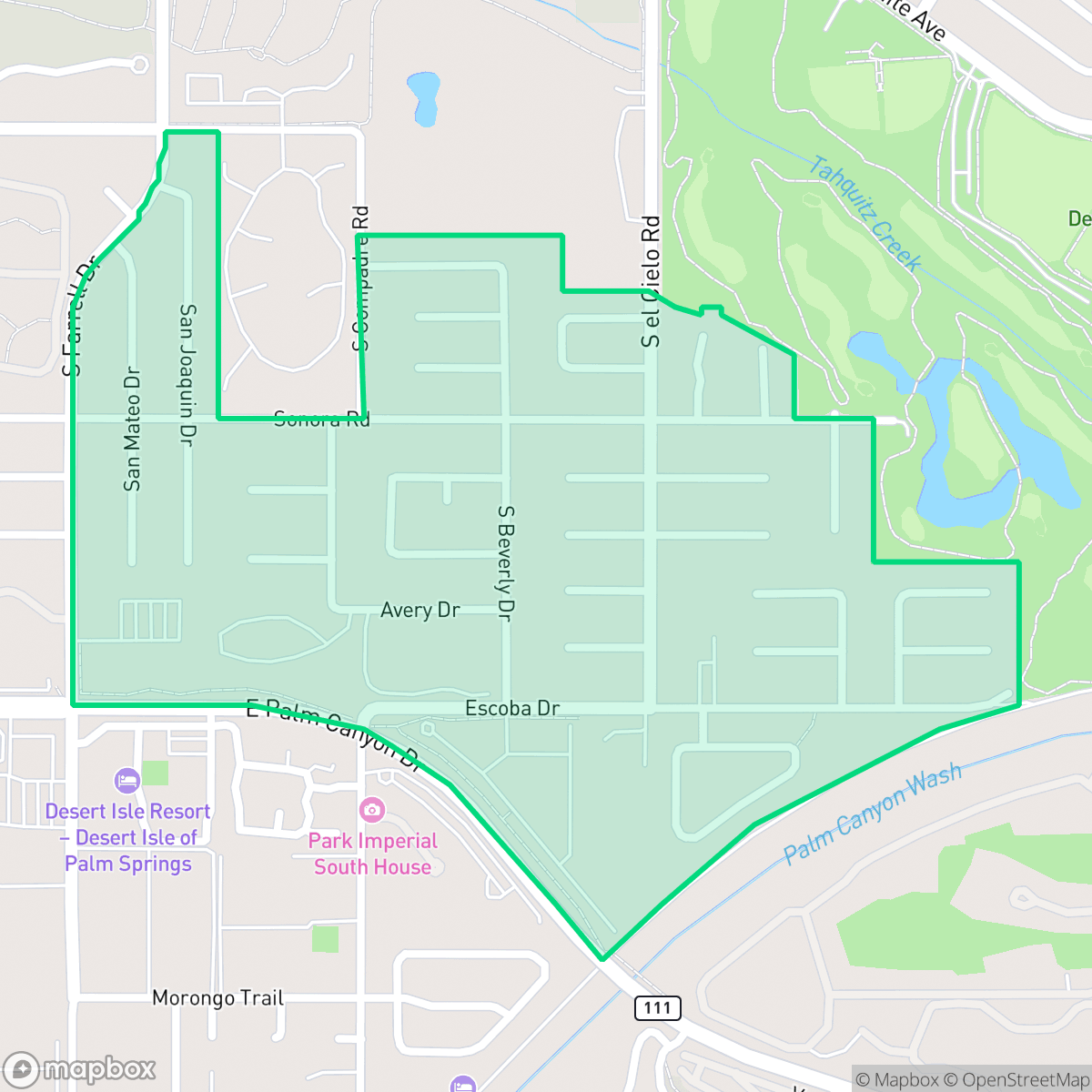
The Los Compadres neighborhood in south Palm Springs traces its identity back to 1941 with the founding of the Los Compadres Stables and Riding Club. Serving as one of the "last vestiges of the West in Palm Springs," the area was once a hub for rodeos, horseback riding, and western-themed social events frequented by Hollywood figures and the city's iconic cowboy mayor, Frank Bogert. Residential development began in earnest during the 1960s and 1970s, transitioning the equestrian grounds into a peaceful neighborhood. Today, Los Compadres is characterized by its architectural diversity, featuring a blend of mid-century modern designs, low-slung California ranch-style homes, and pockets of Spanish-style residences built on spacious, wind-sheltered lots.
This neighborhood functions as a quiet residential pocket, characterized by low-slung architecture and generous lot sizes that provide a sense of seclusion. Residents benefit from high air quality and a moderate acoustic environment, with road traffic noise levels averaging 55 decibels. The area maintains a suburban feel, supported by local amenities like Manhattan in the Desert and community spaces that foster a relaxed, low-density lifestyle. According to iHuus data, the neighborhood provides a consistent, tranquil living experience compared to more central or high-traffic parts of the city. While the area offers a peaceful retreat, prospective residents should note the broader context of the Palm Springs Unified School District, which presents academic variability across its campuses. The neighborhood also faces significant challenges regarding fire safety, a common consideration in the region that requires awareness. It is best suited for those prioritizing a quiet, low-traffic environment over proximity to the dense, high-energy urban core of Palm Springs.
Neighborhood Scores Across 15 Qualities
Residential spacing is consistent with the Palm Springs average, providing a moderate level of buffer between neighboring properties.
Pedestrian access is reliable due to the presence of sidewalks on one side of the street and safe designated crossings. This level of walkability is slightly above the Palm Springs average, according to iHuus data.
Large homes and frequent upscale amenities contribute to an aesthetically pleasing environment that sits above the Palm Springs average. According to iHuus data, the area is characterized by spacious driveways and well-maintained properties.
Wide paths and connected green spaces provide plenty of room for exercise. According to iHuus data, this area offers significantly more pet-friendly infrastructure than the rest of Palm Springs.
Frequent open land and scattered homes provide a more semi-rural atmosphere than the more developed parts of Palm Springs. According to iHuus data, the area features a dense suburban resort layout where grey infrastructure is interspersed with artificial green space.
Low density residential streets and scattered green spaces provide a steady, tranquil pace of life that is slightly more subdued than the Palm Springs average. According to iHuus data, the area maintains a balanced mix of open space and occasional local service points near the water.
Steady noise from nearby busy streets is present, though levels are notably quieter than the Palm Springs average. Residents may experience a consistent hum of local traffic throughout the day.
Air quality remains mostly clean with infrequent periods of elevated readings, performing very similarly to the Palm Springs average according to iHuus data.
Industrial presence is nearly nonexistent here, offering a landscape of quiet streets and open green spaces. While a wastewater treatment plant is located in the northeast corner, the area remains comparable to the city average for its lack of warehouses and heavy industrial facilities.
Health insurance accessibility is notably higher in this neighborhood than the Palm Springs average, according to iHuus data.
Voting patterns and census indicators show a very strong liberal leaning that is slightly more pronounced than the Palm Springs average.
Older adults represent the primary demographic here, though a modest number of younger residents are also present. According to iHuus data, the population age is slightly higher than the Palm Springs average.
Residual flood risk exists within this area due to its location in a 500-year floodplain, though safety levels remain notably higher than the Palm Springs average according to iHuus data.
Address-Level Insights for Los Compadres


iHuus Neighborhood Intelligence Insights
Get address-level neighborhood insights for Los Compadres
- Street-level scores — see how individual blocks compare, not just neighborhood averages
- Micro-zone boundaries — identify quiet pockets, flood boundaries, and walkable clusters before you visit
- 15 dimensions in full — walkability, noise, air quality, school quality, insurance coverage, population age profile, urban/rural index, and more
- Boundary risk alerts — know if your address sits near a block boundary where scores drop, the kind of detail no listing will ever mention
- School insights — individual school ratings and insights, not just district-level data
- Compare before you commit — side-by-side data across neighborhoods, down to block precision
No credit card required
Compare with Any Neighborhood
| Dimension | Los Compadres | Andreas Hills |
|---|---|---|
| 🚶 Walkabilityavg 8.06 | ||
| 🔊 Acoustic Comfortavg 3.6 | ||
| 🤫 Privacy Indexavg 6 | ||
| 🎨 Visual Appealavg 7.66 | ||
| 🐕 Dog Friendlinessavg 6.14 | ||
| 🗺️ Urban-Rural Indexavg 7.27 | ||
| ✨ Neighborhood Vibeavg 4.76 | ||
| 🏥 Health Insurance Coverageavg 7.38 | ||
| 🌿 Air Qualityavg 8.11 | ||
| 🏭 Industrial Proximityavg 9.12 | ||
| 🌊 Flood Safetyavg 5.92 | ||
| 🗳️ Ideological Leanavg 9.69 | ||
| 👥 Population Age Profileavg 6.29 | ||
| 🔥 Fire Safetyavg 0.39 | ||
| 🏫 School Quality |
Los Compadres Rankings
School Districts Serving Los Compadres
School Insights for Los Compadres
Below average outcomes; significant attendance and academic challenges.
School Insights
See what's really behind every school rating near Los Compadres
- Individual school ratings — each school's own score with outcome context, not just a district average
- Enrollment & class size data — student-to-teacher ratio and how it compares to the state average
- Full demographics breakdown — ethnicity and gender composition for every school in the enrollment zone
- Every school in the district — all schools within the enrollment boundary ranked by rating, not just the closest one
- Grade levels & benchmarks — elementary through high school, with below/above state-average flags
No credit card required