Little Tuscany, Palm Springs
Updated · 855 residents
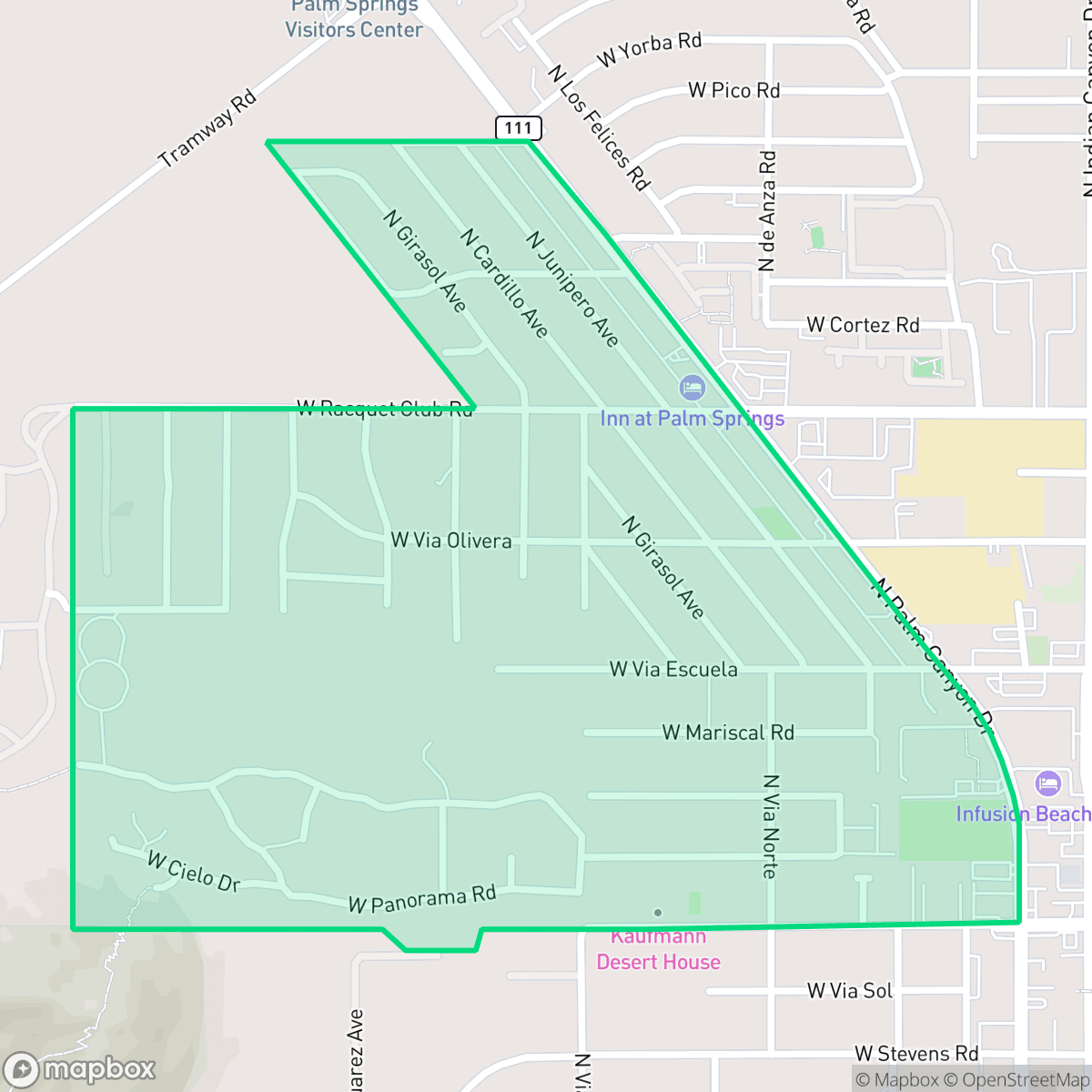
Little Tuscany is a visually striking enclave in northwest Palm Springs known for its dramatic hillside setting and significant architectural heritage. While the area offers high levels of privacy and exceptional scenic beauty, it remains a quiet residential pocket with limited walkability to commercial amenities.
Key Highlights
About Little Tuscany
Perched on the rugged hillsides of northwest Palm Springs, the Little Tuscany neighborhood began in 1934 when builder Alvah Hicks, inspired by a European vacation, envisioned a Tuscan-style village nestled among the area's massive boulders. Hicks constructed seven Italian-inspired residences, including a home later owned by Elvis Presley. Following World War II, the neighborhood transformed into a premier canvas for Desert Modernism, as its challenging, rocky terrain spurred technical and artistic architectural innovation. Today, Little Tuscany is renowned for its high concentration of mid-century modern masterpieces, featuring iconic homes like Richard Neutra’s Kaufmann Desert House (1946), Albert Frey’s Raymond Loewy House (1947), and the 1956 Frederick Loewe Estate. This unique blend of early stone-and-stucco villas and glass-and-steel pavilions remains one of the desert’s most architecturally significant enclaves.
The area is defined by its rugged hillside topography and a high concentration of significant residential architecture, resulting in a visual appeal that ranks among the highest in the city. According to iHuus data, residents benefit from a high degree of privacy and excellent air quality, maintaining a serene atmosphere that is largely removed from industrial activity. While the streets are quiet and suburban, the neighborhood maintains a low profile in terms of general livability, with few businesses or services accessible by foot.
Prospective residents should note that the neighborhood presents specific trade-offs regarding infrastructure and accessibility. Walkability is moderate, and the area is not particularly suited for those who prioritize frequent interaction with local businesses or pet-friendly amenities. Furthermore, the reliance on road access means that traffic noise can be a factor, and the location faces significant fire safety risks, which is a critical consideration for property owners in this terrain. It is best suited for individuals who prioritize architectural significance, privacy, and a quiet, visually stunning environment over urban convenience.
Neighborhood Scores Across 15 Qualities
Residential lots feature significant separation between homes, providing more privacy than the Palm Springs average according to iHuus data.
Sidewalks on one side of the street and safe crossings facilitate easy movement on foot. This level of accessibility is slightly above the Palm Springs average according to iHuus data.
Spacious residential lots and premium amenities contribute to a landscape that is more aesthetically pleasing than the Palm Springs average. According to iHuus data, the area features large-scale homes and well-maintained properties.
Access to public parks and wide grassy verges is below the Palm Springs average. Walking dogs in this area may require traveling outside the immediate neighborhood to find suitable green spaces.
Open desert and mountainous terrain dominate the landscape, providing a more rural feel than the more developed parts of Palm Springs. Residents can expect low building density and frequent vistas of open land according to iHuus data.
A mix of active residential streets and local dining options creates a more vibrant atmosphere than the typical Palm Springs neighborhood. According to iHuus data, residents can enjoy a variety of nearby cafes and eateries, though some areas remain quiet and primarily residential.
Frequent noise from nearby transit corridors and flight paths makes this area louder than the typical Palm Springs neighborhood, according to iHuus data.
Air quality remains mostly clean with rare instances of elevated readings, appearing very similar to the Palm Springs average according to iHuus data.
Industrial activity is entirely absent from this area, which consists solely of residential and natural desert land. According to iHuus data, this neighborhood offers a cleaner environment than the Palm Springs average due to the lack of warehouses or hazardous facilities.
Health insurance enrollment is exceptionally high among residents, significantly surpassing the Palm Springs average according to iHuus data.
Voting patterns and census indicators in Little Tuscany reflect a deeply liberal community, mirroring the broader political landscape of Palm Springs.
Older adults form the majority of the population, representing a slightly more mature age profile than the rest of Palm Springs. According to iHuus data, there is a modest presence of younger residents within the community.
Flood safety levels in this area are lower than the Palm Springs average, as FEMA has not yet completed a detailed study for this specific location. Residents should remain aware that the risk level remains undetermined according to iHuus data.
High fire hazards are present in this area, matching the elevated risk levels found throughout Palm Springs. Residents should maintain maximum protection measures due to the extreme nature of the local fire danger.
Address-Level Insights for Little Tuscany


iHuus Neighborhood Intelligence Insights
Get address-level neighborhood insights for Little Tuscany
- Street-level scores — see how individual blocks compare, not just neighborhood averages
- Micro-zone boundaries — identify quiet pockets, flood boundaries, and walkable clusters before you visit
- 15 dimensions in full — walkability, noise, air quality, school quality, insurance coverage, population age profile, urban/rural index, and more
- Boundary risk alerts — know if your address sits near a block boundary where scores drop, the kind of detail no listing will ever mention
- School insights — individual school ratings and insights, not just district-level data
- Compare before you commit — side-by-side data across neighborhoods, down to block precision
No credit card required
Compare with Any Neighborhood
| Dimension | Little Tuscany | Andreas Hills |
|---|---|---|
| 🚶 Walkabilityavg 8.06 | ||
| 🔊 Acoustic Comfortavg 3.6 | ||
| 🤫 Privacy Indexavg 6 | ||
| 🎨 Visual Appealavg 7.66 | ||
| 🐕 Dog Friendlinessavg 6.14 | ||
| 🗺️ Urban-Rural Indexavg 7.27 | ||
| ✨ Neighborhood Vibeavg 4.76 | ||
| 🏥 Health Insurance Coverageavg 7.38 | ||
| 🌿 Air Qualityavg 8.11 | ||
| 🏭 Industrial Proximityavg 9.12 | ||
| 🌊 Flood Safetyavg 5.92 | ||
| 🗳️ Ideological Leanavg 9.69 | ||
| 👥 Population Age Profileavg 6.29 | ||
| 🔥 Fire Safetyavg 0.39 | ||
| 🏫 School Quality |
Little Tuscany Rankings
School Districts Serving Little Tuscany
School Insights for Little Tuscany
Below average outcomes; significant attendance and academic challenges.
School Insights
See what's really behind every school rating near Little Tuscany
- Individual school ratings — each school's own score with outcome context, not just a district average
- Enrollment & class size data — student-to-teacher ratio and how it compares to the state average
- Full demographics breakdown — ethnicity and gender composition for every school in the enrollment zone
- Every school in the district — all schools within the enrollment boundary ranked by rating, not just the closest one
- Grade levels & benchmarks — elementary through high school, with below/above state-average flags
No credit card required