Little Beverly Hills, Palm Springs
Updated · 275 residents
Little Beverly Hills is a mid-century modern enclave defined by its architectural heritage and street names inspired by its namesake in Los Angeles. While the area offers a strong sense of community and high dog friendliness, residents should be prepared for significant road noise from nearby traffic.
Key Highlights
About Little Beverly Hills
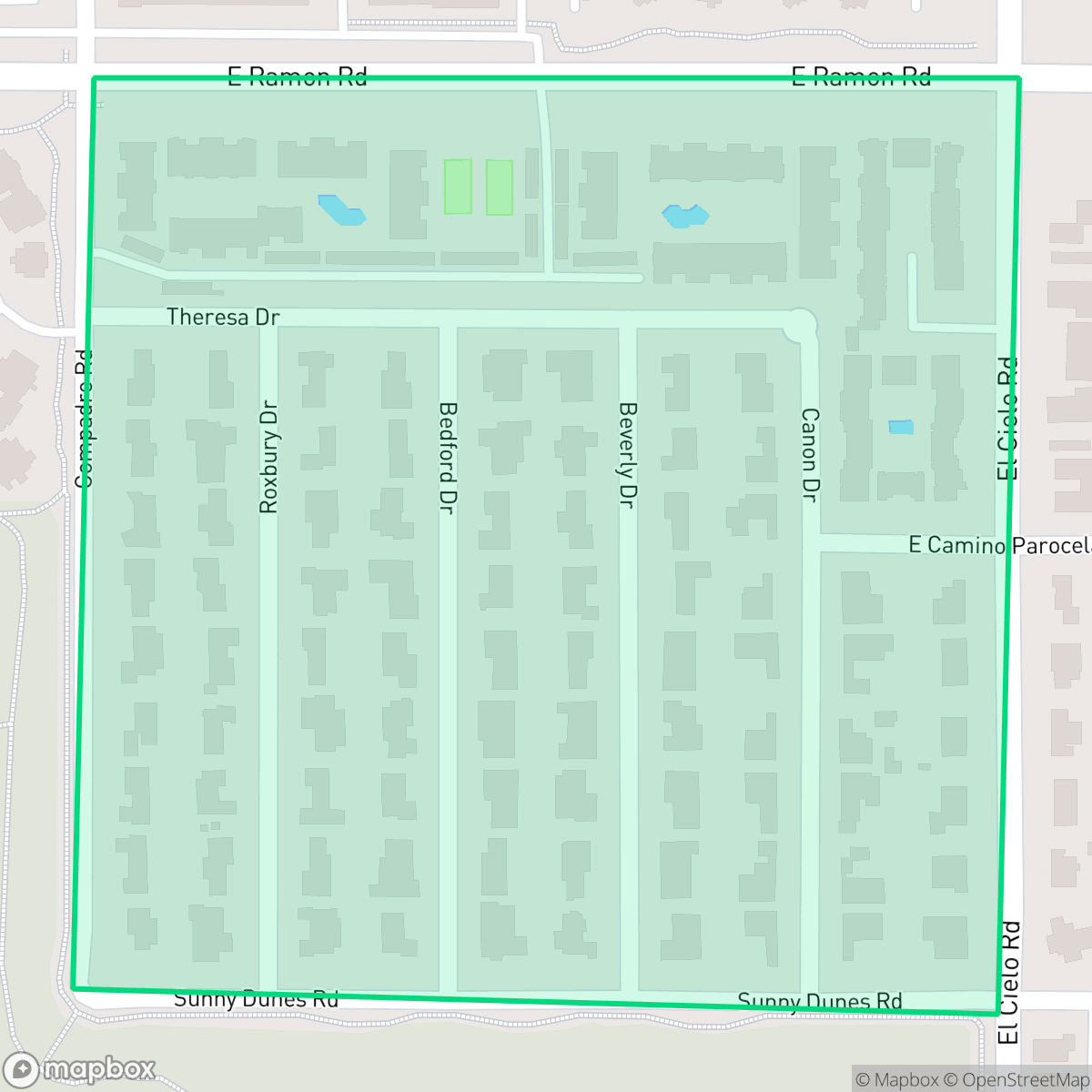
Originally developed in 1957 as Ramon Rise Estates, the Little Beverly Hills neighborhood in Palm Springs, California, is a premier enclave of mid-century modern residential architecture. The neighborhood features 84 homes built between 1957 and 1959, consisting of 64 homes designed by William Krisel and built by the Alexander Construction Company (initially marketed as "Enchanted Village"), alongside 20 homes designed and built by Jack Meiselman. The area earned its nickname because its streets—such as Canon, Beverly, Bedford, and Roxbury Drives—were named after famous thoroughfares in Beverly Hills. Officially recognized by the city in 2014, the neighborhood is celebrated for its classic modernist design elements, including post-and-beam construction, flat or butterfly rooflines, and seamless indoor-outdoor living. Notable local landmarks include the vibrant, artist-inspired "Shag House" on Compadre Road.
The neighborhood maintains a distinct identity through its preserved modernist homes and low-density layout. It offers a unique visual appeal that attracts architecture enthusiasts and those seeking a quiet, residential atmosphere. The area is characterized by its open spaces and proximity to local landmarks like the Shag House, fostering a cohesive aesthetic that reflects the mid-century spirit of Palm Springs. Prospective residents should consider the trade-offs of this location, particularly regarding the high fire risk and the ambient noise levels caused by nearby road traffic. While the neighborhood provides a high degree of walkability for a suburban setting, the car-dependent layout of the city remains a factor for daily commuting. It is best suited for those who prioritize architectural integrity and a pet-friendly environment over absolute acoustic privacy.
Neighborhood Scores Across 15 Qualities
Homes are separated by private yards within a typical suburban grid. This level of density and buffer between neighbors is consistent with the rest of Palm Springs.
Pedestrian-friendly infrastructure with wide sidewalks and frequent crossings makes much of the area accessible on foot. This level of walkability is significantly higher than the average for Palm Springs.
Large homes and frequent private backyard pools contribute to a visual landscape that is more polished than the Palm Springs average. According to iHuus data, the presence of spacious driveways and premium amenities creates a high-end residential feel.
Narrow sidewalk verges and private fencing in residential areas limit accessible green space for dogs. This level of accessibility is slightly below the Palm Springs average, according to iHuus data.
Open land and scattered greenery are more prevalent here than in the rest of Palm Springs. While the area retains a semi-rural feel, certain pockets feature denser suburban development and large commercial facilities near the airport.
Residential streets offer a steady, low-key rhythm with scattered dining options and greenery. This area maintains a subdued energy that is slightly below the city average for activity levels.
Persistent sound from nearby freeways and railroad tracks makes this area noisier than the Palm Springs average. According to iHuus data, residents may experience frequent auditory disruptions due to the proximity of major transportation corridors.
Air quality remains consistently high with rare instances of elevated readings. This level of cleanliness is roughly in line with the rest of Palm Springs.
Residential streets and open green spaces define the area, though proximity to airport runways and large hangars introduces notable noise and activity. This level of industrial and commercial activity is slightly higher than the city average, according to iHuus data.
Health insurance coverage among residents is consistent with the average found across Palm Springs. According to iHuus data, most inhabitants have access to medical coverage.
Voting patterns and census indicators show a very strong liberal leaning, which is slightly more pronounced than the Palm Springs average according to iHuus data.
Older adults make up the majority of the population here, representing a slightly older demographic than the Palm Springs average according to iHuus data.
Residual flood risk exists due to the area's location within a 500-year floodplain, though safety levels remain notably higher than the Palm Springs average according to iHuus data.
Address-Level Insights for Little Beverly Hills


iHuus Neighborhood Intelligence Insights
Get address-level neighborhood insights for Little Beverly Hills
- Street-level scores — see how individual blocks compare, not just neighborhood averages
- Micro-zone boundaries — identify quiet pockets, flood boundaries, and walkable clusters before you visit
- 15 dimensions in full — walkability, noise, air quality, school quality, insurance coverage, population age profile, urban/rural index, and more
- Boundary risk alerts — know if your address sits near a block boundary where scores drop, the kind of detail no listing will ever mention
- School insights — individual school ratings and insights, not just district-level data
- Compare before you commit — side-by-side data across neighborhoods, down to block precision
No credit card required
Compare with Any Neighborhood
| Dimension | Little Beverly Hills | Andreas Hills |
|---|---|---|
| 🚶 Walkabilityavg 8.06 | ||
| 🔊 Acoustic Comfortavg 3.6 | ||
| 🤫 Privacy Indexavg 6 | ||
| 🎨 Visual Appealavg 7.66 | ||
| 🐕 Dog Friendlinessavg 6.14 | ||
| 🗺️ Urban-Rural Indexavg 7.27 | ||
| ✨ Neighborhood Vibeavg 4.76 | ||
| 🏥 Health Insurance Coverageavg 7.38 | ||
| 🌿 Air Qualityavg 8.11 | ||
| 🏭 Industrial Proximityavg 9.12 | ||
| 🌊 Flood Safetyavg 5.92 | ||
| 🗳️ Ideological Leanavg 9.69 | ||
| 👥 Population Age Profileavg 6.29 | ||
| 🔥 Fire Safetyavg 0.39 | ||
| 🏫 School Quality |
Little Beverly Hills Rankings
School Districts Serving Little Beverly Hills
School Insights for Little Beverly Hills
Below average outcomes; significant attendance and academic challenges.
School Insights
See what's really behind every school rating near Little Beverly Hills
- Individual school ratings — each school's own score with outcome context, not just a district average
- Enrollment & class size data — student-to-teacher ratio and how it compares to the state average
- Full demographics breakdown — ethnicity and gender composition for every school in the enrollment zone
- Every school in the district — all schools within the enrollment boundary ranked by rating, not just the closest one
- Grade levels & benchmarks — elementary through high school, with below/above state-average flags
No credit card required