Indian Canyon, Palm Springs
Updated · 914 residents
Indian Canyon is a serene residential enclave in southern Palm Springs defined by its exceptional air quality and quiet atmosphere. Residents enjoy a highly walkable environment with abundant green space and a strong sense of community, making it an ideal setting for those seeking a peaceful desert retreat.
Key Highlights
About Indian Canyon
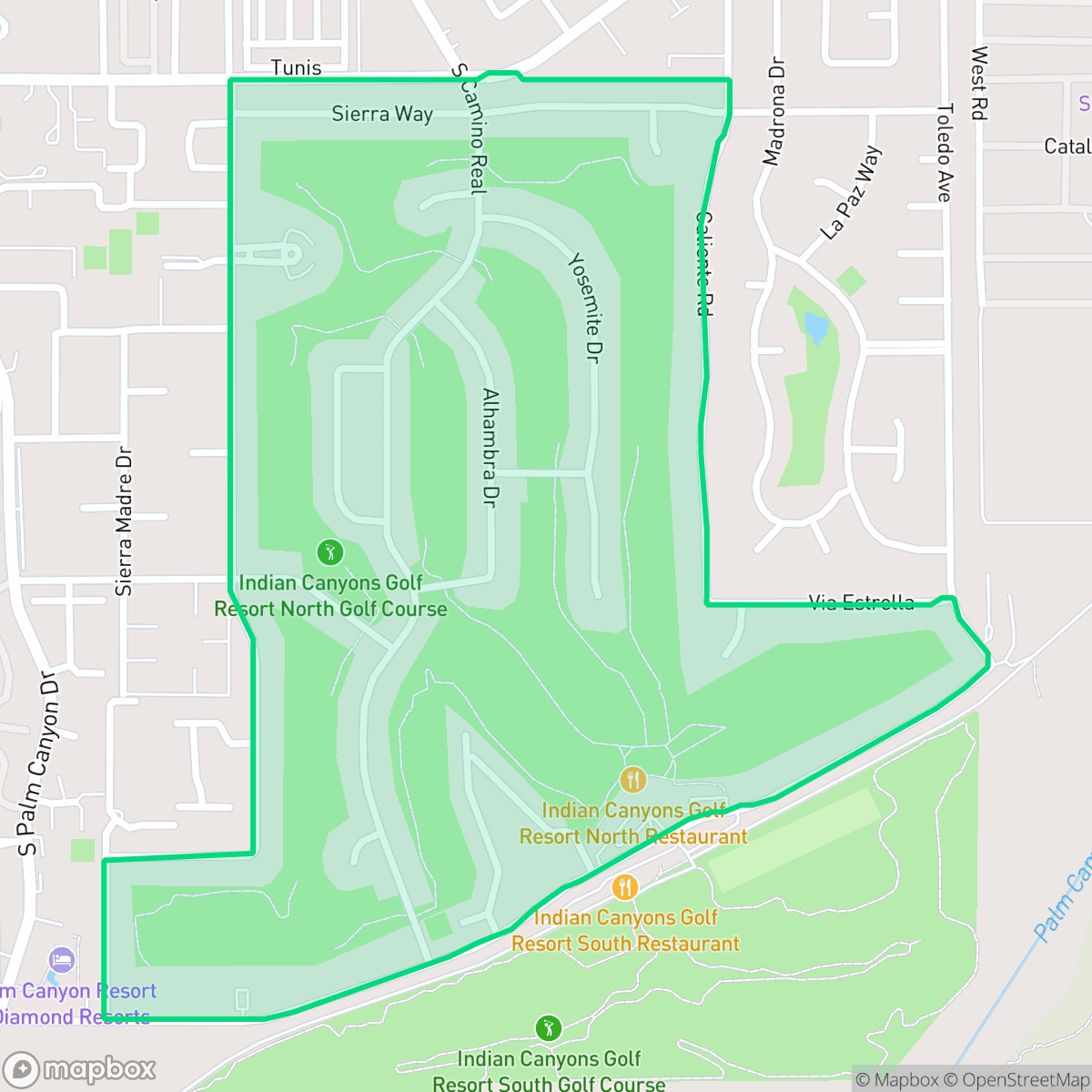
Located in southern Palm Springs, the historic Indian Canyons neighborhood—originally known as the Canyon Country Club—was developed in the early 1960s on land leased from the Agua Caliente Band of Cahuilla Indians. The neighborhood grew around Palm Springs' first 18-hole golf course, which opened in 1962. Its iconic mid-century modern clubhouse, designed by architects Donald Wexler and Richard Harrison, famously overlooks the 100-foot Walt Disney Fountain. Renowned for its seamless integration with the surrounding San Jacinto Mountains, the neighborhood features celebrated mid-century modern residences designed by prominent architects like William Krisel, Stan Sackley, and Dan Palmer. Renamed in 2009 to reflect the surrounding golf course, Indian Canyons historically attracted legendary residents and visitors, including Frank Sinatra, Lucille Ball, and Pancho Gonzales.
The area is characterized by its quiet, suburban rhythm and integration with the desert landscape. With high acoustic comfort, the neighborhood offers a tranquil living experience away from the noise of major thoroughfares. The local infrastructure supports a highly walkable lifestyle, allowing residents to navigate the well-maintained streets and surrounding green spaces with ease. According to iHuus data, the air quality here is excellent, contributing to a healthy environment for outdoor activities and pet owners who benefit from the area's dog-friendly nature.
Prospective residents should note that while the neighborhood excels in environmental quality and tranquility, it maintains a relatively subdued social vibe compared to the more commercial districts of Palm Springs. The school system serving the area, the Palm Springs Unified School District, presents a mixed academic landscape that families should research further. Additionally, while the neighborhood is well-prepared for flood events, the broader region faces significant challenges regarding fire safety. This area is best suited for those prioritizing a quiet, clean, and pedestrian-friendly lifestyle over proximity to dense commercial centers.
Neighborhood Scores Across 15 Qualities
Residential spacing is varied, offering a mix of open views and some distance between neighbors. This level of density is consistent with the typical experience found across Palm Springs.
Pedestrian movement is supported by sidewalks on one side of the street and safe crossings. According to iHuus data, this level of walkability is slightly above the Palm Springs average.
Spacious properties and premium amenities provide an aesthetic quality that is higher than the Palm Springs average, according to iHuus data.
Connected green spaces and wide paths offer ample opportunities for pet exercise. According to iHuus data, this area is significantly more dog friendly than the Palm Springs average due to its safety from traffic.
Open land and scattered homes create a spacious, semi-rural atmosphere that is slightly less dense than the Palm Springs average, according to iHuus data.
Lively blocks with a selection of local amenities and restaurants offer more activity than the Palm Springs average. Residents can enjoy a mix of social spots and green spaces, though the area remains largely car-dependent.
Steady sounds from nearby busy streets are present, though the area remains notably quieter than the Palm Springs average. According to iHuus data, residents can expect a consistent level of local traffic hum.
Air quality remains consistently high with rare instances of elevated readings. This level of cleanliness is slightly better than the Palm Springs average, according to iHuus data.
Industrial activity is absent from this area, providing a purely residential environment with no detected warehouses or hazard sites. According to iHuus data, this lack of industrial proximity is even more pronounced here than in the rest of Palm Springs.
Health insurance accessibility is notably higher here than in the rest of Palm Springs, according to iHuus data. Residents benefit from a significantly greater proportion of covered individuals compared to the city average.
Voting patterns and census indicators show a predominantly liberal community, slightly more so than the average for Palm Springs. According to iHuus data, this area maintains a highly progressive political orientation.
Older adults form the majority of the population here, representing a more mature demographic than the Palm Springs average. According to iHuus data, the area maintains a modest presence of younger residents.
Flood risk in this area is slightly higher than the Palm Springs average because parts of the neighborhood sit within a 500-year floodplain. According to iHuus data, some residual flood risk exists for properties in specific low-lying zones.
Address-Level Insights for Indian Canyon


iHuus Neighborhood Intelligence Insights
Get address-level neighborhood insights for Indian Canyon
- Street-level scores — see how individual blocks compare, not just neighborhood averages
- Micro-zone boundaries — identify quiet pockets, flood boundaries, and walkable clusters before you visit
- 15 dimensions in full — walkability, noise, air quality, school quality, insurance coverage, population age profile, urban/rural index, and more
- Boundary risk alerts — know if your address sits near a block boundary where scores drop, the kind of detail no listing will ever mention
- School insights — individual school ratings and insights, not just district-level data
- Compare before you commit — side-by-side data across neighborhoods, down to block precision
No credit card required
Compare with Any Neighborhood
| Dimension | Indian Canyon | Andreas Hills |
|---|---|---|
| 🚶 Walkabilityavg 8.06 | ||
| 🔊 Acoustic Comfortavg 3.6 | ||
| 🤫 Privacy Indexavg 6 | ||
| 🎨 Visual Appealavg 7.66 | ||
| 🐕 Dog Friendlinessavg 6.14 | ||
| 🗺️ Urban-Rural Indexavg 7.27 | ||
| ✨ Neighborhood Vibeavg 4.76 | ||
| 🏥 Health Insurance Coverageavg 7.38 | ||
| 🌿 Air Qualityavg 8.11 | ||
| 🏭 Industrial Proximityavg 9.12 | ||
| 🌊 Flood Safetyavg 5.92 | ||
| 🗳️ Ideological Leanavg 9.69 | ||
| 👥 Population Age Profileavg 6.29 | ||
| 🔥 Fire Safetyavg 0.39 | ||
| 🏫 School Quality |
Indian Canyon Rankings
School Districts Serving Indian Canyon
School Insights for Indian Canyon
Below average outcomes; significant attendance and academic challenges.
School Insights
See what's really behind every school rating near Indian Canyon
- Individual school ratings — each school's own score with outcome context, not just a district average
- Enrollment & class size data — student-to-teacher ratio and how it compares to the state average
- Full demographics breakdown — ethnicity and gender composition for every school in the enrollment zone
- Every school in the district — all schools within the enrollment boundary ranked by rating, not just the closest one
- Grade levels & benchmarks — elementary through high school, with below/above state-average flags
No credit card required