Historic Tennis Club, Palm Springs
Updated · 679 residents
The Historic Tennis Club is a quiet, visually striking enclave nestled against the San Jacinto Mountains, known for its mix of architectural styles and proximity to downtown amenities. Residents benefit from high levels of dog friendliness and excellent air quality, though the area maintains a lower-key, less commercial atmosphere compared to neighboring districts.
Key Highlights
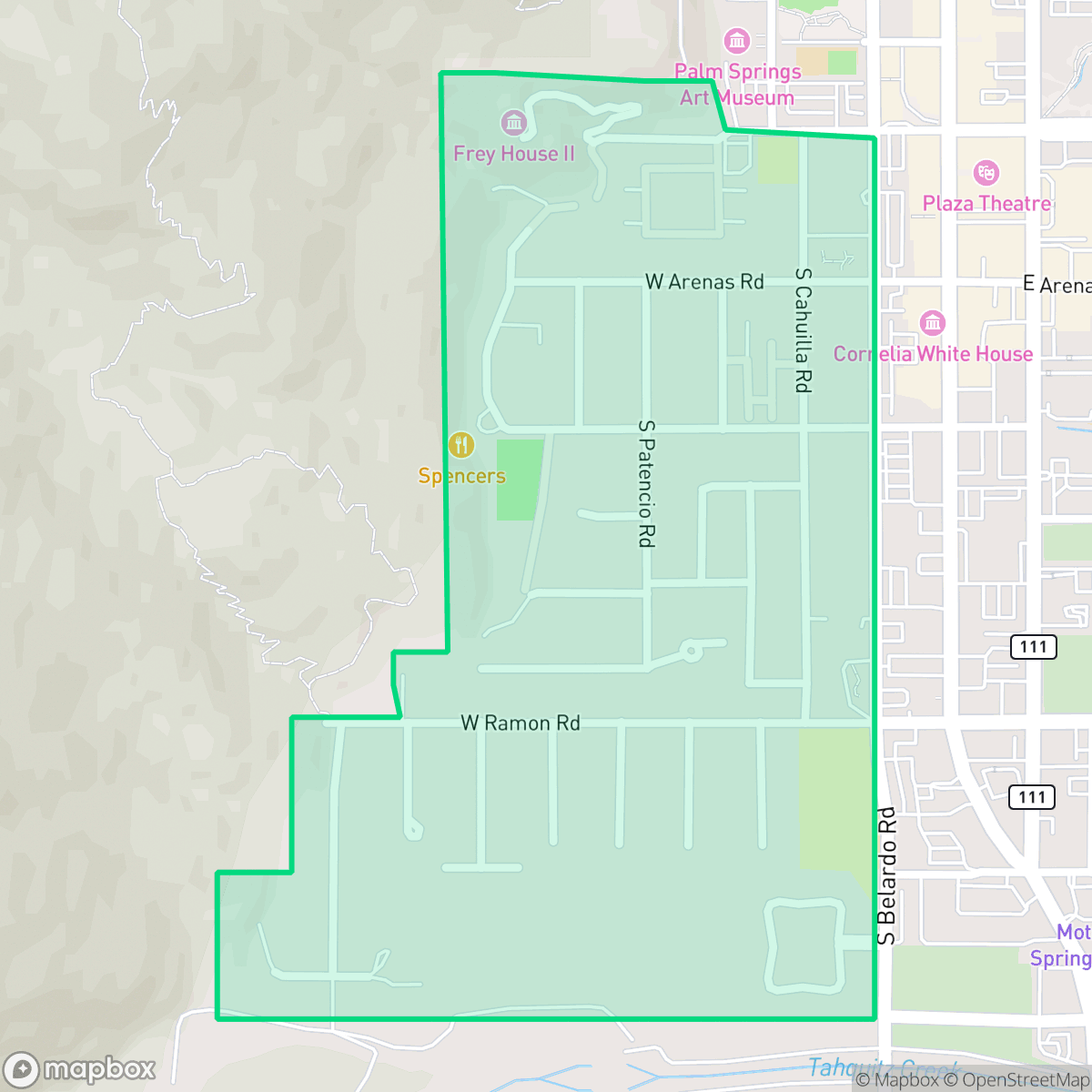
About Historic Tennis Club
Nestled against the San Jacinto Mountains, the Historic Tennis Club is one of Palm Springs' oldest neighborhoods. Developed in the 1920s and 1930s by pioneer Pearl McCallum McManus, the area grew around its namesake, the Palm Springs Tennis Club Resort, which opened in 1937. The club featured architectural contributions by Paul R. Williams and A. Quincy Jones, establishing a sophisticated California Modernist style. The neighborhood became a premier Hollywood playground, attracting stars like Frank Sinatra and Marilyn Monroe. It boasts a rich collection of architectural styles, from the Spanish Revival Thomas O'Donnell House to the mid-century modern Del Marcos Hotel designed by William F. Cody. Other landmarks include Casa Cody, the city's oldest continuously operating hotel, and the Moorish-style Korakia Pensione.
The area offers a tranquil residential environment characterized by its proximity to the San Jacinto Mountains and a distinct visual appeal that ranks well above the city average. While it serves as a quiet retreat, it remains accessible to the cultural offerings of the Palm Springs Art Museum and local dining options. According to iHuus data, the neighborhood maintains a balanced urban-rural rhythm, providing a sense of seclusion despite its central location.
Prospective residents should note that the neighborhood is primarily residential with sparse commercial activity, which contributes to its lower liveliness score. While it is highly dog-friendly and features strong health insurance coverage, the area faces specific trade-offs regarding fire safety and road traffic noise. It is best suited for those who prioritize a peaceful, architecturally significant environment over high-density urban convenience.
Neighborhood Scores Across 15 Qualities
Residential spacing varies across the area, with some multi-family units and townhomes positioned closer to neighbors than the Palm Springs average. According to iHuus data, this results in a mix of shared walls and some buffer between structures.
Sidewalks and safe crossings are available along a standard grid system, but large parking lots and high-traffic roads make the area less walkable than the rest of Palm Springs. According to iHuus data, navigating the neighborhood on foot is less convenient than in more pedestrian-friendly parts of the city.
Standard suburban layouts and boxy roof geometries characterize much of the area, which presents a less varied landscape than the Palm Springs average. According to iHuus data, the visual environment consists primarily of conventional housing and apartment complexes with shared amenities.
Public park access is sparse in this area, as most greenery consists of private landscapes or narrow residential verges. According to iHuus data, the availability of dedicated dog walking areas is slightly below the Palm Springs average.
Open land and scattered homes provide a semi-rural atmosphere that is consistent with the rest of Palm Springs. Residents will find a low-density mix of residential pockets and occasional commercial strips according to iHuus data.
Social activity and local dining options are noticeably more concentrated here than in the rest of Palm Springs. While the area features diverse culinary and cultural attractions near the art museum, the low-density layout often requires a vehicle for easy access.
Steady traffic sounds from nearby busy streets are present, though the acoustic environment remains more tranquil than much of Palm Springs according to iHuus data.
Air quality remains consistently high with rare instances of elevated readings. This level of air cleanliness is nearly identical to the Palm Springs average, according to iHuus data.
Industrial activity is non-existent here, providing an environment free from warehouses or heavy manufacturing. This area is notably more secluded from industrial zones than the Palm Springs average, according to iHuus data.
Health insurance coverage among residents is high, though slightly lower than the average for Palm Springs. According to iHuus data, a significant majority of the population maintains active coverage.
Voting patterns and census indicators show a predominantly liberal leaning, which is slightly more pronounced than the Palm Springs average according to iHuus data.
Residents encounter a balanced demographic of young adults, families, and older individuals; this profile is slightly less skewed toward mid-range age groups than the Palm Springs average.
Residual flood risk exists within this area due to its location in a 500-year floodplain, though safety levels are notably higher than the Palm Springs average according to iHuus data.
Wildfire hazards in this area are significantly higher than the Palm Springs average. Residents should be prepared for extreme fire safety precautions and heightened vigilance.
Address-Level Insights for Historic Tennis Club


iHuus Neighborhood Intelligence Insights
Get address-level neighborhood insights for Historic Tennis Club
- Street-level scores — see how individual blocks compare, not just neighborhood averages
- Micro-zone boundaries — identify quiet pockets, flood boundaries, and walkable clusters before you visit
- 15 dimensions in full — walkability, noise, air quality, school quality, insurance coverage, population age profile, urban/rural index, and more
- Boundary risk alerts — know if your address sits near a block boundary where scores drop, the kind of detail no listing will ever mention
- School insights — individual school ratings and insights, not just district-level data
- Compare before you commit — side-by-side data across neighborhoods, down to block precision
No credit card required
Compare with Any Neighborhood
| Dimension | Historic Tennis Club | Andreas Hills |
|---|---|---|
| 🚶 Walkabilityavg 8.06 | ||
| 🔊 Acoustic Comfortavg 3.6 | ||
| 🤫 Privacy Indexavg 6 | ||
| 🎨 Visual Appealavg 7.66 | ||
| 🐕 Dog Friendlinessavg 6.14 | ||
| 🗺️ Urban-Rural Indexavg 7.27 | ||
| ✨ Neighborhood Vibeavg 4.76 | ||
| 🏥 Health Insurance Coverageavg 7.38 | ||
| 🌿 Air Qualityavg 8.11 | ||
| 🏭 Industrial Proximityavg 9.12 | ||
| 🌊 Flood Safetyavg 5.92 | ||
| 🗳️ Ideological Leanavg 9.69 | ||
| 👥 Population Age Profileavg 6.29 | ||
| 🔥 Fire Safetyavg 0.39 | ||
| 🏫 School Quality |
Historic Tennis Club Rankings
School Districts Serving Historic Tennis Club
School Insights for Historic Tennis Club
Below average outcomes; significant attendance and academic challenges.
School Insights
See what's really behind every school rating near Historic Tennis Club
- Individual school ratings — each school's own score with outcome context, not just a district average
- Enrollment & class size data — student-to-teacher ratio and how it compares to the state average
- Full demographics breakdown — ethnicity and gender composition for every school in the enrollment zone
- Every school in the district — all schools within the enrollment boundary ranked by rating, not just the closest one
- Grade levels & benchmarks — elementary through high school, with below/above state-average flags
No credit card required