Escena, Palm Springs
Updated · 593 residents
Escena is a master-planned community defined by its modernist architecture and central golf course. While the area offers high visual appeal and is notably dog-friendly, residents experience significant noise levels from nearby road traffic and limited walkability.
Key Highlights
About Escena
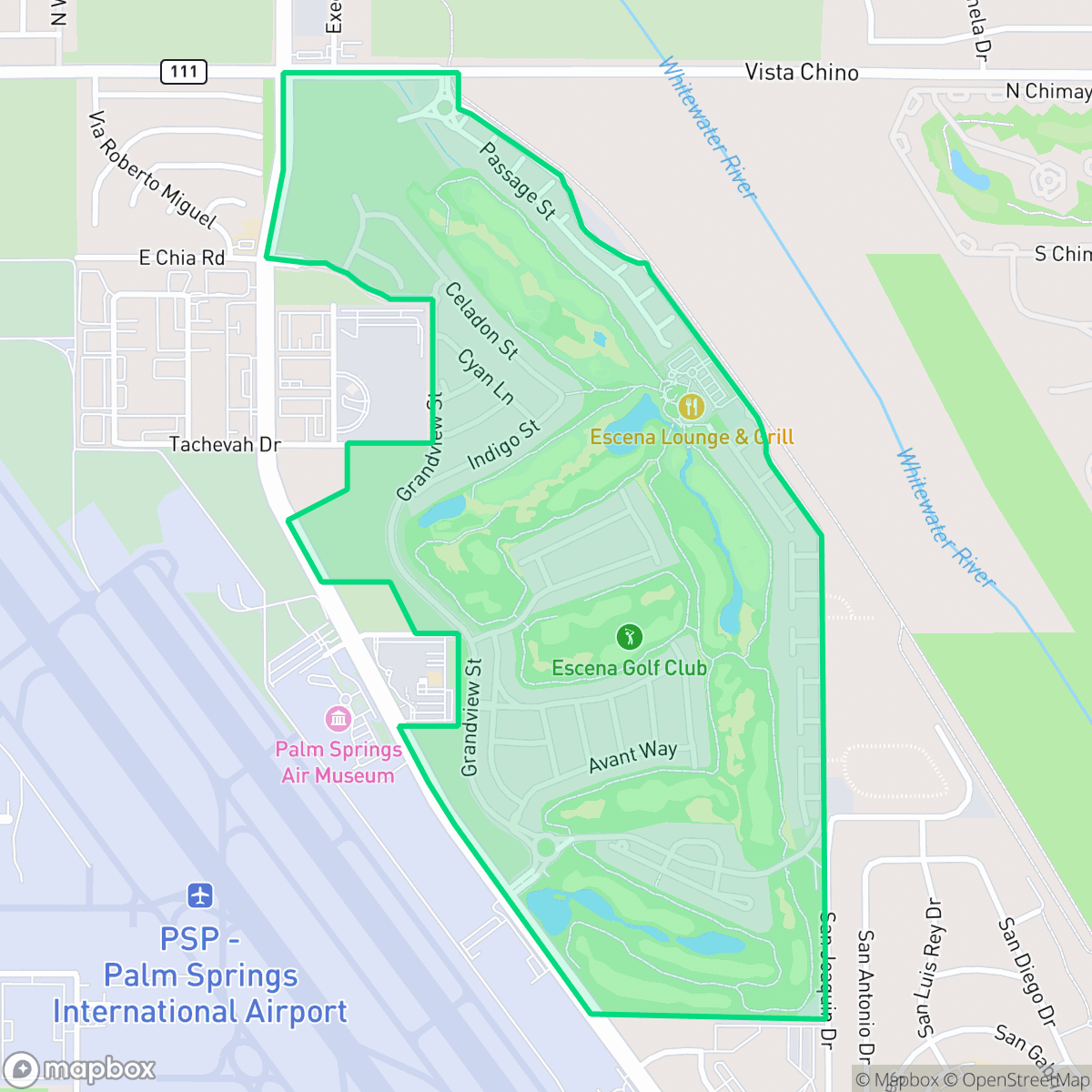
Located at the intersection of Gene Autry Trail and Vista Chino Drive, Escena is a 450-acre master-planned neighborhood in Palm Springs. Its centerpiece, the Escena Golf Club, designed by Nicklaus Design, opened in 2005 as the city's first new public golf course since the early 1990s. Following a brief closure due to the late-2000s financial crisis, the community reopened in 2009 with the addition of the Escena Lounge & Grill, housed in an award-winning, mid-century modern-inspired clubhouse. Architecturally, Escena gained recognition as one of Southern California's first single-family tract developments built in a modern style since the mid-20th century. Collaborations between architect Anthony Poon and developer Andrew Adler introduced sleek, minimalist homes featuring flat roofs, open floor plans, and seamless indoor-outdoor integration, paying homage to Palm Springs' iconic modernist heritage.
The neighborhood maintains a quiet, suburban character that prioritizes aesthetic consistency and open green spaces over high-density urban activity. Residents benefit from a well-maintained environment that blends residential living with proximity to recreational amenities like the local golf course and the nearby Palm Springs Air Museum. The area is marked by a deliberate architectural style that favors clean, minimalist design, creating a distinct visual identity within the broader Palm Springs landscape.
Potential residents should consider that the area is not a hub for nightlife or high-intensity social activity, as reflected in its modest liveliness scores. The location is subject to elevated noise levels primarily driven by regional road traffic, which may impact acoustic comfort for those seeking a secluded retreat. It is best suited for individuals or families who value a modern living environment and pet-friendly surroundings, provided they are comfortable with a suburban lifestyle that requires a vehicle for most daily errands.
Neighborhood Scores Across 15 Qualities
Residential spacing provides a moderate buffer between neighbors, consistent with the typical density found throughout Palm Springs.
Quiet streets allow for low-traffic strolls, though the lack of sidewalks makes this area less walkable than much of Palm Springs. According to iHuus data, pedestrians should be cautious when navigating the neighborhood's roads.
Large homes and frequent upscale amenities contribute to a highly pleasing streetscape. According to iHuus data, the area offers a more polished visual environment than the Palm Springs average.
Access to public parks and green spaces for pets is slightly below the Palm Springs average. According to iHuus data, residents may find fewer immediate options for walking dogs compared to other parts of the city.
Open airfield space and sparse infrastructure create a low building density that is slightly more rural than the Palm Springs average. Large areas of open land and scattered development characterize the landscape according to iHuus data.
Low density and a sparse commercial presence create a quiet, rural atmosphere, though most essential services and social spots require a vehicle to reach. This lack of activity is noticeably lower than the Palm Springs average.
Constant aircraft noise from the nearby airport runway makes this area significantly louder than the Palm Springs average. According to iHuus data, the proximity to flight paths precludes acoustic comfort for residents.
Air quality in this area is consistently good, with rare instances of elevated readings. This level of air cleanliness is consistent with the average found throughout Palm Springs.
Active commercial units and nearby airport infrastructure result in lower industrial proximity levels than the Palm Springs average. While some streets remain residential and quiet, certain areas experience increased daytime traffic and noise from nearby runways.
Health insurance access is more prevalent in Escena than in the rest of Palm Springs, according to iHuus data.
Voting patterns and census indicators show a predominantly liberal political landscape that is consistent with the city average.
Older adults comprise the majority of the population in Escena, which reflects a slightly more mature demographic than the Palm Springs average. Younger residents maintain a modest presence within the community according to iHuus data.
Residual flood risk exists within this area, though the safety level remains notably higher than the Palm Springs average according to iHuus data.
Address-Level Insights for Escena


iHuus Neighborhood Intelligence Insights
Get address-level neighborhood insights for Escena
- Street-level scores — see how individual blocks compare, not just neighborhood averages
- Micro-zone boundaries — identify quiet pockets, flood boundaries, and walkable clusters before you visit
- 15 dimensions in full — walkability, noise, air quality, school quality, insurance coverage, population age profile, urban/rural index, and more
- Boundary risk alerts — know if your address sits near a block boundary where scores drop, the kind of detail no listing will ever mention
- School insights — individual school ratings and insights, not just district-level data
- Compare before you commit — side-by-side data across neighborhoods, down to block precision
No credit card required
Compare with Any Neighborhood
| Dimension | Escena | Andreas Hills |
|---|---|---|
| 🚶 Walkabilityavg 8.06 | ||
| 🔊 Acoustic Comfortavg 3.6 | ||
| 🤫 Privacy Indexavg 6 | ||
| 🎨 Visual Appealavg 7.66 | ||
| 🐕 Dog Friendlinessavg 6.14 | ||
| 🗺️ Urban-Rural Indexavg 7.27 | ||
| ✨ Neighborhood Vibeavg 4.76 | ||
| 🏥 Health Insurance Coverageavg 7.38 | ||
| 🌿 Air Qualityavg 8.11 | ||
| 🏭 Industrial Proximityavg 9.12 | ||
| 🌊 Flood Safetyavg 5.92 | ||
| 🗳️ Ideological Leanavg 9.69 | ||
| 👥 Population Age Profileavg 6.29 | ||
| 🔥 Fire Safetyavg 0.39 | ||
| 🏫 School Quality |
Escena Rankings
School Districts Serving Escena
School Insights for Escena
Below average outcomes; significant attendance and academic challenges.
School Insights
See what's really behind every school rating near Escena
- Individual school ratings — each school's own score with outcome context, not just a district average
- Enrollment & class size data — student-to-teacher ratio and how it compares to the state average
- Full demographics breakdown — ethnicity and gender composition for every school in the enrollment zone
- Every school in the district — all schools within the enrollment boundary ranked by rating, not just the closest one
- Grade levels & benchmarks — elementary through high school, with below/above state-average flags
No credit card required