El Rancho Vista Estates, Palm Springs
Updated · 71 residents
El Rancho Vista Estates is a quiet, low-density neighborhood in Palm Springs celebrated for its preserved mid-century desert modernism. While the area offers high visual appeal and a rural feel, residents face significant road traffic noise and limited walkability.
Key Highlights
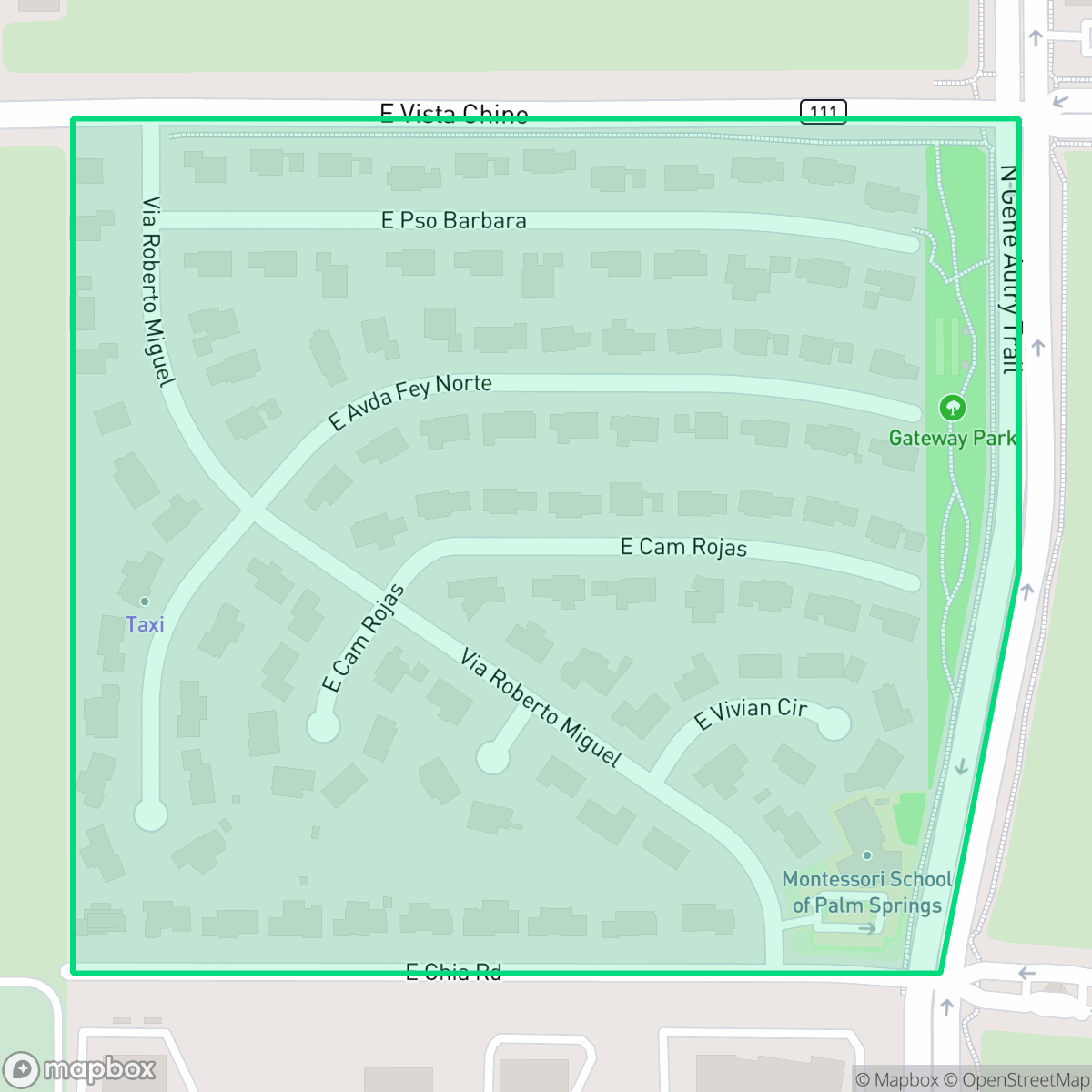
About El Rancho Vista Estates
Developed starting in 1959 by Roy Fey, El Rancho Vista Estates in northeast Palm Springs is the first and only residential subdivision designed by the renowned modernist architectural duo Donald Wexler and Richard Harrison. Built to make high-end desert modernism accessible, the neighborhood’s initial phases featured three distinct floor plans—the Bermuda, the Capri, and the Casablanca—characterized by flat or butterfly roofs, floor-to-ceiling glass, and decorative concrete block walls. Notable early residents included fitness pioneer Jack LaLanne and architect Richard Harrison himself. Recognized as a Class 3 historic asset by the City of Palm Springs, the neighborhood experienced a major preservation renaissance starting in 2000, led by residents John Lewis and Jane Steichen-Lewis, who restored dozens of homes. Today, it remains a highly intact showcase of mid-century desert modernism.
The neighborhood functions as a unique, low-density enclave that balances its identity as a historic architectural showcase with a mixed-use environment. According to iHuus data, the area maintains a distinct rural character despite its proximity to essential local services and light industrial units. This creates a quiet, sparse atmosphere that contrasts with the more densely populated sections of Palm Springs, favoring those who prioritize aesthetic integrity and open space over urban convenience. Prospective residents should note that the area presents specific livability trade-offs, particularly regarding acoustic comfort due to regional road traffic. While the neighborhood boasts high visual appeal, it offers limited walkability and requires a reliance on vehicles for daily errands. The local school district provides a range of facilities and programs, though academic performance remains inconsistent across the region. Those considering the area should also account for the heightened fire safety risks inherent to the local desert environment as highlighted in iHuus data.
Neighborhood Scores Across 15 Qualities
Residential spacing is consistent with the Palm Springs average, providing a balance of separation and proximity between neighbors. According to iHuus data, properties feature mixed layouts that offer some buffer from adjacent homes.
Sidewalks are available on one side of the streets with safe crossings provided. This level of pedestrian accessibility is slightly lower than the Palm Springs average, according to iHuus data.
Large residential properties and frequent upscale amenities provide an environment that is more visually polished than the Palm Springs average, according to iHuus data.
Direct access to public parks and wide green verges is sparse in this area. According to iHuus data, opportunities for outdoor pet exercise are below the Palm Springs average.
Natural landscapes and low building density characterize this area, providing a much more secluded environment than the typical Palm Springs setting. According to iHuus data, the terrain is notably more rural than the city average.
Low-density residential blocks and light industrial units define this area, which offers significantly less commercial activity than the Palm Springs average. According to iHuus data, the landscape is primarily composed of open spaces and limited local services, making it a remote and car-dependent environment.
Frequent noise from nearby transit corridors and flight paths significantly impacts acoustic comfort. This area experiences much higher levels of disturbance than the Palm Springs average, according to iHuus data.
Air quality remains mostly clean with only rare instances of elevated readings. This level of air purity is roughly in line with the Palm Springs average according to iHuus data.
Industrial activity and heavy warehouses are absent from this area. Residents can expect a purely residential environment that is consistent with the broader Palm Springs area.
Health insurance coverage in this area is high, though it sits slightly below the Palm Springs average according to iHuus data.
Voting patterns and census indicators in this area reflect a deeply liberal leaning, consistent with the broader political landscape of Palm Springs.
A balanced mix of young adults, families, and older residents characterizes the community. This demographic spread is slightly more varied than the typical age profile found across Palm Springs.
Residual flood risk exists within this area, though the safety profile remains notably higher than the Palm Springs average according to iHuus data.
Address-Level Insights for El Rancho Vista Estates


iHuus Neighborhood Intelligence Insights
Get address-level neighborhood insights for El Rancho Vista Estates
- Street-level scores — see how individual blocks compare, not just neighborhood averages
- Micro-zone boundaries — identify quiet pockets, flood boundaries, and walkable clusters before you visit
- 15 dimensions in full — walkability, noise, air quality, school quality, insurance coverage, population age profile, urban/rural index, and more
- Boundary risk alerts — know if your address sits near a block boundary where scores drop, the kind of detail no listing will ever mention
- School insights — individual school ratings and insights, not just district-level data
- Compare before you commit — side-by-side data across neighborhoods, down to block precision
No credit card required
Compare with Any Neighborhood
| Dimension | El Rancho Vista Estates | Andreas Hills |
|---|---|---|
| 🚶 Walkabilityavg 8.06 | ||
| 🔊 Acoustic Comfortavg 3.6 | ||
| 🤫 Privacy Indexavg 6 | ||
| 🎨 Visual Appealavg 7.66 | ||
| 🐕 Dog Friendlinessavg 6.14 | ||
| 🗺️ Urban-Rural Indexavg 7.27 | ||
| ✨ Neighborhood Vibeavg 4.76 | ||
| 🏥 Health Insurance Coverageavg 7.38 | ||
| 🌿 Air Qualityavg 8.11 | ||
| 🏭 Industrial Proximityavg 9.12 | ||
| 🌊 Flood Safetyavg 5.92 | ||
| 🗳️ Ideological Leanavg 9.69 | ||
| 👥 Population Age Profileavg 6.29 | ||
| 🔥 Fire Safetyavg 0.39 | ||
| 🏫 School Quality |
El Rancho Vista Estates Rankings
School Districts Serving El Rancho Vista Estates
School Insights for El Rancho Vista Estates
Below average outcomes; significant attendance and academic challenges.
School Insights
See what's really behind every school rating near El Rancho Vista Estates
- Individual school ratings — each school's own score with outcome context, not just a district average
- Enrollment & class size data — student-to-teacher ratio and how it compares to the state average
- Full demographics breakdown — ethnicity and gender composition for every school in the enrollment zone
- Every school in the district — all schools within the enrollment boundary ranked by rating, not just the closest one
- Grade levels & benchmarks — elementary through high school, with below/above state-average flags
No credit card required