El Mirador, Palm Springs
Updated · 440 residents
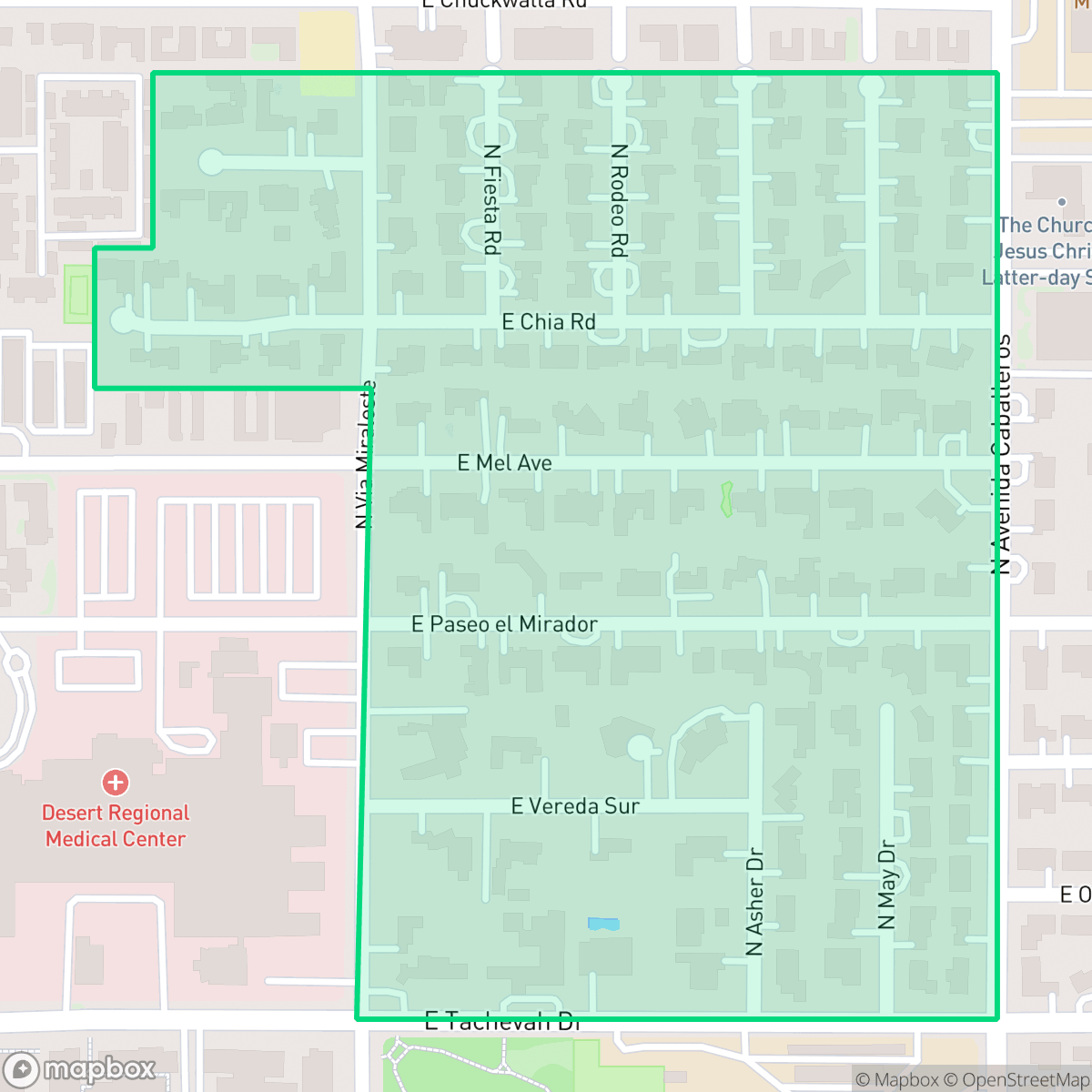
El Mirador is a historic Palm Springs neighborhood defined by a diverse architectural landscape ranging from 1920s Spanish Revival villas to mid-century modern residences. It offers exceptional walkability and a quiet, suburban atmosphere, though residents should note that road traffic noise is a common feature of the area.
Key Highlights
About El Mirador
One of Palm Springs' oldest neighborhoods, El Mirador developed around the legendary El Mirador Hotel, which opened on New Year’s Eve in 1927. Designed by Walker & Eisen in the Spanish Colonial Revival style, the resort featured a 60-foot bell tower and the Coachella Valley’s first 18-hole golf course. It became a premier playground for Hollywood elite like Mary Pickford and Albert Einstein. During World War II, the federal government converted the hotel into Torney General Hospital. Although a 1989 fire destroyed the original structure, a historically accurate replica of the iconic tower was rebuilt in 1991 at the site, which is now the Desert Regional Medical Center. Today, the residential neighborhood showcases an architectural evolution ranging from 1920s Spanish Revival villas to mid-century modern homes.
The neighborhood serves as a quiet residential enclave situated near the Desert Regional Medical Center. Its streets feature a blend of historic charm and mid-century design, creating a visually appealing environment that maintains a serene, suburban feel. The area is highly accessible on foot, allowing residents to navigate local streets with ease, while the surrounding green spaces provide a reprieve from the density found in more commercial parts of the city. Prospective residents should consider the trade-offs associated with the area, particularly regarding acoustic comfort. While the neighborhood is highly walkable and maintains good air quality, road traffic contributes to higher noise levels than the city average. It is well-suited for those who value architectural history and pedestrian accessibility, provided they are comfortable with the ambient sounds of a suburban setting.
Neighborhood Scores Across 15 Qualities
Residential spacing is consistent with the rest of Palm Springs, offering a mix of visible neighbors and moderate buffers between properties.
Pedestrian access is excellent here due to wide sidewalks and frequent crossings. This level of walkability is significantly higher than the Palm Springs average according to iHuus data.
Large residences and premium amenities create a highly attractive streetscape that sits above the Palm Springs average. According to iHuus data, the area is characterized by spacious properties and well-maintained surroundings.
Opportunities for pet exercise are somewhat limited due to a lack of wide green verges or immediate park access. According to iHuus data, the availability of dog-friendly spaces in this area is slightly below the Palm Springs average.
Open land and scattered homes provide a more tranquil atmosphere than the more densely developed areas found elsewhere in Palm Springs. According to iHuus data, this neighborhood features more frequent patches of woodland and fields compared to the city average.
Residential life here is characterized by a serene, low-density atmosphere with limited commercial activity. This level of activity is lower than the Palm Springs average, offering a peaceful environment with a sparse selection of nearby services.
Local traffic from a nearby busy street creates a consistent level of ambient noise. This acoustic environment is slightly more active than the average for Palm Springs, according to iHuus data.
Air quality remains mostly clean with only rare instances of elevated readings, performing very similarly to the Palm Springs average according to iHuus data.
Industrial activity and warehouses are entirely absent from this area. Residents experience a quieter environment than the Palm Springs average due to the lack of nearby manufacturing or hazard sites.
Health insurance access is widespread among residents, sitting slightly above the Palm Springs average according to iHuus data.
Voting patterns and census indicators show a predominantly liberal community that aligns with the political profile of the rest of Palm Springs.
Older adults represent the majority of the population, with a slightly higher proportion of seniors than the Palm Springs average according to iHuus data.
Residual flood risks exist within this area, though overall safety levels remain higher than the Palm Springs average according to iHuus data.
Address-Level Insights for El Mirador


iHuus Neighborhood Intelligence Insights
Get address-level neighborhood insights for El Mirador
- Street-level scores — see how individual blocks compare, not just neighborhood averages
- Micro-zone boundaries — identify quiet pockets, flood boundaries, and walkable clusters before you visit
- 15 dimensions in full — walkability, noise, air quality, school quality, insurance coverage, population age profile, urban/rural index, and more
- Boundary risk alerts — know if your address sits near a block boundary where scores drop, the kind of detail no listing will ever mention
- School insights — individual school ratings and insights, not just district-level data
- Compare before you commit — side-by-side data across neighborhoods, down to block precision
No credit card required
Compare with Any Neighborhood
| Dimension | El Mirador | Andreas Hills |
|---|---|---|
| 🚶 Walkabilityavg 8.06 | ||
| 🔊 Acoustic Comfortavg 3.6 | ||
| 🤫 Privacy Indexavg 6 | ||
| 🎨 Visual Appealavg 7.66 | ||
| 🐕 Dog Friendlinessavg 6.14 | ||
| 🗺️ Urban-Rural Indexavg 7.27 | ||
| ✨ Neighborhood Vibeavg 4.76 | ||
| 🏥 Health Insurance Coverageavg 7.38 | ||
| 🌿 Air Qualityavg 8.11 | ||
| 🏭 Industrial Proximityavg 9.12 | ||
| 🌊 Flood Safetyavg 5.92 | ||
| 🗳️ Ideological Leanavg 9.69 | ||
| 👥 Population Age Profileavg 6.29 | ||
| 🔥 Fire Safetyavg 0.39 | ||
| 🏫 School Quality |
El Mirador Rankings
School Districts Serving El Mirador
School Insights for El Mirador
Below average outcomes; significant attendance and academic challenges.
School Insights
See what's really behind every school rating near El Mirador
- Individual school ratings — each school's own score with outcome context, not just a district average
- Enrollment & class size data — student-to-teacher ratio and how it compares to the state average
- Full demographics breakdown — ethnicity and gender composition for every school in the enrollment zone
- Every school in the district — all schools within the enrollment boundary ranked by rating, not just the closest one
- Grade levels & benchmarks — elementary through high school, with below/above state-average flags
No credit card required